Monday.com report says practical AI tools win over workplace hype
Most directors are juggling several AI tools, not one. monday.com’s new report says the winners are practical systems that save time, not flashy demos.

Practical AI is winning the day, not the pitch deck
The most revealing number in monday.com’s new AI report is not how many people are using AI. It is how little loyalty they have to any one tool. According to the survey, 76% of directors switch between multiple AI products every day, while only 2% rely on a single solution. That is the clearest sign yet that AI at work is still being judged on utility, speed, and fit, not on brand mystique.
For monday.com, that finding lands directly in the middle of its own product story. If employees are already mixing and matching tools to get through the day, then the real competition is not another model demo. It is whether a feature can slot into a workflow fast enough to earn trust, reduce drag, and prove that it belongs there.
What the survey says workers actually want
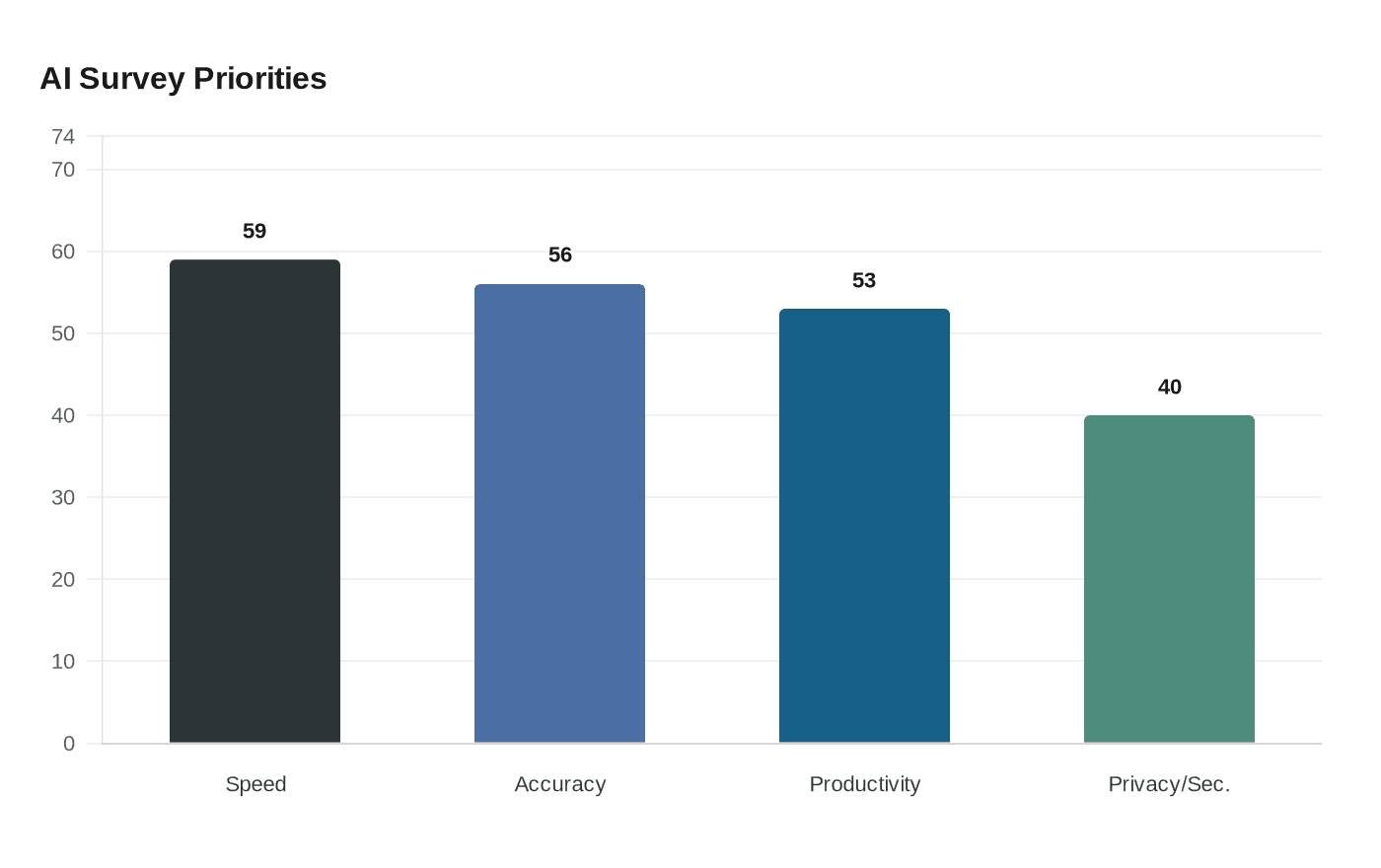
The report, built from a Nielsen survey of 500 directors in the United States and the United Kingdom and insights from millions of monday.com workflows, points to a far more practical AI mindset than the industry’s hype cycle suggests. Directors named speed, accuracy, and productivity as the top reasons to adopt AI, with speed at 59%, accuracy at 56%, and productivity at 53%. Innovation, despite being the word that often shows up in corporate decks, did not make the top five.
That matters because it shows how workplace AI is being evaluated inside real teams. People are not asking whether a tool sounds futuristic. They are asking whether it helps them move faster without introducing new mistakes, and whether it can shave down the repetitive work that sits between them and a decision. In other words, AI is being treated less like a breakthrough and more like infrastructure.
The blockers are social, not just technical
The report is equally blunt about what slows adoption. Data privacy and security concerns were the biggest barrier, cited by 40% of directors. That is not a small compliance footnote. It is a reminder that even when the technology is available, people still have to trust it with sensitive work, shared information, and decisions that carry real business risk.
The more uncomfortable issue is emotional. monday.com says enterprise directors are twice as likely to worry about being judged or discredited for using AI than directors at mid-sized companies, and those age 35 and older feel that pressure more strongly than younger colleagues. That is the part many AI rollouts miss: the fear is not just, “Will this tool work?” It is also, “Will I look replaceable, lazy, or careless if I use it?” In many workplaces, that anxiety can slow adoption more than any model limitation.
Where AI is already becoming operational
The report’s real value is that it moves the conversation away from abstract transformation and toward actual work patterns. monday.com frames this shift as an “operational era of AI,” and that wording is not accidental. The tools that are winning are the ones people can put to work quickly, with low friction and a visible payoff.
That lens fits especially well for engineers, product managers, and sales teams at monday.com. Engineers need reliability and workflow integration as much as they need model quality. Product managers need adoption that comes from solving a genuine bottleneck, not from adding another optional feature to the backlog. Sales teams need a business case that speaks in terms of time saved, accuracy gained, and work unblocked, not technical novelty.
The report also shows that adoption is uneven across the economy. Construction and real estate lead on monday.com’s platform, while tech and finance lag behind. Smaller companies also tend to show heavier AI use per employee than enterprises. That split suggests that the fastest adopters are often the ones with the fewest layers between the tool and the job to be done.
monday.com’s own AI playbook is built around this reality
The report lines up with monday.com’s broader AI strategy in 2025, which centered on three pillars: AI Blocks, Product Power-ups, and the Digital Workforce. The logic is straightforward. Instead of treating AI as a separate destination, monday.com wants to embed it inside existing products and workflows so it feels native to the way work already happens.
That is also why the company’s earlier move toward work execution matters. The launches of monday magic, monday vibe, and monday sidekick marked a shift from work management toward work execution, a signal that monday.com wants to be the layer where tasks actually get done rather than just tracked. The new report strengthens that positioning by arguing that practical AI is not a side quest. It is becoming the core of how software earns its place in daily work.
For employees, that has a real implication. The winning AI tools will not be the ones that ask people to rebuild their habits from scratch. They will be the ones that shave off repetitive steps, reduce context switching, and help teams move from idea to action without adding more process theater.
The bigger market signal: adoption is widespread, maturity is not
monday.com’s findings also sit inside a larger industry pattern that should feel familiar to anyone working in enterprise software. Microsoft and LinkedIn said in 2024 that 75% of global knowledge workers were already using generative AI at work, but leaders still lacked a clear plan for turning that usage into business transformation. McKinsey’s 2025 workplace AI report pushed the same point further, saying almost all companies are investing in AI but only 1% believe they have reached maturity.
Taken together, those numbers show the same gap from a different angle. AI is no longer waiting for permission to enter the workplace. The question now is whether companies can operationalize it without creating more noise than value. That is where monday.com’s report is useful: it captures a market in which adoption is real, but trust, usefulness, and workflow fit still decide what survives.
What this means for monday.com’s next phase
For monday.com, the lesson is less about chasing the loudest AI narrative and more about proving that its platform can make work easier in ways people feel immediately. The report suggests that the company’s strongest argument is not that AI is everywhere. It is that the AI people actually keep using is the kind that fades into the background and makes the rest of the workflow better.
That is a stricter test than any launch event or product demo. It forces the company to build for speed, accuracy, and usability, while also helping employees overcome the social hesitation that still shadows AI use inside enterprises. In a market crowded with promises, the tools that last will be the ones that behave like part of the work, not a spectacle around it.
Know something we missed? Have a correction or additional information?
Submit a Tip