Intercom guide spotlights onboarding, retention, and customer health at monday.com
Intercom’s playbook turns onboarding into a retention system at monday.com, where faster handoffs, health signals, and expansion now shape the post-sale motion.
Customer success is the operating system, not the handoff
Intercom’s customer-success framework puts a blunt truth at the center of SaaS: keeping customers is not a support function, it is a company-wide operating model. The guide defines customer success strategy as a comprehensive plan for building and maintaining long-term relationships so customers stay satisfied and loyal, and it says the work usually depends on smooth onboarding, proactive communication, staff training, and KPI measurement.
That matters inside monday.com because the product does not live in a single department. Engineers, product managers, sales teams, and customer-facing operators all shape whether a customer gets value quickly enough to stay, expand, and renew. Intercom’s bigger point is simple: customer success is a business effort to help customers achieve their objectives, and that starts long before a renewal conversation.
The sharpest takeaway for monday.com teams is that customer success should not be treated as a polite wrapper around the sale. If a customer needs long implementation cycles, too much manual intervention, or repeated human rescue before seeing value, churn risk rises fast. In a crowded SaaS market, the companies that win are usually the ones that help customers get more than they paid for, consistently enough that the product becomes part of the daily workflow rather than an occasional tool.
Onboarding is where retention starts showing up in the numbers
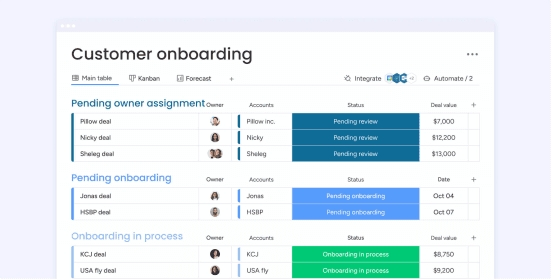
monday.com’s own onboarding use case mirrors that logic in very practical terms. The company describes it as a way to plan and run smooth onboarding and renewal management in one place, with a centralized handoff from account executive to account manager and automations that notify stakeholders at the right time. That is not just a process improvement; it is a direct attempt to remove the friction points that often sit between a closed deal and a durable account.
The company says the template can improve customer satisfaction by 65% and customer retention by 74%, with implementation time of just 1 to 5 hours for the basic version. For anyone working in product, engineering, or sales at monday.com, that is the real signal: onboarding is not a side project, it is one of the fastest ways the company can protect revenue quality. A smoother first run does more than calm implementation anxiety. It shapes whether the customer ever reaches the kind of habit formation that leads to expansion.
Intercom’s own materials point in the same direction. It says great onboarding matters from first use through activation and longer-term engagement, and its related guidance frames onboarding as the bridge that helps activate customers and move them toward becoming paying users. That is a useful lens for monday.com teams because it links feature adoption, workflow setup, and long-term revenue health into one chain instead of three separate jobs.
Health signals now matter as much as logo counts
The clearest sign that this is a strategic issue, not a tactical one, is how monday.com’s financials are increasingly tied to deeper usage inside accounts. In fourth quarter and full-year 2025 results released on February 9, 2026, monday.com reported revenue of $333.9 million for the quarter and $1.232 billion for the year. It also said customers with more than $50,000 in ARR represented 41% of total ARR, while net dollar retention for customers with more than $100,000 in ARR was 116%.
That is the kind of number customer-success teams live and die by, but it should matter just as much to product and sales leaders. High net dollar retention usually means customers are not just staying, they are finding enough additional value to spend more over time. monday.com’s second-quarter 2025 results pointed in the same direction, with revenue of $299.0 million, 27% year-over-year growth, a 117% net dollar retention rate for customers with more than $100,000 in ARR, and monday CRM recently reaching $100 million in ARR.
The account-level story is just as revealing. athenahealth’s customer story says the company achieved 100% adoption across campaign workflows, saved more than $60,000 by retiring legacy plug-ins, and tracked more than 1,000 creative requests in its first six months. That is what healthy adoption looks like in practice: not just a login, but repeated use inside core workflows, less dependency on patchwork tools, and a clearer operational rhythm across teams.
The market is pushing customer success toward measurable operating discipline
Intercom’s guidance does not sit in a vacuum. Forrester says onboarding is critical for successful adoption, revenue retention, and growth. Gartner goes further, urging SaaS leaders to build customer-success scorecards around leading indicators because customer achievement is what drives advocacy, retention, and expansion. The common thread is that teams cannot manage customer health by instinct alone.
That is especially true as customer-success functions get pulled toward efficiency, automation, and revenue accountability. Gainsight has said the discipline is being reshaped by those pressures, and its research found that 48% of surveyed SaaS companies already had a formal Digital Customer Success program. For monday.com, the lesson is not to chase automation for its own sake. It is to use automation to make proactive outreach, onboarding, and health monitoring more consistent, so the human work goes where it matters most.
That also creates a clearer brief for internal teams. Product managers need to notice where users stall after setup. Engineers need to see which friction points force manual intervention. Sales teams need to sell with a realistic picture of time to value, not just close the deal and move on. Customer success should be the shared system that connects those decisions, because in a work-OS company, every weak handoff eventually shows up in retention.
What this means for monday.com’s next stage of growth
monday.com’s numbers show a business moving upmarket, but the operational challenge is the same one Intercom puts at the center of customer success: help customers reach their goals early, then keep proving the product’s value after the sale. That is how onboarding turns into retention, retention turns into expansion, and expansion turns into durable revenue quality.
For a company built around coordinating work, the message is unusually direct. Customer success is not a department at the end of the funnel. It is the set of habits, automations, and product choices that decide whether accounts become sticky, broad, and hard to replace. In a market where growth is increasingly judged by health, not just bookings, that is the motion that matters most.
This article was produced by Prism’s automated news system from verified source data, official records, and press releases, then run through automated quality and moderation checks before publishing. The system is built and supervised by the people who set the standards it runs under. Read our full AI policy.
Did this article answer your question?