monday.com course shows how OKRs turn strategy into execution
A free 4-chapter OKR course shows how monday.com can turn big strategy into weekly work, with clearer priorities, ownership, and measurable outcomes.
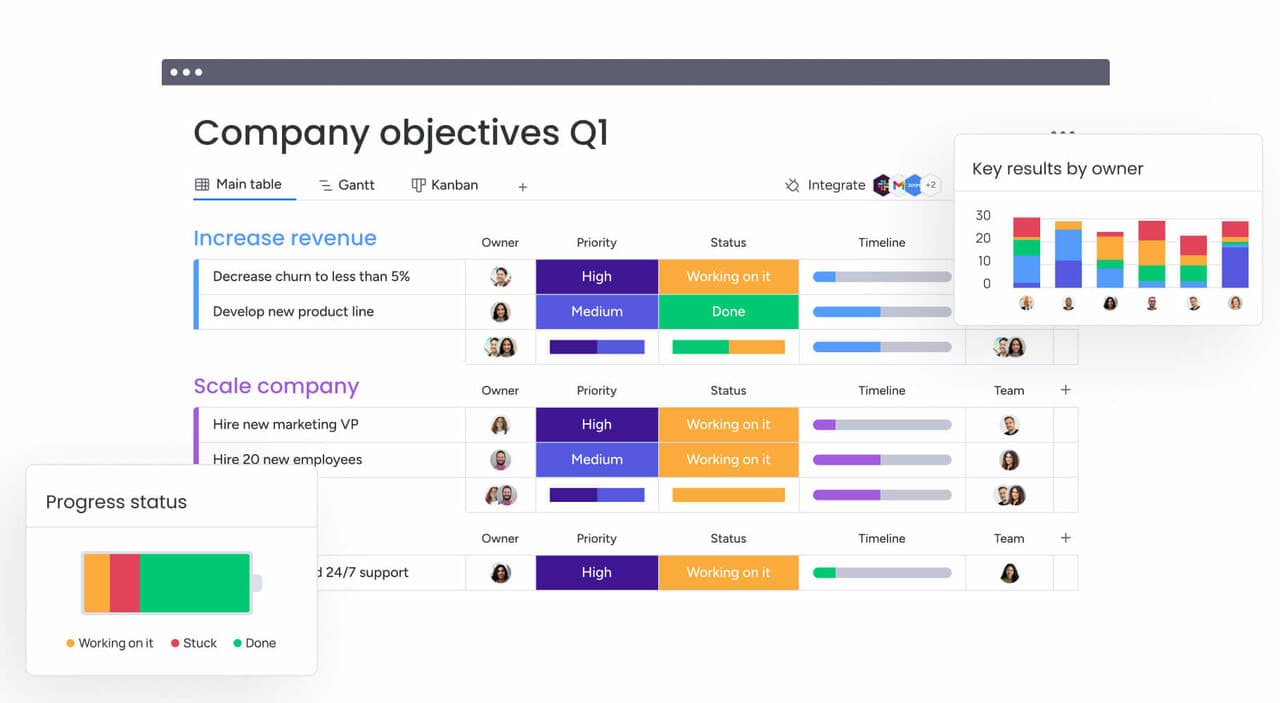
At monday.com, OKRs only matter if they change what teams do next week. The free What Matters course turns that into a working system, showing how Objectives and Key Results bridge strategy and execution in a way engineers, product managers, and sales teams can actually use. With 4 chapters, 31 video lessons, and a 2 hour 13 minute runtime, it is built less like theory and more like a practical operating manual.
What the course teaches
The course starts with the basics, then moves quickly into the parts that keep OKRs from turning into another planning exercise. It explains how to write objectives, how to separate key results from generic tasks, and how to run a full OKR cycle without losing the link to business outcomes. It also breaks out the cadence of OKRs, cascading and laddering goals, committed versus aspirational OKRs, and CFRs, the conversations, feedback and recognition rhythm that keeps the system alive.
That structure matters because OKRs fail in familiar ways. Teams often write goals that read like project lists, then wonder why the work never sharpens into measurable progress. The course keeps pushing the opposite habit: choose a small number of priorities, define success in numbers or outcomes, and use the cycle to decide what deserves attention, not just what sounds ambitious.
Why monday.com employees should care
monday.com says it serves over 250,000 customers worldwide and describes itself as the “AI work platform” that brings people, workflows, and AI agents together on one flexible platform. The company has also used the phrase “strategy into execution at scale” to describe what it is trying to do. That makes OKR discipline especially relevant inside a business where product, go-to-market, and operations all need to move in the same direction without flattening local judgment.
For engineers, the point is not to turn every ticket into a metric. It is to know which handful of product or reliability outcomes actually matter for the quarter, and which tradeoffs are worth making when scope starts to expand. For product managers, OKRs give a way to defend roadmap choices in terms of outcome, not output. For sales teams, they clarify which revenue, expansion, or adoption goals are driving the wider growth plan rather than just filling dashboards with activity.
The course’s emphasis on bridging strategy and execution is the key lesson for a company like monday.com. A strong OKR should be specific enough to steer weekly decisions, but ambitious enough to push a team beyond business as usual. If a goal does not change prioritization, ownership, or measurement, it is probably not doing the job this framework was designed to do.
How to turn OKRs into actual operating discipline
The course is useful because it treats OKRs as a cadence, not a slogan. The cadence forces teams to revisit progress often enough to catch drift, while cascading and laddering help connect a company-level objective to team-level work without losing accountability. CFRs matter for the same reason: progress is not just a spreadsheet exercise, it depends on managers and peers speaking openly about what is working, what is stuck, and what recognition is due.
A practical monday.com approach looks like this:
- Write objectives as outcomes, not tasks.
- Make key results measurable, so success can be tracked without interpretation fights.
- Use committed OKRs for must-hit goals and aspirational OKRs for stretch work.
- Revisit progress on a regular cadence, so the team adjusts before the quarter is gone.
- Ladder team goals up to the broader company plan, so the weekly work still points toward the same destination.
That is the execution gap the course is trying to close. In a SaaS company with multiple functions, it is easy for planning to happen in one layer and work to happen in another. OKRs only earn their keep when the same objective changes how a product team plans releases, how sales frames pipeline, and how leadership decides where to spend the next quarter’s attention.
Why the framework still fits a fast-growing SaaS company
The historical backdrop helps explain why this framework still has staying power. OKRs are generally traced to Intel and Andy Grove in the 1970s, then popularized much later by John Doerr and his Measure What Matters framework. That lineage matters because it shows OKRs were built for execution under pressure, not for decorative planning decks.
monday.com’s recent business updates make the point even sharper. On February 9, 2026, the company said it delivered 27% revenue growth for full-year 2025 and a 14% non-GAAP operating margin. It also said monday vibe was the fastest product to surpass $1 million in annual recurring revenue in the company’s history, that customers with more than $50,000 in ARR represented 41% of total ARR, and that it recorded record net adds of customers with more than $100,000 in ARR.
The company was already signaling the same direction in earlier quarters. In Q3 2025, management said it was moving upmarket while expanding its product suite, with larger customers adopting multiple products to run critical workflows. In Q2 2025, revenue reached $299.0 million, up 27% year over year, and monday CRM crossed $100 million in ARR. Those are exactly the kinds of growth moves that make OKR discipline useful, because they require product breadth, enterprise adoption, and execution focus to stay aligned at the same time.
For a company built around orchestrating work, the lesson is straightforward. Strategy only matters when it reaches the level where teams choose what to stop, what to start, and what to measure. That is where OKRs stop being a template and start acting like an operating system for the business.
This article was produced by Prism’s automated news system from verified source data, official records, and press releases, then run through automated quality and moderation checks before publishing. The system is built and supervised by the people who set the standards it runs under. Read our full AI policy.
Did this article answer your question?