monday.com employees should know the difference between ESOPs and stock options
A stock benefit can be a retirement plan or an option to buy shares, and mixing them up can change taxes, vesting, and the value of your monday.com offer.
Why the acronym trips up so many employees
At monday.com, stock talk can sound simple until the paperwork lands. An ESOP is a retirement plan with employer stock contributions, while stock options give you the right to buy shares later at a set price. That difference changes what you actually own, when you can benefit, and how much of the package is really tied to long-term wealth.

Investor.gov is blunt about the confusion: an employee stock ownership plan should not be confused with an employee stock option plan. The names sound close, but the workplace implications are not close at all. One structure is built around retirement benefits and employer contributions; the other is built around a purchase right that may or may not become valuable depending on the stock price and the vesting terms.
What an ESOP really is
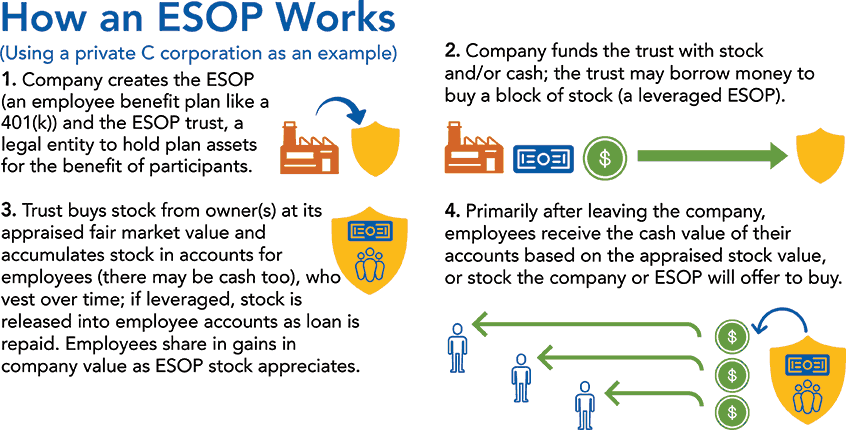
An ESOP, in the legal and retirement-plan sense, is a qualified defined contribution plan. The Internal Revenue Service says it is designed to invest primarily in employer securities, and the U.S. Department of Labor says ESOPs are federally regulated retirement benefit plans governed under ERISA. In plain English, that means the company contributes stock into a plan for employees, and the rules are designed to protect participants as retirement savers.
That structure matters because an ESOP is not the same as getting a bundle of tradeable company shares in your brokerage account. It is a retirement vehicle, with tax treatment, distribution rules, and oversight that look much more like a pension-style benefit than a startup-style grant. If you are reading benefits paperwork and see ESOP, you need to ask whether the company is describing a retirement plan, not a compensation award.
What stock options actually give you
Stock options are different in a way that affects everyday financial planning. They give you the right to buy company stock at a fixed price after a certain period, often once vesting requirements are met. If the share price rises above that exercise price, the option can become valuable; if it does not, the option may never produce a gain.
That is why the label alone is not enough. The real questions are simple but decisive: What is the strike price? When do the options vest? How long do you have to exercise them after leaving? And what happens if the stock price moves against you before you can use them? Those details determine whether the offer is a meaningful wealth builder or just a headline on a compensation slide.
Why this distinction matters at monday.com
For monday.com employees, the issue is more than terminology. The company is publicly traded on Nasdaq under the ticker MNDY, serves more than 250,000 customers worldwide, and filed its 2025 Annual Report on Form 20-F on March 13, 2026. In a public SaaS company like this, stock-related benefits sit alongside salary, bonus, and other incentives as a major part of the employment bargain.
That makes clarity essential for engineers, product managers, and sales professionals weighing a new offer or a promotion. If the company is offering equity compensation, a retirement plan with stock contributions, or both, the answer affects taxation, liquidity, vesting, and the timing of any eventual payout. It also affects how you compare monday.com with another employer, because two offers that look similar on paper can behave very differently in real life.
The money angle inside monday.com’s own numbers
The company’s latest results make the stakes hard to ignore. monday.com reported 27% revenue growth for fiscal year 2025 and a 14% non-GAAP operating margin. It also reported $87.603 million in share-based compensation in the first half of 2025, up from $63.166 million in the first half of 2024.
That is a useful reminder for employees who see stock-based pay as an abstract perk. Equity is not a side note in monday.com’s economics. It is part of the company’s compensation structure, part of its retention strategy, and part of the cost of doing business as a high-growth public SaaS company. The more stock-based pay matters to the company, the more important it is for employees to know exactly which kind of stock benefit they are being offered.
How the confusion can distort career decisions
This is where the ESOP-versus-stock-options mix-up can quietly steer people wrong. An employee who thinks “stock benefit” always means the same thing may overvalue one offer and undervalue another. A retirement plan with employer stock contributions may look like a fast-growth wealth engine, when it is actually a structured retirement benefit with regulatory protections and distribution rules. Stock options, by contrast, may sound safer than they are if the employee does not understand vesting or the exercise price.
The misunderstanding can also affect control and value in a broader sense. Stock options do not automatically give you the same kind of ownership influence people imagine when they hear “equity.” An ESOP does not function like a personal stock grant you can manage on your own schedule. In both cases, the details determine who controls the timing, when value can be realized, and what happens if you leave before the benefit matures.
What to check before you sign or stay
Before you make a career move based on stock language, separate the documents into two buckets: compensation and retirement. Then read for the mechanics, not just the headline.
- If it is an ESOP, ask how the plan is funded, when benefits vest, and how distributions work.
- If it is stock options, confirm the strike price, vesting schedule, expiration window, and exercise rules after departure.
- Ask whether the company is offering both a retirement plan and equity compensation, because those are not interchangeable.
- Compare the tax treatment of each benefit, since the timing of taxes can matter as much as the nominal value.
- Treat “stock” as a category, not an answer. The acronym only matters once you know the structure behind it.
For monday.com employees, that distinction is especially relevant in a company with a large global customer base, public-market scrutiny, and a compensation model that clearly uses share-based pay at scale. The more precise the language, the better the decision. In a workplace where equity can shape retention, recruiting, and long-term finances, understanding what you actually hold is not a technicality. It is the difference between a retirement benefit and a purchase right, and that difference can reshape the entire value of a job offer.
This article was produced by Prism’s automated news system from verified source data, official records, and press releases, then run through automated quality and moderation checks before publishing. The system is built and supervised by the people who set the standards it runs under. Read our full AI policy.
Did this article answer your question?