Monday.com employees weigh target-date funds versus custom portfolios
Target-date funds are the easy 401(k) default, but monday.com employees with RSUs or a different risk profile may want to build their own mix.
The default is a decision, not a verdict
A target-date fund can feel invisible until you realize it is making a very real choice for you. The SEC’s Investor.gov glossary describes it as a diversified fund that automatically shifts toward a more conservative mix as a future target date gets closer, with the manager handling the asset allocation, diversification, and rebalancing. In plain English: you hand off the stock-and-bond math, and the fund does the rest.

That matters because 401(k) plans often use target-date funds as the default investment for people who never make an election. The Government Accountability Office says target-date funds were the most popular investment option used by 401(k) participants, with assets in defined contribution plans around $2.8 trillion as of June 2023. This is not a niche product anymore. It is the quiet path millions of workers take because it is the easiest path.
Why the default became so common
The rise of target-date funds is tied to the fact that many workers never actively choose an investment mix. A Department of Labor fact sheet from 2006 said about one-third of eligible workers did not participate in employer-sponsored defined contribution plans, and later guidance explained why plan sponsors increasingly use target-date funds as the qualified default investment alternative, or QDIA, for participants who do not choose. That default structure is meant to solve a real behavioral problem: people delay, procrastinate, or avoid the decision entirely.
The convenience is the selling point. Vanguard’s retirement guidance says you can either pick a single target-date fund or build your own portfolio, and the right answer depends on how much control, customization, and complexity you want to take on. That same logic explains why employers lean on the default. It keeps participation simple, especially for workers who are busy, not interested in portfolio management, or just trying to make sure they are saving something rather than nothing.
What target-date funds actually do
The key concept is the glide path, the term the Department of Labor uses for the way a target-date fund changes over time. Some funds follow a “to retirement” glide path, meaning they become most conservative by the target date. Others follow a “through retirement” glide path, which keeps reducing equity exposure after the target date has passed.
That difference is not a footnote. It changes how much risk you are carrying at retirement and after it. The SEC’s 2025 Investor Bulletin also notes that some target-date funds are mutual funds or ETFs regulated by the SEC, while others held in retirement accounts are collective investment trusts, or CITs, which are not regulated by the SEC. So even if two options have the same year in the name, they may not behave the same way, carry the same protections, or follow the same strategy.
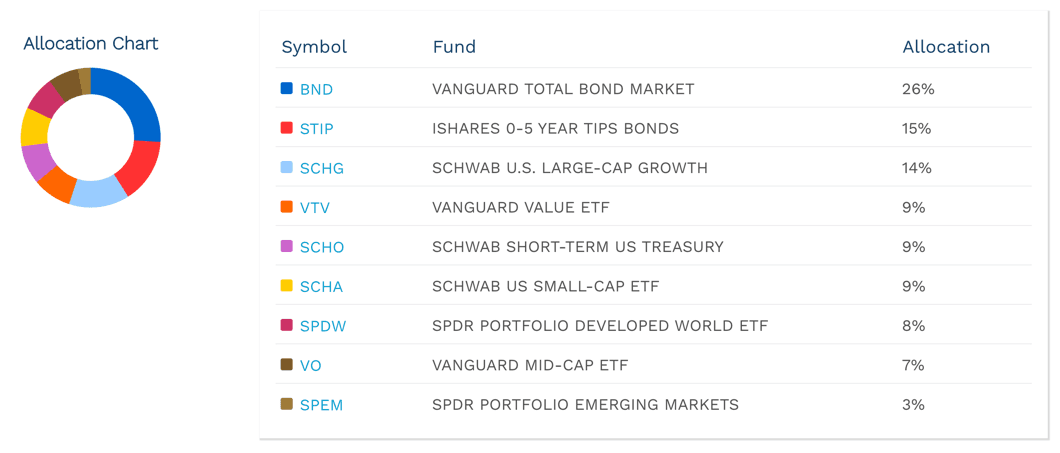
Vanguard says its target-retirement funds use broad index funds spanning thousands of U.S. and international stocks and bonds, automatically rebalance, and gradually shift toward bonds as retirement gets closer. That is the appeal in one sentence: broad diversification, automatic maintenance, and a built-in move toward lower risk over time.
When the hands-off choice makes sense
For many monday.com employees, a target-date fund is the right kind of boring. If you do not want to think about bond weights, rebalancing, or how much international exposure you should hold, the default can be a sensible set-it-and-forget-it option. It gives you professional management without asking you to become your own portfolio manager.
That can be especially useful if your retirement savings are your main market exposure and your compensation is mostly salary and cash bonus. It is also a reasonable choice for workers who are earlier in their careers, who do not yet have a complicated balance sheet, or who simply know they will not monitor their investments regularly. The whole point is to make participation easier than in the era when workers had to choose every fund themselves.
When monday.com employees may want to override it
The default becomes less automatic once equity compensation enters the picture. monday.com is a public company with 3,155 employees as of December 31, 2025, and for employees who hold meaningful RSUs, company stock can already add a heavy dose of one-company risk to the household balance sheet. In that case, leaving the 401(k) in an aggressively stock-heavy target-date fund may mean stacking the same risk on top of itself.
That does not mean a target-date fund is wrong. It means the fund should be judged as part of your total picture, not in isolation. If you already own a lot of monday.com stock through equity awards, if you want a different stock-to-bond split, or if your tolerance for market swings is lower than the target-date glide path assumes, a custom portfolio may fit better. The decision is less about sophistication and more about whether the default matches your actual exposure.
GAO has warned that target-date design varies, which is another reason not to treat every fund as interchangeable. Two plans can both offer a “2055” fund and still expose you to meaningfully different levels of risk, fees, and stock ownership along the way.
Questions to ask before you leave it alone
If you are tempted to ignore the default, at least understand what it is doing for you. Before you decide to stay put, ask HR or the plan provider:
- Is the plan’s default actually a target-date fund, and is it used as the QDIA?
- Is the target-date option a mutual fund, ETF, or collective investment trust?
- Does the fund follow a “to retirement” or “through retirement” glide path?
- How aggressive is the fund today, and how much equity will it still hold at the target date?
- What are the fees, and how does this fund compare with the other lineup options?
- What assets does it hold underneath the wrapper: broad index funds, active funds, or something more specialized?
- How does this fit with my RSUs, cash savings, and any other retirement accounts I already have?
Those questions turn the default from an assumption into a choice. That is the real lesson here. A target-date fund can be a perfectly good answer, but only if the answer fits the rest of your financial life.
For monday.com employees, the smartest move is not to chase complexity for its own sake. It is to make sure the easy option is actually easy for your situation, not just easy for the plan.
This article was produced by Prism’s automated news system from verified source data, official records, and press releases, then run through automated quality and moderation checks before publishing. The system is built and supervised by the people who set the standards it runs under. Read our full AI policy.
Know something we missed? Have a correction or additional information?
Submit a Tip