Monday.com guide says remote workers need routines and clear boundaries
monday.com’s remote-work playbook treats routines, focus and clear boundaries as job skills, not perks, and its own templates show how to make them stick.
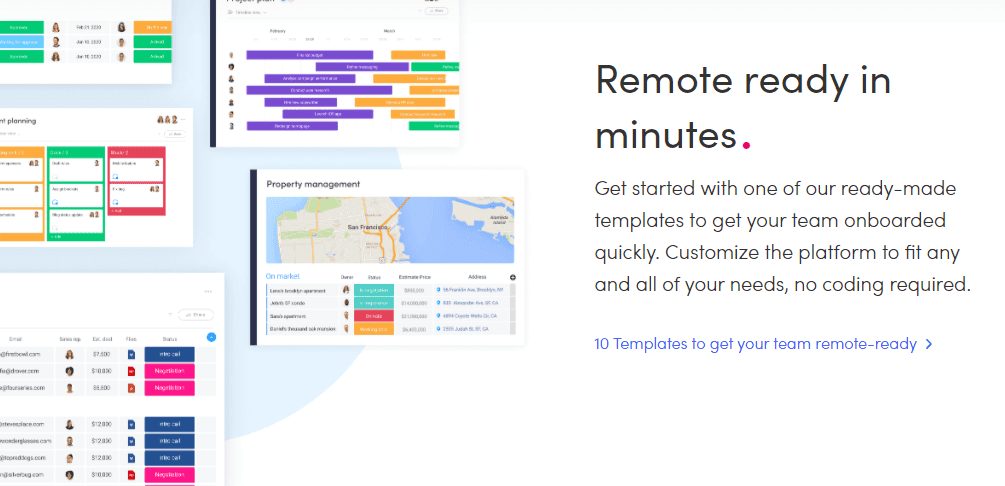
monday.com published its Working Remotely: A Survival Guide in 2020. For individual contributors, routines, focus time and clear expectations are the cost of flexibility, not an optional upgrade. Engineers, product managers and sales teams still need to move in sync with a fast-moving SaaS business while working from different places and schedules.
Make work visible without turning it into surveillance
Visibility should help people coordinate, not hover over each other. The platform helps teams align fast, collaborate, boost communication and track progress whether they are remote or in the office, and its current template library includes tools built for process rather than theater.
Those templates include remote work requests, sync meeting summaries, daily team tasks, 1-on-1 meeting logs, time tracking, remote equipment checks, a knowledge library and employee onboarding. For an individual contributor, that mix points to a practical habit: put status where teammates can see it before they have to ask. In a company like monday.com, where the product itself is built around work visibility, the point is to make it easier for distributed teams to know what is moving, what is blocked and what needs attention.
Protect focus before the calendar fragments it
Remote flexibility can be a benefit and a liability at the same time. Working from home cuts commute time and can give people more control over the day, but it also brings distractions, slower communication, blurred boundaries and the low-grade isolation that builds when work is always nearby and never quite contained.
For engineers and product managers, that means focus has to be scheduled, not hoped for. Long stretches of deep work are only useful if they are protected from constant pings, ad hoc meetings and the pressure to respond instantly to every message. For sales professionals, the same discipline shows up differently: remote selling depends on deliberate follow-up, clear pipeline habits and a steady rhythm that keeps deals from stalling between calls.
A useful remote routine usually has a few non-negotiables:
- Block out deep-work time before the rest of the day fills it.
- Use one task system so priorities do not live in scattered notes, chats and tabs.
- Batch communication instead of reacting to every notification in real time.
- Build short breaks into the day so work does not bleed into every hour at home.
Set communication norms before friction does it for you
The hardest remote-work problems are often not technical. They are communication problems that create context switching, delay decisions and make people feel like they are working alone even when they are not. Proactive communication matters for exactly that reason: when you wait for others to notice you are stuck, you lose time and everyone else loses clarity.
That is where sync meeting summaries and 1-on-1 logs matter. Used well, they become a record of what was decided, what remains open and who owns the next move. A remote team does not need more chatter; it needs cleaner handoffs, clearer response expectations and a shared sense of when a question should be async, when it needs a meeting and when it can wait until the next check-in.
For individual contributors, the practical move is to make communication explicit before it gets messy. Say when you are heads-down. Say when you will be back online. Say which decisions you can make yourself and which ones need a second set of eyes.
Draw boundaries on purpose, not by accident
People do not accidentally create strong work-life separation at home. They build it through routines, structured task systems and clear expectations with teammates. That is a useful correction for anyone who has let remote work become a permanent state of partial attention, where email, Slack and home life all blur into one long workday.
The healthiest boundary-setting habits are usually small, visible and repeatable. A clear start-of-day ritual helps signal that work has begun. A defined shutdown routine makes it easier to stop checking messages after hours. And a shared expectation with teammates about response windows can do more to prevent burnout than any number of vague reminders to “take care of yourself.”
The same idea applies to breaks. If the workday is fully self-managed, breaks have to be too. They do not happen because somebody notices you need one; they happen because you planned for them and protected them.
Why monday.com keeps returning to this topic
In the company’s 2020 State of Remote Work release, 69% of people said they enjoyed working from home more than expected and 54% said they were more productive at home.
The company has continued to build out a remote-work content hub, keeping templates and best practices in rotation instead of treating them as one-off pandemic content. monday.com became a public company on June 10, 2021, later opened its North American headquarters in New York City at 225 Park Avenue South in a 110,000-square-foot, four-floor space, and continues to present itself as an AI work platform in investor materials. Its fiscal 2025 results cited 27% revenue growth and a 14% non-GAAP operating margin.
The market still rewards people who can work this way
Pew Research Center found in March 2023 that 35% of U.S. workers whose jobs can be done from home were working from home all the time, while 41% were on hybrid schedules. In December 2024, Pew found that 40% of workers were dissatisfied with the amount of flexibility they had to work remotely. In January 2025, Pew found that 75% of employed adults with jobs that can be done from home were working remotely at least some of the time.
This article was produced by Prism’s automated news system from verified source data, official records, and press releases, then run through automated quality and moderation checks before publishing. The system is built and supervised by the people who set the standards it runs under. Read our full AI policy.
Did this article answer your question?