Monday.com guide says specialized AI agents will shape future work
Monday.com is betting on specialist AI agents, and that pushes teams to design permissions, handoffs and governance before they scale.

Specialized agents are the new operating model
Monday.com’s latest AI shift is not about adding one smarter chatbot. The company is rebuilding its platform around AI Work Platform with Native Agents, then opening that model to external AI agents through dedicated onboarding and purpose-built infrastructure so work can be done inside the system, not just talked about around it. That matters for monday.com because it changes AI from a feature layer into a strategic layer, one that touches execution, permissions and the way teams hand work off to software.
The core idea in monday.com’s 2026 AI guide is simple: the future of work belongs to specialized helpers, not one all-knowing assistant. One agent can manage a calendar, another can analyze customer feedback, and another can keep data clean and ready for action. The guide also draws a sharp line between automation and agents, saying agents do not just follow rules, they monitor outcomes, adapt when conditions change, and keep work moving with less supervision.
That is the right mental model for monday.com’s product teams as the platform moves deeper into enterprise workflows. For engineers, the important design questions are task boundaries, tool calls and permissioning, because an agent that can see too much or do too much stops feeling helpful very quickly. For product managers, the real choice is whether a workflow belongs to one agent or a coordinated set of smaller agents with clearer responsibilities.
The first work that will split apart
The earliest AI agent wins are usually the most repetitive jobs, the ones that already live in every weekly review and every inbox. monday.com’s own examples point to that pattern: Meeting Scheduler syncs impossible calendars, Project Monitor surfaces hidden risks, and Vendor Researcher compares every quote. On the company’s platform page, agents are also framed around practical outcomes like resolving tickets nonstop, keeping projects on track, closing deals around the clock and filling roles faster.

That makes project updates, support triage, research, scheduling and handoffs the most obvious places to break work into separate agents first. A scheduling agent can chase open calendar slots, a research agent can collect vendor or market information, a support agent can route and resolve routine tickets, and a project agent can flag delayed dependencies before a manager notices them in a status meeting. This is the kind of decomposition that makes AI reliable inside a business, because each agent has one job, one goal and one set of limits.
What managers have to design so agents feel like teammates
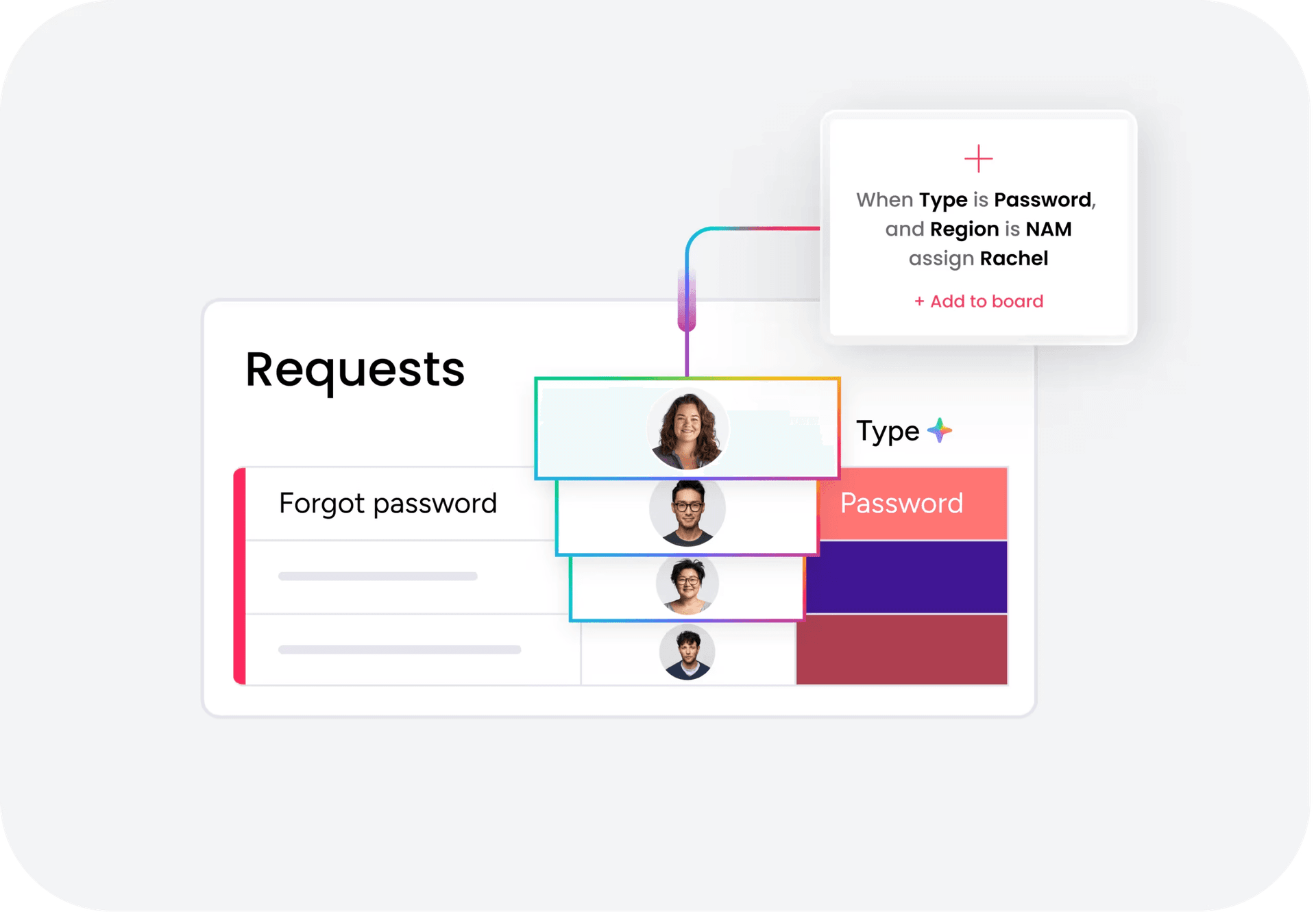
The difference between a useful agent and a noisy add-on is governance. monday.com’s support documentation says custom agents can use boards, data, docs, workflows and permissions, which is the right shape for enterprise work because the agent can operate with the same context humans use. The same documentation says admins can manage AI governance, AI credits, usage limits and agent directory settings, giving leaders a way to see what is running, who owns it and what it is allowed to touch.
That structure also points to how the platform should be rolled out inside a company. monday.com’s own guide recommends starting small, automating one routine process first, refining it, and then scaling intentionally. In practice, that means a manager should not ask for a giant transformation on day one. The better move is to pick one workflow with obvious waste, give an agent a narrow mandate, watch how it behaves, and only then expand to adjacent steps or more sensitive handoffs.
monday.com is also creating a distinction between prebuilt and custom help. Its support materials describe Expert Agents, including CRM-specific agents, alongside a flexible builder for custom agents tailored to a team’s workflow. That split matters for sales, support and product groups inside monday.com because it suggests a future where some work can be standardized quickly while more complex processes still get a custom design pass.

Why monday.com is pushing this now
The company has made the AI story part of its investor message as well as its product roadmap. monday.com says more than 250,000 customers worldwide use the platform, and its investor relations language now says AI does not just assist, it executes. In Q4 2024, revenue was $268.0 million, up 32% year over year, and in Q1 2026 revenue rose to $351.3 million, up 24% year over year, while the company said it launched an AI Work Platform with Native Agents.
The scale story is just as important as the feature story. monday.com said 2025 revenue grew 27%, monday CRM reached $100 million in ARR, monday vibe became the fastest product in company history to pass $1 million in ARR, and customers with more than $50,000 in ARR represented 41% of total ARR. Those numbers explain why the company is treating agents as platform architecture rather than a side experiment: the bet is that AI will deepen value in existing accounts and expand what monday can run, not just what it can track.
That framing has been building for more than a year. At Elevate 2025, Chief Product & Technology Officer Daniel Lereya said the new era is one where software does not just manage work, it actually does the work for you. monday.com first laid out its 2025 AI strategy around three pillars, AI Blocks, Product Power-ups and the Digital Workforce, then moved to dedicated agents that can complete tasks end to end and adapt as conditions change. The shift from “assist” to “execute” is now visible across product pages, support docs and earnings materials, which is usually a sign that a company wants customers to think in operating models, not feature checklists.
For monday.com employees, that means the real opportunity is not a single magical bot. It is a bench of specialized agents that can be trusted to do one part of the job well, then hand the work back to people at the right moment, under the right permissions and with the right audit trail. That is a much harder product to build, but it is also the kind of platform shift that can define the next phase of work software.
This article was produced by Prism’s automated news system from verified source data, official records, and press releases, then run through automated quality and moderation checks before publishing. The system is built and supervised by the people who set the standards it runs under. Read our full AI policy.
Know something we missed? Have a correction or additional information?
Submit a Tip