monday.com managers can improve hiring with structured interviews
monday.com hiring gets fairer when every interviewer uses the same questions and scorecard, turning gut feel into a process that is easier to compare, defend, and scale.
Hiring at monday.com gets better when interviewers stop improvising. A candidate can still make a strong first impression, but the company gets a stronger team when decisions come from a repeatable process, not from whoever happened to be most persuasive in the room. That matters at a global software company building AI-powered products, where managers, engineers, PMs, and sales leaders need a shared bar even when they sit in different regions and time zones.
Why structure beats gut feel
The core problem with improvised interviews is simple: they reward charm, familiarity, and a background that feels familiar to the interviewer. That can make a candidate seem stronger than they are, while quieter but more capable people get overlooked. Structured interviews shift the focus back to the job by asking the same job-related questions and using the same scoring standard for every finalist.
That is the anti-bias mechanism here. Fairness does not come from hoping interviewers will “be objective.” It comes from building a process that makes objectivity easier to practice. When monday.com managers use standardized questions and defined scorecards, they reduce the odds that one polished answer or one shared hobby drives the decision more than evidence does.
SHRM’s guidance points in the same direction. Its interview resources encourage questions that fit company policy, practices, and culture, while its bias-reduction materials frame structured interviewing and AI tools as ways to improve hiring accuracy and cut costly recruitment mistakes. The logic is practical, not decorative: consistency helps interviewers compare candidates on what actually matters.
What structured interviewing looks like in practice
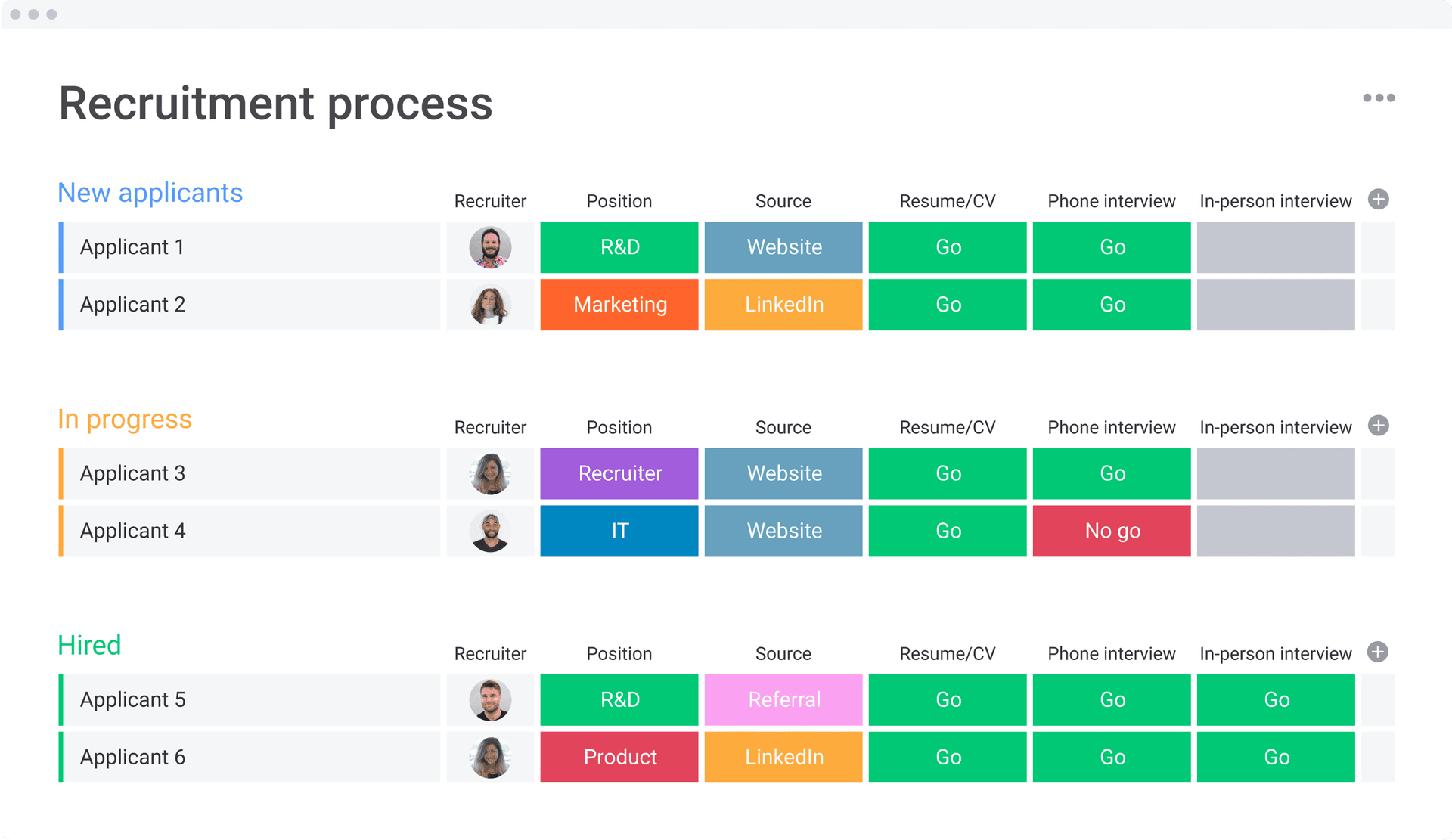
A structured interview is not a rigid script that turns every conversation into a robot exercise. It is a controlled process that uses repeatable questions, clear scoring criteria, and an evaluation framework tied to the role. monday.com’s own recruiting guidance says interview templates can keep interviews on track by combining questions, scoring criteria, and evaluation frameworks, so each interviewer is measuring the same things.
That matters because the before-and-after difference is real. In an improvised interview, one manager might ask about product sense, another might spend most of the time talking about team fit, and a third might wander into unrelated topics. In a structured process, the panel agrees in advance on the competencies that matter and asks questions designed to reveal them.
For monday.com, that approach is especially useful because the company hires across technical, product, and commercial functions. A sales candidate, a backend engineer, and a product manager do not need identical questions, but they do need an interviewer panel that knows how to evaluate them consistently. Structured scorecards make that possible by generating role-specific attributes and tailored questions, which reduces inconsistency and subjective decision-making across hiring panels.
A useful way to think about the change:
- Interviews become comparable instead of conversationally loose.
- Scorecards make it easier to defend a decision with evidence.
- Candidates get a clearer sense of what success looks like.
- Hiring managers align faster on the real requirements of the role.
How monday.com already signals this approach
monday.com’s careers materials already point toward a hiring model built around consistency. The company describes itself as a global software company building AI-powered products, and its job language says all qualified candidates will be considered regardless of protected characteristics such as race, color, religion, nationality, sexual orientation, gender identity, age, marital status, pregnancy, family or parental status, disability, veteran status, or other legally protected characteristics.
That promise is only meaningful if the interview process can carry it. Structured interviews help turn a broad fairness statement into operational reality. For a company with more than 2,500 employees globally, the risk is not just bias in one hiring loop, but drift across teams that each invent their own version of “good candidate” and end up applying different standards.
monday.com’s engineering interview guide shows how central process design already is to evaluation. It lays out HR and technical stages, including Zoom interviews and coding or challenge-based assessments. That kind of sequencing matters because it separates conversation from measurement, giving interviewers a clearer way to compare candidates on technical readiness, communication, and role fit.
The company’s recruitment optimization numbers make the case even more concrete. monday.com says one workflow improved hire time by 17%, candidate experience score by 22%, and the number of candidates processed by 29%. Those gains suggest that structure is not just about compliance or optics. It is an operating advantage that helps hiring teams move faster without making the process sloppier.
Why this matters for managers, not just recruiters
Managers often think of interviews as a personal skill, something improved by experience or instinct. The research points to a different truth: the best interviewers are often the ones who use the best system. The U.S. Office of Personnel Management defines structured interviews as a way to measure job-related competencies systematically, with the goal of giving candidates equal opportunity and assessing them accurately and consistently. The U.S. Equal Employment Opportunity Commission likewise urges employers to explain hiring policies to everyone involved in decisions and to make sure those decisions are not based on protected characteristics.
That is especially relevant in tech, where teams can overvalue charisma or familiarity with a particular background. At monday.com, where innovation depends on engineers, product teams, and go-to-market staff working from a common playbook, hiring inconsistency can ripple far beyond one open role. A bad interview process does not just waste time, it can quietly shape the culture of the next team.
The practical lesson for managers is not to eliminate human judgment. It is to discipline it. Define the competencies before the interview, ask every candidate the same core questions, score answers against the same standard, and calibrate panelists before they compare notes. That is how fair hiring becomes repeatable hiring, and repeatable hiring is what scales in a company that is still growing fast while building products for a global workforce.
For monday.com, the case for structured interviews is ultimately the case for better execution. Good intentions may start the process, but standardization is what makes the hiring bar real.
This article was produced by Prism’s automated news system from verified source data, official records, and press releases, then run through automated quality and moderation checks before publishing. The system is built and supervised by the people who set the standards it runs under. Read our full AI policy.
Did this article answer your question?