monday.com shares project examples to help teams manage complex work
monday.com’s new examples guide turns project chaos into reusable workflows, showing how clear scope, visibility, and AI tools keep complex work moving.
Why monday.com is leaning into project examples
Too many deadlines, a shifting stakeholder list, and a distributed team that cannot rely on hallway updates is exactly the kind of mess monday.com is trying to turn into a repeatable workflow. Its updated project-management examples piece treats cross-functional chaos as an operating problem, not a personal productivity flaw, and pushes teams to build structure before the next project starts.
The guide spans 10 industries, including construction, healthcare, retail operations, and nonprofit fundraising. It frames each example around a specific challenge, the approach used to solve it, and the lesson teams can reuse, which makes the piece feel less like a showcase and more like a pattern library for real work.
The five-phase framework underneath the examples
At the center of the article is a familiar but useful reminder: every project still moves through initiation, planning, execution, monitoring, and closing. monday.com has used that same five-phase framework in earlier lifecycle and process explainers, and the repetition matters because it gives employees a common language for work that otherwise splinters across teams, tools, and time zones.
For product managers and engineers, the lifecycle lens is especially practical. Initiation clarifies what problem is worth solving, planning turns that problem into scope and dependencies, execution puts the work in motion, monitoring exposes drift early, and closing captures what the team can carry into the next release or customer rollout.
Choosing the right methodology
monday.com also makes a point that many teams learn the hard way: not every project should be run the same way. Waterfall, Agile, and hybrid approaches each have a place, and the right choice depends on how much uncertainty the work carries.
That distinction matters inside a SaaS company where product innovation and feature launches can range from tightly defined work to fast-changing bets. If the scope is stable, a more linear approach can reduce noise. If requirements are shifting, a more iterative process can keep the team from locking itself into the wrong plan. Hybrid approaches are often the real-world answer, especially when some parts of a project are fixed while others need room to evolve.
What successful projects have in common
The strongest thread running through the examples is not industry-specific expertise. It is a repeatable set of operating habits: clear scope, the right methodology, proactive risk management, stakeholder alignment, and visibility into the work.
Those ingredients are simple enough to sound obvious, but they are the difference between a plan that survives contact with reality and a plan that collapses the moment one stakeholder changes direction. In a remote or hybrid environment, where people cannot depend on quick desk-side clarifications, visibility becomes the connective tissue that holds the work together.
- Clear scope keeps teams from solving the wrong problem.
- The right methodology keeps execution matched to uncertainty.
- Proactive risk management surfaces problems before they become blockers.
- Stakeholder alignment limits churn when multiple functions touch the same project.
- Visibility into the work makes handoffs, dependencies, and deadlines harder to miss.
For sales teams, this is also a vocabulary lesson. The value of modern work software is not just task storage or pretty boards. It is the ability to explain, in plain terms, how scope, risk, and dependencies get coordinated across the business.

How monday.com turns the pattern into a platform
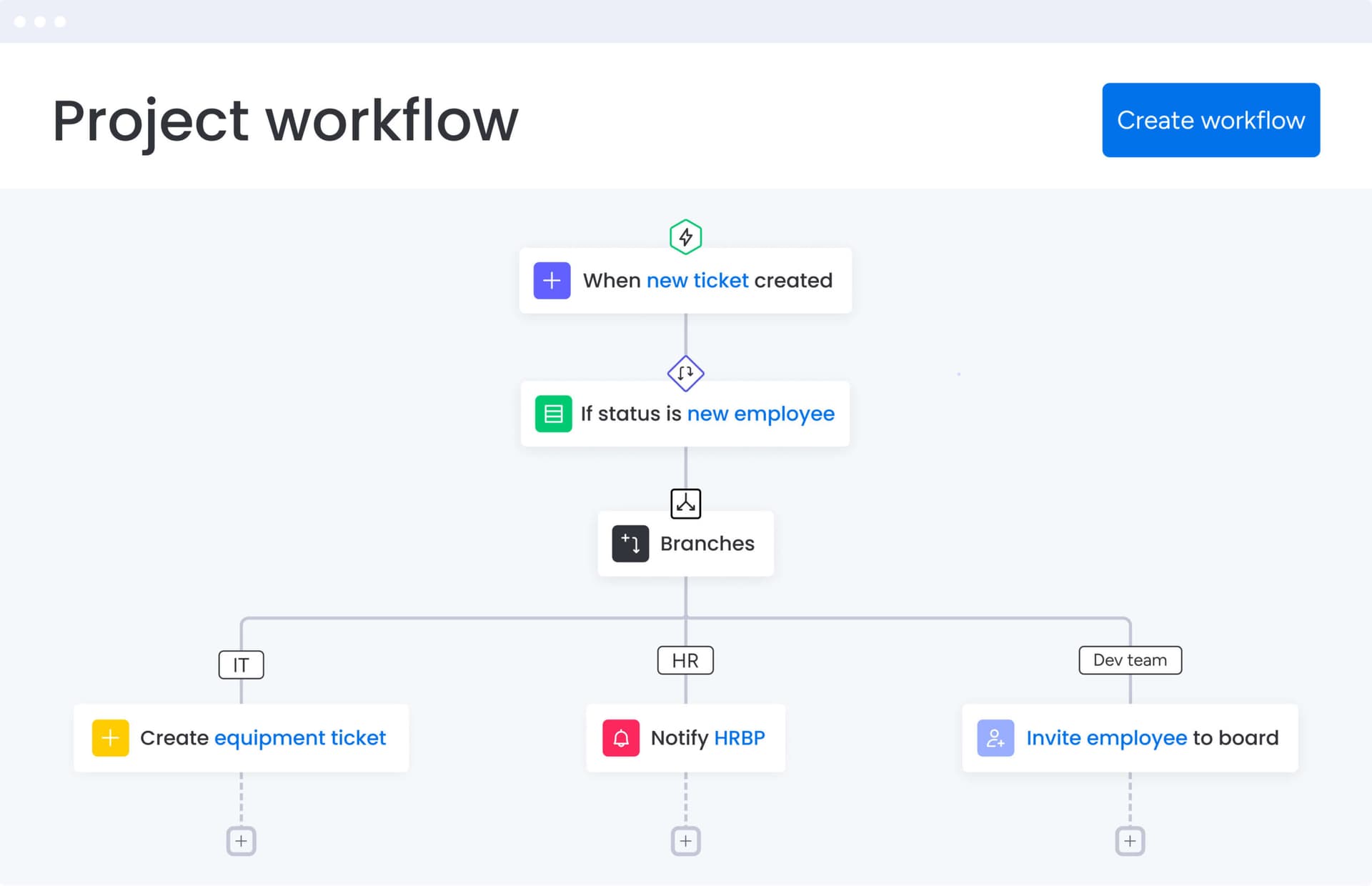
The article’s practical advice lines up closely with monday.com’s broader platform story. Its AI Work Platform now highlights dashboards, Gantt charts, automations, monday agents, monday sidekick, and monday vibe, all of which point toward the same idea: plans should be visible, adjustable, and easy to act on.
That message became sharper in 2026, when monday.com said its platform now enables AI agents to sign up, authenticate, and operate directly inside monday.com. For workers, that changes the shape of execution: fewer disconnected handoffs, less manual coordination, and more of the routine setup work moving into the system itself.
Dashboards and Gantt charts help teams see progress and dependencies. Automations reduce the repetitive work that clogs execution. monday sidekick and monday vibe signal a broader shift toward AI-assisted workflows that can support planning and follow-through, not just generate summaries after the fact. For engineers and product managers, that makes the platform feel less like a passive tracker and more like an operating layer for complex work.
Why this resonates beyond the blog post
The scale behind monday.com explains why this kind of content lands. The company says more than 250,000 customers worldwide use the platform, and that it is trusted by over 60% of the Fortune 500. Those numbers suggest that the problem the article is solving is not niche, it is mainstream: teams everywhere are trying to coordinate work that cuts across functions, geographies, and budgets.
The broader labor market points the same direction. Project Management Institute’s 2025 Pulse of the Profession report emphasizes business acumen as a differentiator for project success beyond budget, scope, and schedule. PMI also said up to 30 million new project professionals will be needed globally by 2035. Put together, those signals show why project literacy is becoming a core workplace skill, not a narrow PM specialty.
For monday.com employees, that is the strategic takeaway. The company is not just shipping a tool that stores tasks. It is building a system that helps teams choose a method, expose risk early, and keep execution legible as the work changes. In a market crowded with work software, the advantage goes to the platform that helps people turn messy collaboration into a repeatable operating rhythm.
Know something we missed? Have a correction or additional information?
Submit a Tip