Salesforce shows how agentic AI is reshaping software delivery
Salesforce's agentic shift raises the bar for monday.com: speed now has to come with guardrails, or it becomes a liability. The real test is who controls the handoff.

The real question behind agentic engineering
Autonomous tools are no longer just suggesting code at Salesforce. The company says they are writing code, reviewing pull requests, and driving deployments, which changes the workplace question from whether AI can help to what has to change inside engineering before AI can ship safely.
That is the operational threshold every SaaS company now has to face. If agents are taking over more of the mechanical work, human engineers are left with the parts that carry the most risk: architecture, product judgment, incident response, security, and the edge cases that automation still handles poorly.
What Salesforce says changed inside the org
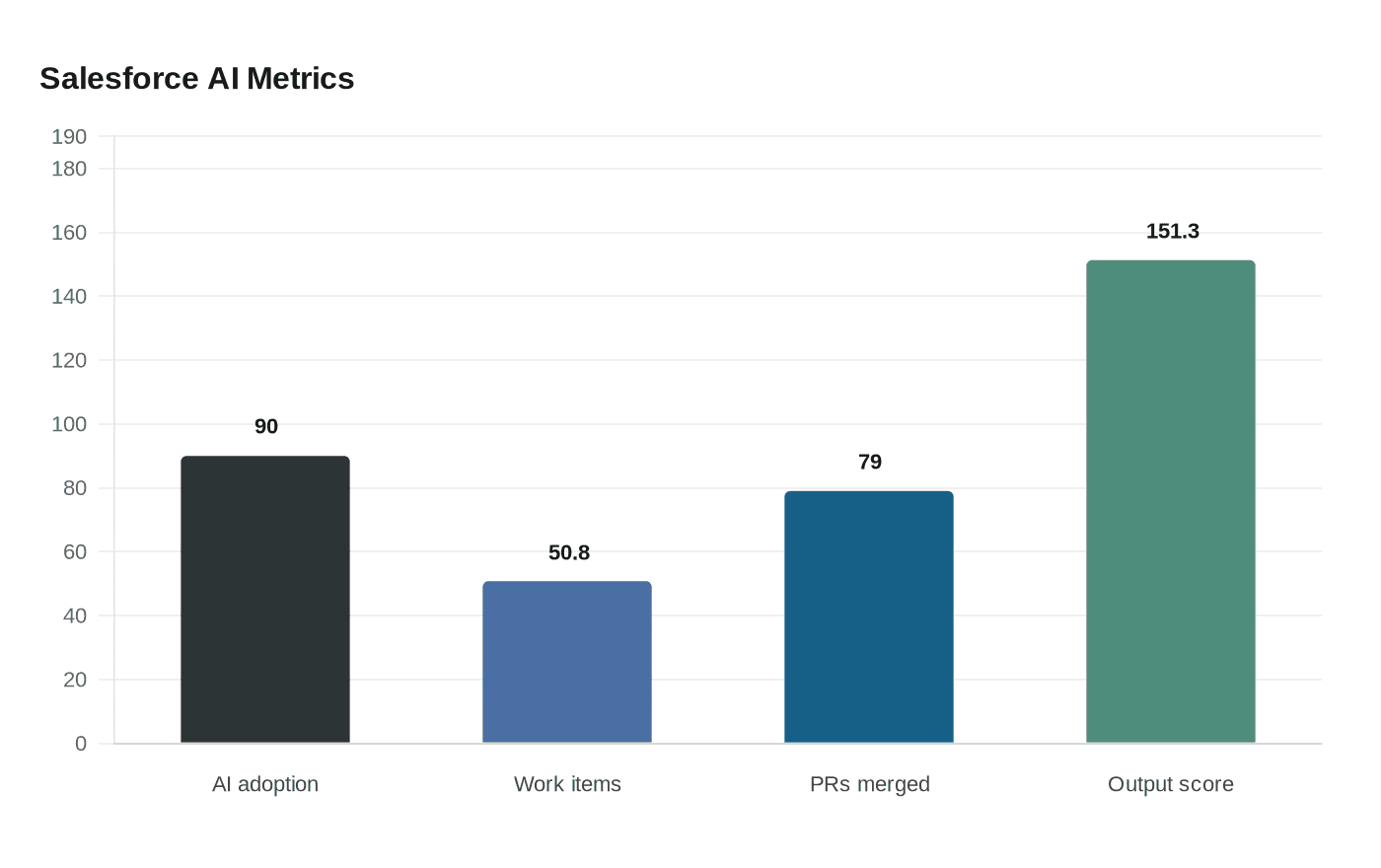
Salesforce’s internal shift was not framed as a narrow pilot. The company said it standardized on Claude Code, removed token limits, and crossed 90% AI adoption among engineers. That combination matters because it suggests the company is not treating AI as an optional add-on. It is pushing the tooling into the center of daily engineering work.
The results Salesforce reported give the move some weight. In April 2026, it said work items completed per developer were up 50.8% year over year, PRs merged per developer were up 79%, and its Effective Output score had increased 151.3% year over year. Those are not vanity metrics. They point to a management decision to measure output in the flow of engineering work, not just in broad claims about productivity.
Salesforce also pointed to a concrete delivery example: its Agentforce Commerce team completed a 33-API-endpoint migration in 13 days, versus an estimated 231 person-days under a traditional approach. That kind of delta is exactly why agentic engineering is becoming a boardroom issue, not just a developer-tooling story. It shows what happens when automation is allowed to move beyond drafting code and into delivery itself.
Why monday.com cannot treat this as someone else’s story
For monday.com, this is not a distant enterprise anecdote. The company has been building toward the same category shift. In February 2025, monday.com laid out an AI vision built around three pillars: AI Blocks, Product Power-ups, and the Digital Workforce. Later in 2025, it introduced monday magic, monday vibe, and monday sidekick, then in September 2025 it unveiled monday agents, a no-code agent builder, and said the platform serves more than 250,000 customers.
That is the key point for anyone working on product, engineering, or sales inside monday.com: the company is no longer just a work-management vendor. It is repositioning itself as an AI work platform, which means the standard for internal engineering discipline rises along with the product pitch.
The financial backdrop makes that shift harder to fake. monday.com reported fiscal 2025 revenue of $1.232 billion, up 27% year over year, and said customers with more than $50,000 in ARR represented 41% of total ARR. It also said monday vibe was the fastest product in company history to surpass $1 million in ARR. When a company is growing at that scale, buyers will not just ask whether AI exists in the product. They will ask whether the company can ship AI features quickly without creating reliability, auditability, or support problems.
What has to change inside the engineering org
Agentic engineering only works when the org is redesigned around control, not just speed. That means the boundary between human and machine has to be explicit. Engineers need to know where agents can act independently, where they must hand off, and who owns the final call when the software is heading toward production.
At a practical level, that shifts the center of gravity toward a few guardrails:
- Review loops need to stay real, not ceremonial. If agents are drafting code and opening pull requests, humans still need to validate the architecture, the security posture, and the failure modes.
- Test coverage has to become a first-class control, because automation without strong tests just accelerates mistakes.
- Traceability matters more than ever. If a release is driven by an agent, the team needs to know what changed, why it changed, and who approved it.
- Incident response cannot be delegated away. When the system breaks, the human chain of responsibility has to be obvious.
- Edge cases should stay human-led. The more autonomous the workflow, the more important it is to reserve judgment for ambiguous or high-risk decisions.
That is also why monday.com’s own guidance on AI for software engineering is useful here. The company has said teams should balance automation with expertise, start with smaller AI wins such as code formatting and test generation, and measure deployment frequency, bug escape rates, and developer satisfaction. That is a much more grounded framework than a generic promise to “move faster.” It treats AI as an operating change, not a branding exercise.
What product leaders and sales teams should take from this
For product managers, the warning is simple: throughput is not the finish line. Faster code only matters if it turns into better learning, fewer bottlenecks, and cleaner releases. If AI speeds up development but also increases rework, support load, or hidden technical debt, the org has not improved. It has just compressed the pain.
For sales and customer-facing teams, the implication is even more direct. Buyers increasingly expect faster iteration, more reliable releases, and more visible governance from the vendors they trust. A company like monday.com can use its AI story in the market, but that story has to survive scrutiny from customers who want proof that autonomy does not mean loss of control.
That is why the comparison with Salesforce matters. The message is not that every company should copy the same tooling stack. The message is that engineering organizations are being judged on how well they combine automation with accountability. In monday.com’s case, that will touch monday CRM, monday dev, and the broader platform story, because the product promise and the internal delivery system are becoming the same conversation.
The standard now being set
The companies that scale best will be the ones that make their engineering org more agentic without making it opaque. Salesforce is showing what that looks like when the system is tuned for speed. monday.com now has to prove it can pair that same ambition with disciplined workflows, clear ownership, and enough human oversight to keep the machine honest.
This article was produced by Prism’s automated news system from verified source data, official records, and press releases, then run through automated quality and moderation checks before publishing. The system is built and supervised by the people who set the standards it runs under. Read our full AI policy.
Did this article answer your question?