SAP’s AI-native vision raises stakes for monday.com in enterprise software
SAP is making enterprise AI about context, not add-ons, and that puts monday.com under pressure to prove its workflows can reason, govern, and act.
SAP’s latest AI-native pitch is not really about SAP at all. It is a warning shot for the rest of enterprise software: buyers are moving past the question of whether a product has AI and toward a harder one, where is AI embedded in the workflow, the data model, and the decision path?
SAP is reframing the enterprise stack
SAP’s June 8 AI-native North Star architecture is explicitly a direction of travel, not a delivery promise. That matters because the company is drawing a line between the first wave of AI, which added intelligence inside existing applications, and the next phase, which has to operate across the business with enough context, governance, and shared data to produce trusted outcomes. SAP says enterprise software has long been a system of record; the new standard is a system of context.
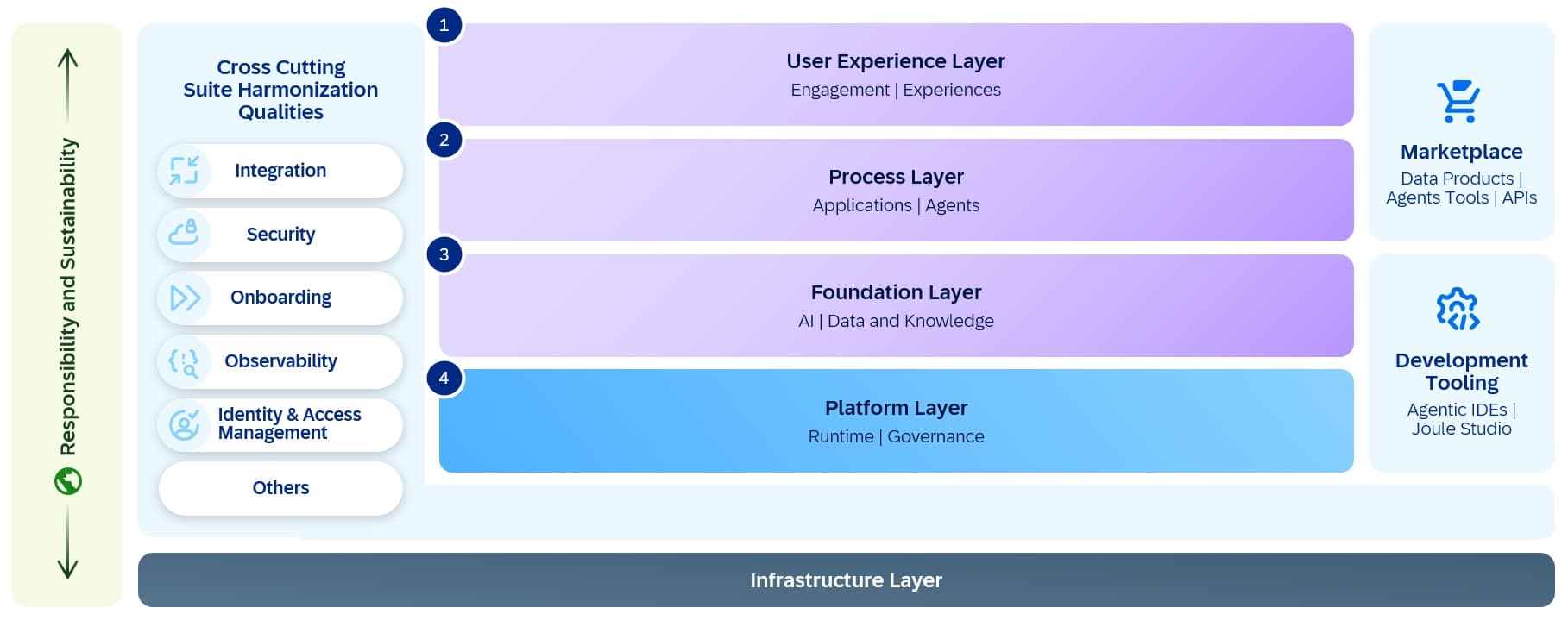
That architecture is organized around four layers: user experience, process, foundation, and platform. The goal is to connect Joule, agents, the SAP Knowledge Graph, and enterprise data in a continuous loop so intent can become action. In plain English, SAP is saying that AI is only useful when it understands what happened, what matters next, and who is accountable if something goes wrong.
The timing is not accidental. SAP tied this framing to its May 2026 Sapphire announcements about the Autonomous Enterprise, which centered on a unified AI platform for building, contextualizing, and governing agents, an autonomous suite that executes core business operations, and a new user experience for how people work with enterprise software. That is a big strategic claim, and it shows where the market is headed: less chatbot, more orchestration.
Why that matters inside monday.com
For monday.com, this is not an abstract industry memo. It is the same conversation buyers are already having about work management, CRM, and service software: does the platform simply store work, or does it help the organization understand and act on work at scale? The answer will shape product decisions in Tel Aviv, sales motions in New York, and the day-to-day priorities of engineers and product managers who are trying to turn AI from a feature into an operating layer.
SAP’s framing also puts governance back at the center of the AI debate. Business leaders are not looking to trade accountability for convenience, especially in core workflows where approvals, handoffs, and auditability matter. That is why the enterprise buyer’s real concern is not whether a demo can generate text. It is whether the system can reason across processes, preserve trust, and explain why it made a recommendation.
For monday.com, that raises the bar on product design. AI features increasingly need to be grounded in process knowledge, not just natural language generation. If the platform is going to help teams move faster, it has to know the structure of work, the dependencies between tasks, and the rules that govern who can do what, when, and with which data.
monday.com has already been moving in that direction
The company has spent 2025 widening its AI surface area. It introduced monday magic, monday vibe, and monday sidekick, then added monday agents and monday campaigns. Those names sound like feature launches, but the strategic signal is broader: monday.com is trying to turn AI from a helper layered onto work into part of the work OS itself.
That shift became more concrete on March 11, 2026, when monday.com said it had built infrastructure that allows external AI agents to sign up, authenticate, and operate directly inside the platform. That is a major architectural move. It suggests the company is no longer thinking only about prompting humans more efficiently, but about creating a controlled environment where software agents can participate in workflows alongside people, data, and permissions.
For a company like monday.com, that is the real test of AI-native design. The value is not in adding another shiny assistant. It is in deciding how agents enter the system, what they are allowed to see, what actions they can take, and how the platform keeps those actions traceable. That is exactly the kind of architectural question SAP is pushing into the center of enterprise software.
The numbers show why this matters now
The financial backdrop helps explain the urgency. monday.com reported fourth-quarter 2024 revenue of $268.0 million, full-year 2024 revenue of $972 million, and net dollar retention of 112%. It also said it surpassed $1 billion in annual recurring revenue in 2024. By the first quarter of 2026, revenue had reached $351.3 million, and the company said it posted record net adds of customers with more than $500,000 in annual recurring revenue.
Those figures matter because they show monday.com is moving further upmarket while trying to preserve momentum. That is where enterprise AI gets harder, not easier. Bigger customers care more about governance, data boundaries, integration depth, and workflow reliability, which means the company cannot sell AI as a cosmetic layer. It has to make AI work inside a stack that can satisfy procurement, security, and operations at once.
For sales teams, that changes the conversation. The strongest pitch is not “we have AI too.” It is “here is where AI sits in the process, how it uses your data, and how the platform controls decisions.” For product teams, it means the roadmap has to connect AI to execution, not just generation. And for engineering, it means the architecture has to support agents, permissions, context, and auditability without turning the product into a fragile tangle of one-off automations.
What buyers will start asking next
The SAP and monday.com story lands in the same place: the enterprise stack is becoming AI-native, and that changes the buying criteria. The old checkbox question, does this tool have AI, is too shallow. The better questions are:
- Where is AI embedded, in the interface, the process layer, or the core data model?
- Does it understand the workflow well enough to act, or only to suggest?
- Can it reason across systems without losing governance and traceability?
- Does it help a team make a decision, or merely produce text around one?
That is the architectural stakes story for monday.com. If SAP is right, the winners will not be the companies that add the most AI badges. They will be the ones that make AI feel native to how work actually moves. For monday.com, that means the race is no longer about launching features in isolation. It is about proving that the platform itself can become the context layer enterprise buyers now expect.
This article was produced by Prism’s automated news system from verified source data, official records, and press releases, then run through automated quality and moderation checks before publishing. The system is built and supervised by the people who set the standards it runs under. Read our full AI policy.
Did this article answer your question?