GDC report warns Nintendo of layoffs, AI skepticism, and talent uncertainty
Developers are still lining up for Switch 2 even as layoffs and AI pessimism hit the game job market, sharpening Nintendo’s recruiting leverage and retention pressure.
The game talent market looks battered, but Nintendo’s new hardware still has pull. In a survey of more than 2,300 game industry professionals, 39 percent said they were interested in making games for Nintendo Switch 2, even as 28 percent said they had been laid off in the past two years and 33 percent of U.S. respondents reported the same.
That contradiction matters inside Nintendo. A platform that draws that much interest gives recruiters, producer teams, and business development staff a stronger hand when they talk to studios, contractors, and new hires. It also raises the stakes for retention, because the people building, testing, localizing, and supporting Switch 2 games are operating in a labor market where half of respondents said their current or most recent employer had conducted layoffs in the past 12 months.
The strain is even clearer at the top and bottom of the pipeline. Two-thirds of respondents at AAA studios said their companies had layoffs, compared with one-third at indie studios. Among students, 74 percent said they were worried about their future job prospects in games, a warning sign for the next wave of applicants that Nintendo, its partners, and outside vendors depend on for programming, QA, localization, art, and marketing roles.
The survey also showed just how little faith the industry has in generative AI. Only about 7 percent of respondents said it was having a positive impact on games, down from 13 percent in the 2025 report. For Nintendo managers, that skepticism is relevant well beyond R&D. It shapes how teams think about workflow automation, content review, customer-facing work, and whether AI tools are seen as time-savers or just another layer of pressure on already lean staffs.
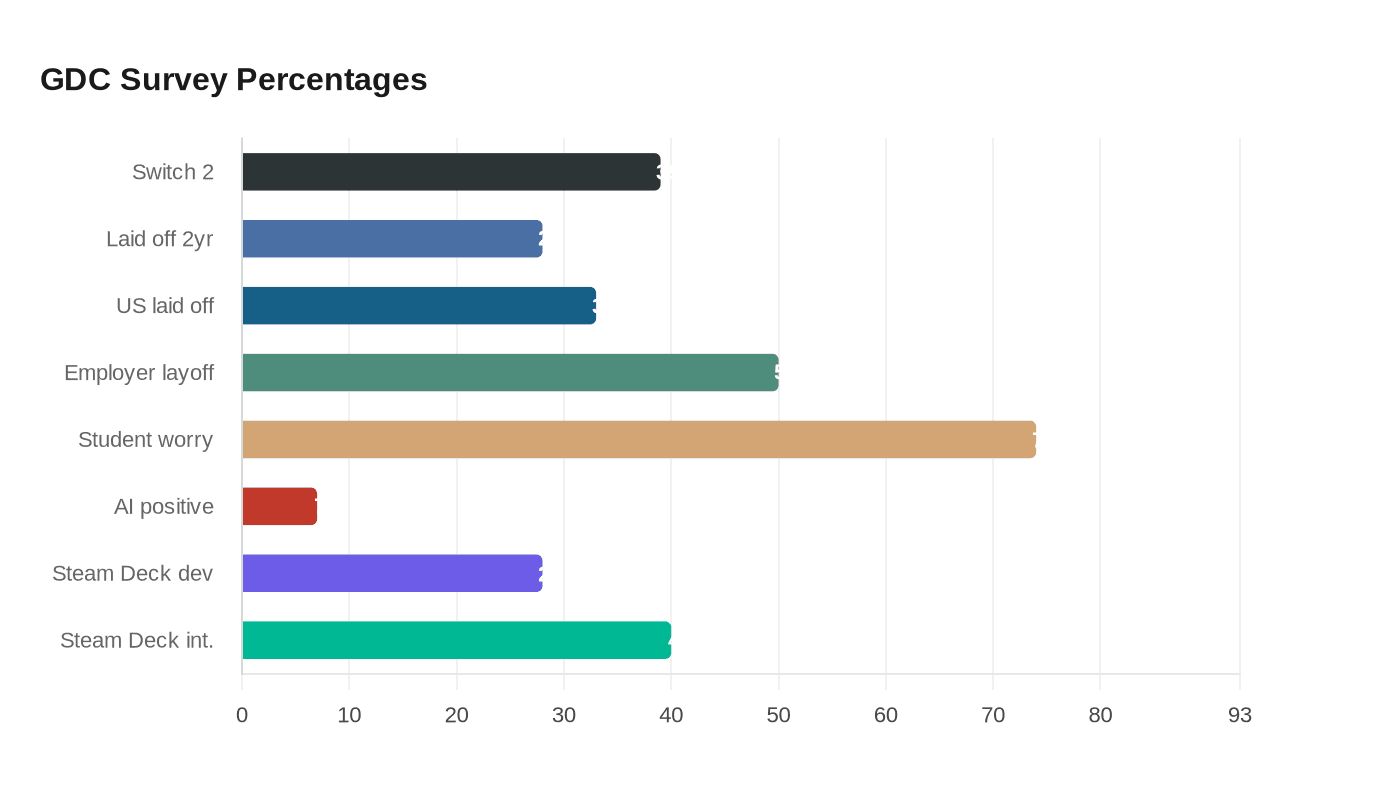
The hardware signal is strong enough to keep attention on Nintendo anyway. Steam Deck was the fourth-most-developed-for platform in the survey, with 28 percent of developers making or optimizing games for it, while 40 percent said they were interested in making games for Valve’s handheld. Switch 2 sits right in that same fight for production time and optimization budgets, which is why the interest number matters for Nintendo’s partner teams as much as for its consumer business.
Nintendo has already turned Switch 2 into a live market question. The company announced the system on April 2, 2025, said it would launch in the United States on June 5, 2025, at $449.99, and paired the reveal with a Mario Kart World bundle. That means the question for Kyoto is no longer whether studios are curious. It is whether that curiosity turns into committed work, and whether Nintendo can use the platform’s momentum to hold onto talent in an industry still shaken by layoffs and wary of what comes next.
This article was produced by Prism’s automated news system from verified source data, official records, and press releases, then run through automated quality and moderation checks before publishing. The system is built and supervised by the people who set the standards it runs under. Read our full AI policy.
Did this article answer your question?