Nintendo Cuts Brazilian eShop Prices, Introduces New Digital Pricing Model
Donkey Kong Bananza dropped R$50 overnight as Nintendo reset its Brazilian eShop conversion rate, cutting prices across all tiers and introducing a new digital-vs-physical pricing model.

Donkey Kong Bananza cost R$50 less on the Brazilian Nintendo eShop when players loaded the storefront Wednesday morning, the most visible sign of a broad repricing that quietly took effect overnight across both the Nintendo Switch and Nintendo Switch 2 catalogs in Brazil and across Latin America.
The cuts reflect a reset in Nintendo's internal dollar conversion rate, now pegged at approximately R$5.48, down from an implied rate of roughly R$6.25 that the company had maintained even as the Brazilian real strengthened steadily through 2025. The USD/BRL rate peaked near R$6.30 at the start of last year before falling to a low of approximately R$5.27 by November, with the full-year average settling at R$5.59, a decline of roughly 12.5% in the dollar's value against the real.
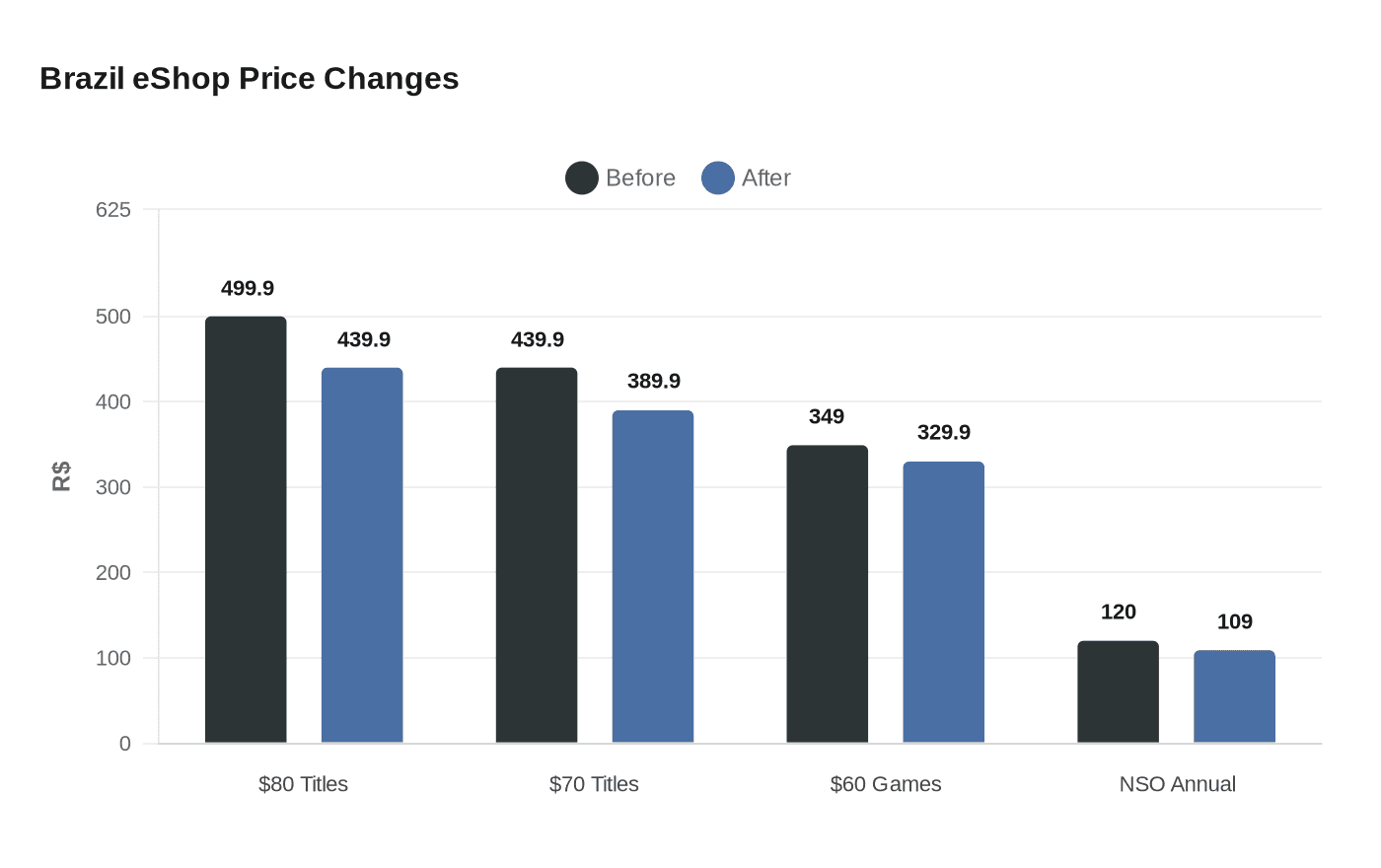
The adjustment cascaded across all major price tiers: $80 flagship titles fell from R$499.90 to R$439.90, $70 titles including Donkey Kong Bananza dropped from R$439.90 to R$389.90, and $60 games moved from R$349.00 to R$329.90. The Nintendo Switch Online annual individual plan also dropped, from R$120 to R$109, with all annual subscription tiers, including family plans and the Expansion Pack, reduced accordingly. For players who had been waiting out the full-price window, the cuts narrow the gap that once made holding off for a seasonal sale the rational choice.
What makes this adjustment structurally significant beyond the per-game savings is a parallel change to how Nintendo will price digital games going forward. Starting with the May 21, 2026 launch of Yoshi and the Mysterious Book, new Nintendo digital titles will carry lower prices than their physical cartridge counterparts. Until now, Nintendo's Brazilian market policy priced physical and digital releases identically; the separation marks a structural shift in how the eShop is positioned regionally.
The repricing arrives at a moment when the affordability gap between Nintendo's standard pricing and Brazilian household economics had become a pressure point. A R$499.90 game represents nearly a third of Brazil's monthly minimum wage of approximately R$1,518 (around $260 USD). Community discussions ahead of the Switch 2's arrival noted that an $80 game would consume roughly 10 times more of a Brazilian average earner's income, proportionally, than it would for a counterpart in the United States.
Nintendo's move also lands as a competitive counter-signal. Sony and Microsoft recently raised game and subscription prices across emerging markets, making Wednesday's reductions a sharp contrast in regional strategy. The timing, with Nintendo's fiscal year closing in March, positions the company to enter a new annual cycle with fresh engagement incentives as Switch 2 adoption builds.
Brazilian gaming commentator Daniel Reen flagged a critical open question: whether Nintendo will hold the R$5.48 conversion rate steady across all game tiers as Switch 2 flagship titles carry price points between $70 and $80. Nintendo Brazil's press office, when contacted, confirmed only the Yoshi and the Mysterious Book pricing as official. The repricing covers all Nintendo-published games already on the eShop, including recent releases Pokémon FireRed & LeafGreen and Pokémon Pokopia, plus active pre-orders. Third-party publishers are expected to apply the same updated conversion in subsequent days, with reseller platforms like Nuuvem also affected by the recalibration.
One benchmark stays out of reach. Despite the across-the-board reductions, the new prices still fall short of the original pricing levels from when the eShop launched in Brazil in 2017. How far Nintendo moves toward closing that gap will depend on whether the R$5.48 rate holds as the Switch 2 catalog expands.
Know something we missed? Have a correction or additional information?
Submit a Tip