Valve’s Steam Controller design offers Nintendo a lesson in hardware trust
Valve’s controller story shows that hardware trust is earned in millimeters, not slogans. Nintendo teams know the same lesson: comfort, legibility, and repeatability are design decisions, not luck.
Hardware trust starts with the smallest decisions
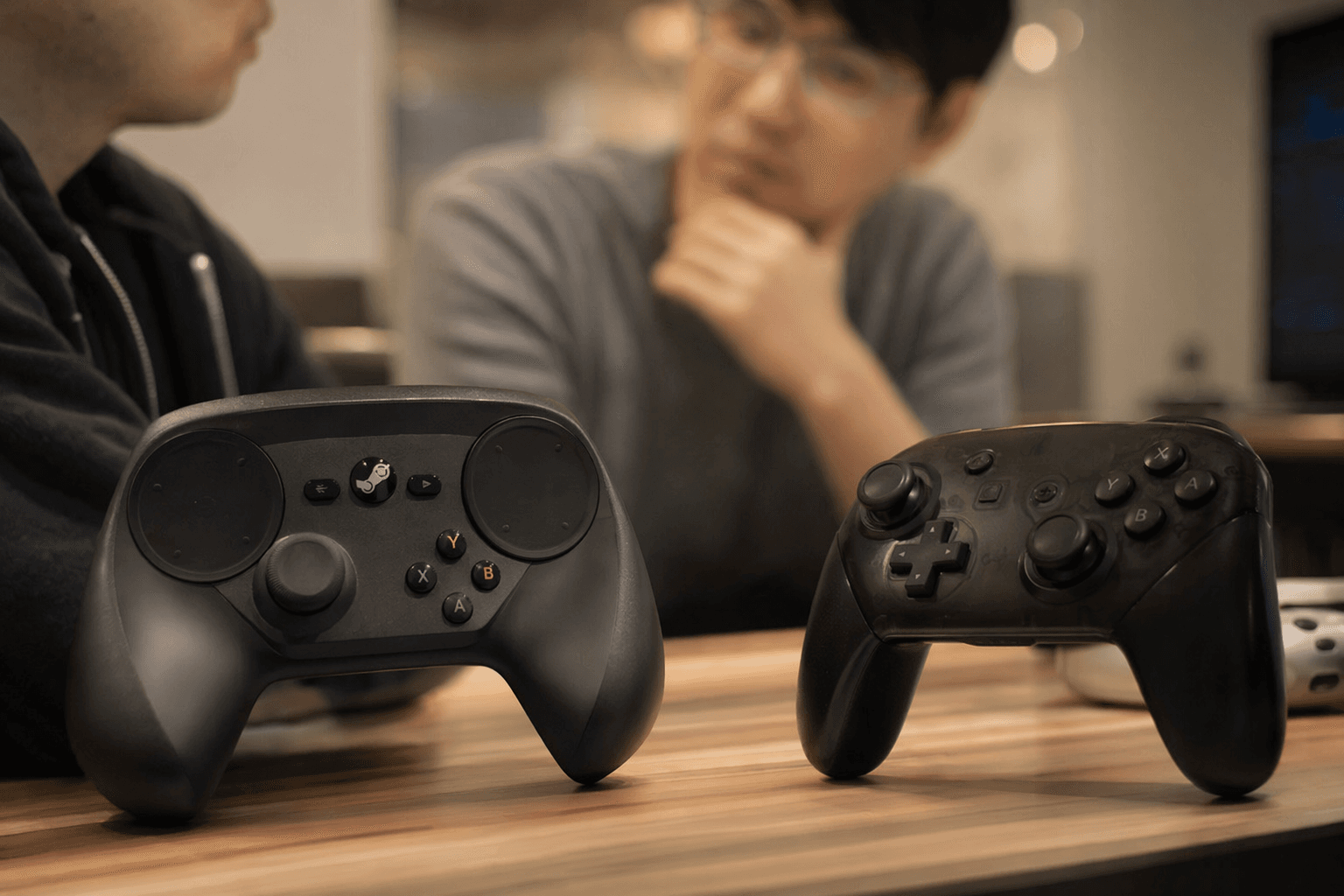
Valve’s Steam Controller story is useful precisely because it treats feel as an engineering outcome. The hardware did not succeed, or stumble, because of one grand idea. It succeeded or stumbled in the smaller places, where button shape, stick placement, trigger resistance, grip angle, and the relationship between the hand and the shell decide whether a controller disappears in use or becomes the thing players notice every minute.
That is the core lesson Nintendo workers should keep in view. A controller is not just a sketch approved by industrial design or a feature list signed off by product management. It is a promise that the player can understand it instantly, hold it for long sessions, and trust it under real living-room conditions.
Valve’s first Steam Controller was bold, but it had to earn comfort
Valve released the original Steam Controller on November 10, 2015, and discontinued it in November 2019. The idea behind it was unusually ambitious: Valve’s store page framed it as a way to play the entire Steam library on TV, including games that were never designed with a controller in mind. That meant the device had to bridge two worlds at once, the familiar console gamepad and the broader PC library.
The early reaction captured the tension well. IGN said the controller was comfortable once you got past some initial awkwardness, while PCMag described it as innovative but still a work in progress. That is the kind of split verdict hardware teams should study closely, because it signals a design that impressed people intellectually before it fully won them physically.
The details that mattered were not cosmetic
One of the most revealing details in Game Developer’s design feature is the placement of the Steam Controller’s rear buttons. They sit under the curve of the grip, near where many players’ middle and ring fingers naturally rest. That is not a flashy gesture. It is a small, deliberate alignment between anatomy and interface, and it is exactly the sort of decision that can make a device feel intuitive before a user has memorized its layout.
This is where Valve’s “it just works” philosophy mattered. Not because the phrase is magical, but because the controller had to make its unusual control scheme feel seamless on day one. In hardware, the last few percent of polish often live in the places that are easiest to dismiss during planning and hardest to recover later.
Why Nintendo should read this as a QA story, not just a design story
Nintendo’s own controller history shows the same pressure in a different form. Joy-Con specifications list a weight of 52.1 g for the left unit, battery life of about 20 hours, and charging time of about 3.5 hours. Those are not abstract numbers. They shape how a controller feels in a hand, how long it stays trustworthy in a session, and how much friction appears once the system is in a living room rather than a spec sheet.
Nintendo support materials also stress correct Joy-Con orientation and attachment. That emphasis says something important: good hardware has to be self-explanatory as well as functional. If players can misread how to hold it, attach it, or pair it, the product has already lost some of its authority before gameplay starts.
That is where QA crosses from bug hunting into usability discipline. A controller can be technically working and still fail in practice through fatigue, confusion, or a mismatch between what the hardware promises and what the player perceives. The 2020 academic study on Switch controller configurations reinforced that point by noting discomfort during extended use, which turns ergonomics from a side issue into a core design variable.
The lesson for Nintendo is about trust, not novelty
Valve’s Steam Controller is not a simple success story, and that is what makes it valuable. Its first version was praised for precision, criticized for awkwardness, and eventually retired in 2019. Valve then announced a new Steam Controller in November 2025 alongside a new Steam Machine and Steam Frame, which shows that hardware ideas can return only after the underlying feel story is strong enough to try again.
Nintendo works in a space where players carry a long memory of what a controller should feel like. By 2015, many people already knew the shape of confidence in their hands, so any deviation had to prove itself immediately. That makes the bar for Nintendo especially high, whether the topic is Joy-Con ergonomics, accessory compatibility, or how a system communicates input affordances on first boot.
The practical takeaway is straightforward. Hardware trust is earned through repetition, through repeated small engineering decisions that make a product legible, teachable, and resistant to user error. When that work is done well, players stop thinking about the device and start thinking about the game, which is exactly where a great controller belongs.
Know something we missed? Have a correction or additional information?
Submit a Tip