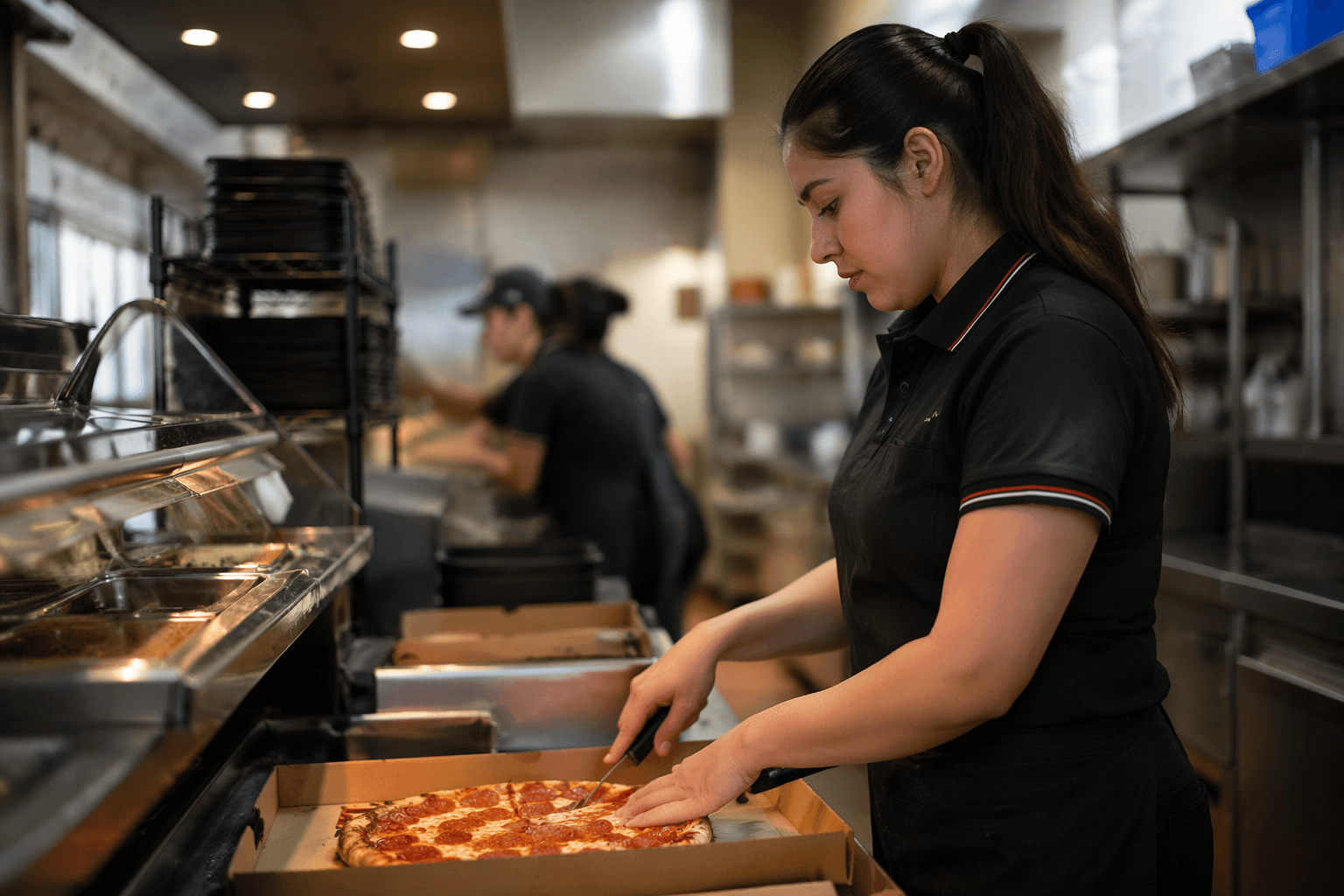
EEOC guide reminds Pizza Hut to balance ADA accommodations and safety rules
Pizza Hut workers can ask for real fixes, from stools to schedule changes, while managers still protect food safety and document the process.
Why the EEOC guide still matters at Pizza Hut
A Pizza Hut crew member who cannot stand through a full shift, lift heavy boxes, or keep up with a noisy rush does not have to treat that as the end of the job. The EEOC’s restaurant guide was built around a simple point: food-safety rules and the ADA can be followed at the same time, and employers still have to consider reasonable accommodations for qualified people with disabilities. Even though the EEOC later marked the restaurant guide as rescinded as part of keeping guidance current, accurate, and clear, the day-to-day playbook it points to still fits the realities of pizza shops, delivery routes, and late-night shifts.

For Pizza Hut, that matters because the work is physical, fast, and often short-staffed. A driver who relies on tips and mileage, a line cook working a hot station, or a host taking orders at the front counter can all run into different barriers. The question is not whether the worker can do every task exactly the old way. The question is whether the essential duties can still be done safely, with a practical adjustment.
What reasonable accommodation can look like on the floor
EEOC guidance says reasonable accommodation can change the application process, the way a job is performed, or other parts of the job such as training or benefits, so long as the person can still perform the central duties of the role. In restaurant settings, that can mean job restructuring, leave, modified or part-time schedules, modified workplace policies, reassignment, and other accommodations.
At Pizza Hut, that can turn into very ordinary fixes:
- A stool for a host, counter worker, or cashier who cannot stand for long stretches.
- A modified training format for a new hire who needs written instructions, extra repetition, or a slower pace.
- A schedule change for a crew member whose medical treatment limits late nights or doubles.
- Lifting restrictions that shift a worker away from stock runs, dough bags, or drink cases and toward tasks that fit the restriction.
- Communication support, such as a better headset, written backup instructions, or a quieter assignment for someone who struggles to hear in a loud kitchen or drive-thru area.
The important point is that the accommodation should help the person do the job, not erase the job. EEOC guidance makes clear that the employee still has to be qualified and able to handle the essential functions of the role, with or without the accommodation. That distinction is what keeps the conversation practical instead of adversarial.
What to say when you need help keeping the job
The fastest way to lose time is to wait until a problem becomes a write-up. If a standing limit, lifting restriction, hearing issue, or treatment schedule is making the job harder, raise it early and clearly. You do not need a dramatic explanation. You need a plain description of what part of the job is difficult and what change would let you keep working.
A solid request usually includes four things:
1. The specific task that is creating the barrier, such as long standing, heavy lifting, or constant verbal communication in a loud environment.
2. The adjustment that would help, such as a stool, shorter shifts, rotated duties, a different station, or a modified training schedule.
3. Any medical note or supporting paperwork the employer asks for, if needed to confirm the limitation.
4. A written record of when you made the request and who received it.
For a driver, that might mean asking for a temporary change in delivery assignments, a lighter load, or a schedule that avoids the most physically demanding rushes while treatment is underway. For a kitchen crew member, it might mean moving off stock or prep duties that involve repeated lifting. For a counter or headset role, it might mean switching to written order backup or a headset with better audio support.
If the request is made verbally, follow up in writing. Keep it short, keep it factual, and keep a copy. In a franchise system, local managers often control the day-to-day schedule, so a paper trail helps if a request gets passed around or slows down.
How managers should handle the request without creating conflict
EEOC small-business guidance recommends identifying who handles accommodation requests and making sure managers respond promptly and effectively. That is especially useful in restaurants, where a crew member may tell the shift leader, the assistant manager, or the general manager before anyone else. If the store does not have a clear point person, the request can disappear into a shift change.
A good manager response starts with acknowledgment, not judgment. The manager should hear the limitation, ask what task is affected, and move into the interactive process instead of deciding on the spot that the answer is no. The goal is to look for a workable adjustment, document the conversation, and keep the worker updated if the process takes time.
That matters in a Pizza Hut kitchen because the environment changes by the hour. A stool might work at the front counter but not on a crowded line. A reassigned task might work on slower shifts but not during a dinner rush. A modified schedule may solve a recovery period without hurting the store’s staffing model. Managers who stay focused on solutions can often keep a worker on the team without creating a scene in front of the crew.
Where safety rules still draw the line
The EEOC’s restaurant guidance was created because food-service employers often wondered how to follow public-health rules while still complying with the ADA. The answer is not that safety gets ignored. It is that safety and access are reviewed together.
That means a manager can still say no to a specific setup if it would break sanitation rules, remove an essential function, or create an undue hardship. The ADA requires reasonable accommodation unless it would cause undue hardship, so the law does not force a store to accept every request in every form. But it does require the store to look for alternatives before closing the door.
For Pizza Hut, that could mean moving a worker to another station rather than forcing a risky task change, or adjusting hours rather than rewriting a whole job. The point is to balance the needs of the business with the reality of the worker’s limitation, not to use food-safety language as a reflexive excuse.
The corporate backdrop matters too
Pizza Hut applicants are told in current job postings that Yum! Brands is committed to providing reasonable accommodation to applicants with disabilities or special needs, and that accommodation can be requested by contacting the nearest location. Yum! also says in its human-rights materials that it wants a work environment that respects, supports, and promotes human rights.
That does not replace the ADA, but it does show the company knows accommodation is part of the workplace conversation from hiring onward. For workers, that means the request should be treated as part of normal operations, not as a personal favor. For managers, it means the safest route is the simplest one: identify the contact person, respond quickly, document the steps, and keep the focus on whether the job can still be done.
In a business where turnover is constant, delivery competition is fierce, and every shift matters, the stores that handle accommodation well will keep more people working. The stores that treat it like a fight will lose time, talent, and trust.
This article was produced by Prism’s automated news system from verified source data, official records, and press releases, then run through automated quality and moderation checks before publishing. The system is built and supervised by the people who set the standards it runs under. Read our full AI policy.
Did this article answer your question?