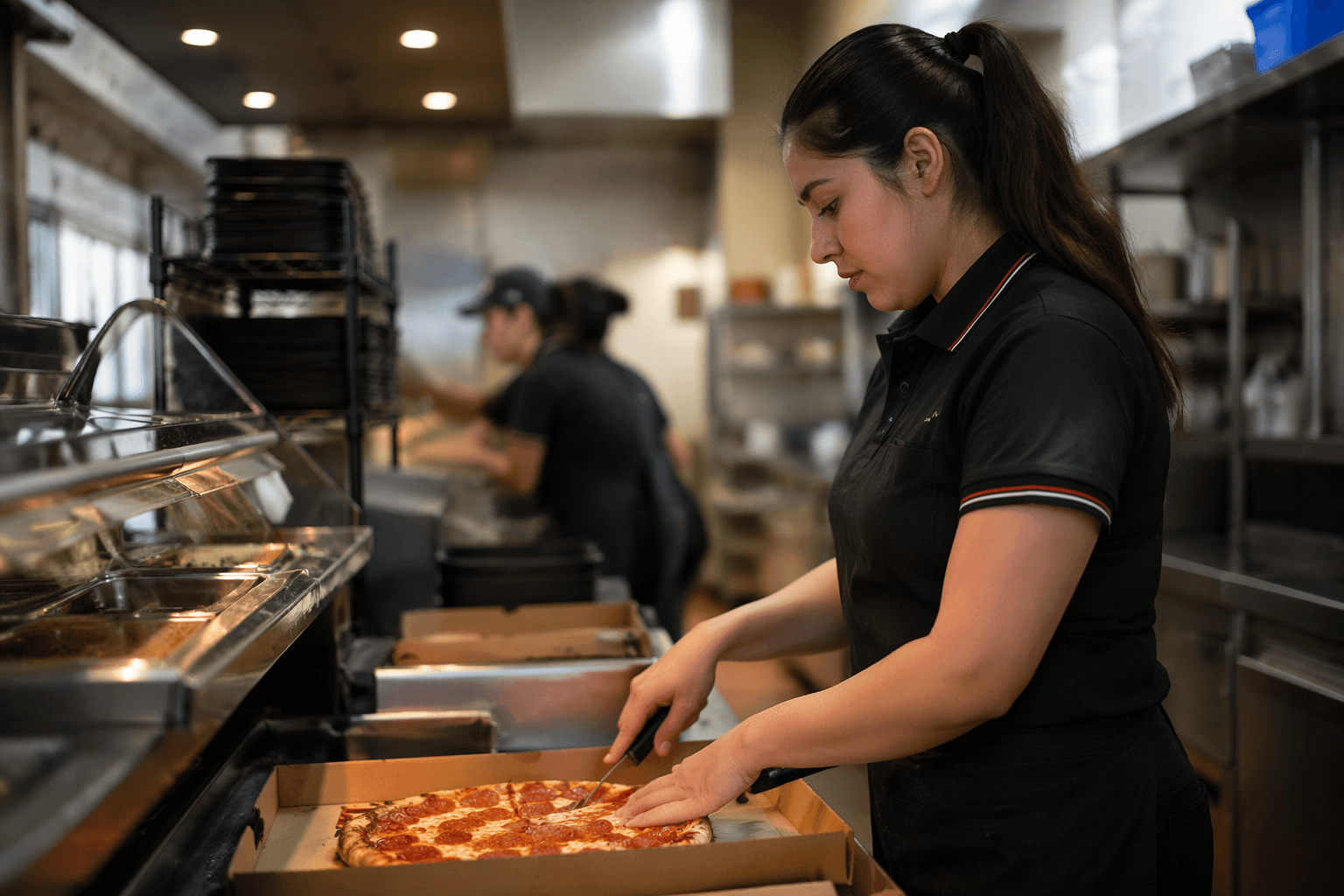
Pizza Hut assistant manager role demands leadership, safety and operations skills
Pizza Hut’s assistant manager role is less about paperwork and more about keeping a store staffed, safe and consistent when the rush hits.

What the job really asks of you
Pizza Hut’s assistant restaurant general manager role in Ashburn, Virginia is a blunt reminder that this job is not just about covering a break or counting a drawer. The posting describes a person who directs shift leaders, trainers and team members, helps run the store’s daily rhythm, and learns how to coach people while keeping the operation steady.
That mix matters because the fastest way a Pizza Hut store gets into trouble is usually simple: a shift opens short, the line gets sloppy, training slips, or a safety step gets missed when volume spikes. The role is built to prevent exactly that. An assistant manager is expected to keep the guest experience stable, solve staffing gaps, and make sure the restaurant stays clean, organized and safe while still pushing the company’s initiatives forward.
Leadership on the floor, not just in the office
The clearest thing the posting shows is that Pizza Hut wants assistant managers who can lead people in real time. That means coaching while orders are flying, correcting standards without slowing the line, and helping shift leaders and trainers do their jobs better the next time the room gets busy. It also means learning to build a bench of key holding managers and team members, not just surviving one shift at a time.
That is why this role is a genuine test of whether someone can move from strong crew member to culture carrier. A good assistant manager does not simply keep themselves afloat; they make it easier for everyone else to perform. In a restaurant system as large and decentralized as Pizza Hut’s, that ability is a competitive advantage. In a bad week, it can be the difference between a store that wobbles and one that keeps its standards intact.
Operations is where the job becomes real
The posting makes clear that the job includes inventory, forecasting and scheduling, which means the work stretches well beyond the front counter. If the schedule does not match demand, the store pays for it in overtime, burnout or bad service. If inventory is off, the line slows down and the team starts improvising instead of executing.
That is why assistant managers have to think like operators. They need to understand when the store will be slammed, where coverage is thin, and how to set up shifts so the team is not constantly reacting. The best assistant managers are often the ones who can spot trouble before it shows up in a ticket time or a missed prep task.
Safety and standards are not side tasks
Pizza Hut says the role is responsible for following training, brand standards, food and driver safety requirements, and employee-handbook policies. That is not window dressing. In a pizza shop, one missed safety step can ripple fast: food quality drops, drivers get exposed to avoidable risk, and the store’s reputation takes the hit.
The emphasis on driver safety is especially important in a delivery-heavy business where the store still has to compete with DoorDash and Uber Eats. That competition raises the pressure to move quickly, but speed without process is where stores get into trouble. An assistant manager has to keep the team focused on doing the basics correctly, because a fast shift that breaks safety or service standards is not a win.
The company tools are part of the job
Pizza Hut also makes the digital side of the role clear. The posting points to internal tools such as Hut Link, Learning Zone and Pizzapedia. Hut Link is an access-controlled portal for authorized employees and franchise system users, and Yum’s login pages make clear that training access is limited to authorized users and business purposes.
That tells you the job is not just learned from experience on the floor. An assistant manager is expected to work inside company systems, use the training tools, and follow the processes that keep a franchise network consistent. In practical terms, that means the people who do best in the role are usually the ones who can pair street-level judgment with the discipline to actually use the tools the company gives them.
Why the franchise structure changes the job
Pizza Hut says it was founded in 1958 and is now the second-largest pizza company in the world, with more than 19,000 restaurants in 108 countries and territories. It also says more than 6,000 locations are in the United States, and that most Pizza Hut restaurants are operated by franchisees.
That matters because assistant managers are not working in a neat corporate vacuum. They are helping protect standards in a huge franchise system where local management decisions carry a lot of weight. The broad brand may look uniform from the outside, but execution depends on the general manager, assistant managers and shift leaders in each store. In that sense, the role is both local and strategic: one bad staffing week or one weak trainer can affect the guest experience immediately, while a strong assistant manager can steady the whole shop.
The pay tells you why the role is a stepping stone, and why it is hard
Indeed’s current U.S. average hourly pay estimate for Pizza Hut assistant managers is $16.42, based on 597 past and present job postings, with a range from $8.25 to $24.80 per hour. That spread says a lot about how uneven the role can be across markets, stores and franchise operators.
It also explains why the job still functions as a stepping stone for many workers. The title can open a path into management, but the pay is modest for a role that carries staffing, training, safety and scheduling pressure. For crew members looking up the ladder, the upside is clear: if you can keep a shift moving, train without gumming up the line, and hold standards under pressure, you are proving that you can lead more than yourself.
What Pizza Hut is really looking for
Pizza Hut’s own history reinforces that the company sees restaurant leadership as a mix of guest experience, financial control, people development and food safety. Its brand story goes back to the Carney brothers borrowing $600 from their mother to start the business in 1958, and that origin story still hangs over the company’s modern management culture: small details, tight operations and people who can make the store work.
The assistant manager role sits right in that tradition. It is not a desk job pretending to be a restaurant job. It is a floor-level leadership role that asks one person to keep staffing aligned, develop future managers, enforce standards and make sure the store does not drift when pressure rises. For some employees, that makes it a stepping stone. For Pizza Hut, it makes the assistant manager one of the main people holding the culture together shift by shift.
This article was produced by Prism’s automated news system from verified source data, official records, and press releases, then run through automated quality and moderation checks before publishing. The system is built and supervised by the people who set the standards it runs under. Read our full AI policy.
Did this article answer your question?