Pizza Hut faces pressure as quality beats speed in pizza wars
Pizza Hut is being squeezed in a market where hot, accurate pizza now matters more than raw speed, and the operators with tighter systems are pulling ahead.

Pizza Hut is fighting in a two-speed market now. Chains with scale, tighter systems, and a clearer value story are pulling ahead, while the middle gets squeezed harder every quarter. For drivers, kitchen crew, and managers, the real shift is simple: the job is no longer just to move fast, but to send out a pizza that arrives hot, accurate, and worth the price.
The new rules of the pizza fight
The Food Institute’s 2026 pizza playbook says quality has become the top driver of delivery satisfaction. Customers are more forgiving of a late order than a cold or off-tasting pizza, which turns a lot of old delivery thinking upside down. In the 2026 Pizza Delivery and Carryout Report from Intouch Insight and PMQ Pizza, Jet’s Pizza scored better on overall satisfaction than Domino’s even though Jet’s average delivery time was much slower, a reminder that speed alone no longer wins the night.
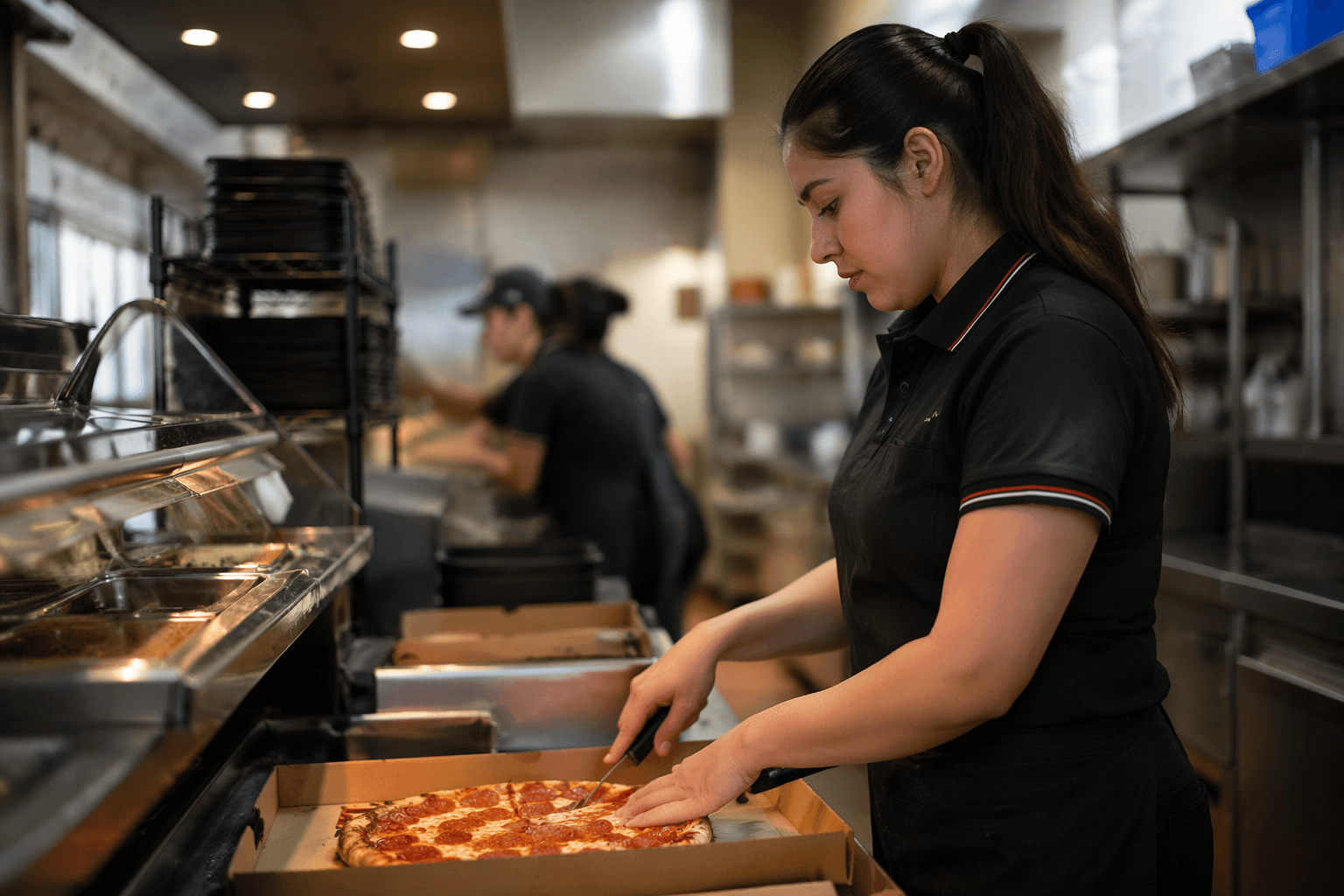
That matters on the floor. A delivery driver can still get blamed for lateness, but the bigger damage often comes from a crushed box, a weak seal, a bad temperature hold, or a handoff that leaves the product sitting too long. For kitchen crews, one sloppy build can erase the advantage of getting an order out quickly in the first place. For managers, the new scorecard is not just labor cost and ticket times, but whether the store is consistently delivering the same hot, intact product every time.
What the winners are doing differently
The brands pulling ahead are not just “faster” in the old sense. They are better at deploying labor where it matters, using technology to keep orders moving without losing accuracy, and keeping the menu disciplined enough that the line does not fall apart under pressure. That shows up in the store as tighter scheduling around peaks, cleaner handoffs between make line and driver, and fewer chances for a custom order to turn into a remake.
Technology, in this market, is less about shiny features and more about control. If the systems help managers see where orders are backing up, where drivers are waiting, and which items are slowing the line, then tech becomes an operations tool instead of a buzzword. The same goes for menu discipline: a store that protects its core items and its execution standards can keep value messaging believable, while a store that leans on discounting without control just trains customers to expect cheap, inconsistent pizza.
For workers, that means the pressure is not evenly distributed. Drivers feel it in the race between delivery time and tip potential. Kitchen crews feel it in the rush when one bad build can ruin a whole run of orders. Managers feel it in the tension between cutting labor and keeping enough people in place to protect quality. In a two-speed market, the operation that looks lean on paper can become the one that bleeds the most on the customer experience.
Why Pizza Hut is under extra pressure
The broader market backdrop is rough. In January 2026, Food Institute said America’s pizza giants were struggling, pointing to Pizza Hut’s identity crisis and Domino’s market stagnation woes. The same report said several pizza chains filed for bankruptcy in 2025, including Pieology Pizzeria, Anthony’s Coal Fired Pizza & Wings, and Bertucci’s Brick Oven Pizza & Pasta. It also noted that California Pizza Kitchen sold itself to an investor group for less than $300 million, far below the $470 million price cited when it went private in 2011.
That kind of churn matters because it shows how unforgiving the category has become. Pizza is still popular, and Technomic says it remains one of the most craveable foods in foodservice, but popularity does not automatically translate into healthy unit economics. If a chain cannot defend quality, explain its value clearly, and execute consistently across stores, the market punishes it quickly.
For Pizza Hut, that leaves a narrow path. The brand cannot rely on nostalgia alone, and it cannot assume discounting will fix a weak operation. Promos can drive traffic for a weekend, but if the pizza comes out lukewarm, inconsistent, or late enough to annoy the customer, the value story collapses the moment the box is opened.
The corporate backdrop behind the pressure
Pizza Hut’s struggles are also playing out inside Yum! Brands. On November 4, 2025, Yum! said it had launched a formal review of strategic options for Pizza Hut, saying the brand needed additional action to realize its full value and that the review may be better executed outside Yum! Brands. The company said it retained Goldman Sachs and Barclays as advisers and did not set a deadline for the process.

Yum! said the review was meant to help Pizza Hut reach its full potential for franchisees, consumers, and employees, while also maximizing shareholder value. That language matters for people inside the system because it signals that the brand’s problems are not being treated as a short-term sales dip. They are being treated as a structural question about what Pizza Hut should be, how it should compete, and whether the current setup can still support growth.
Yum! also said it operates more than 62,000 restaurants in more than 155 countries and territories across KFC, Taco Bell, Pizza Hut, and Habit Burger & Grill. Against that scale, Pizza Hut cannot afford to be the brand that drifts into the middle of the market and gets squeezed from both sides.
Carryout, delivery, and the next test
The competitive pressure is not just coming from inside Pizza Hut. On March 2, 2026, Restaurant Business said Papa Johns and Pizza Hut were both facing challenges, and that the fast-food pizza market had stagnated over the prior two years. The report said inflation was making customers cut back on pizza occasions and that third-party delivery had taken a bite out of demand, while Domino’s held up better because it did a stronger job courting carryout customers.
That shift has real workplace consequences. If more guests move to app-based ordering and away from traditional delivery occasions, the mix of work changes for drivers, the pace changes for the kitchen, and the pressure on local managers changes with it. The brands that win in that environment are the ones that can make every order feel dependable, whether it is carried out, delivered, or ordered through a marketplace app.
The bottom line is blunt: Pizza Hut is not just fighting for market share, it is fighting for relevance in a category where quality now beats speed more often than not. The stores that pull ahead will look organized, consistent, and worth the price. The stores getting squeezed will look busy but brittle, with promotions doing the heavy lifting for an operation that cannot quite hold up its end of the bargain.
This article was produced by Prism’s automated news system from verified source data, official records, and press releases, then run through automated quality and moderation checks before publishing. The system is built and supervised by the people who set the standards it runs under. Read our full AI policy.
Did this article answer your question?