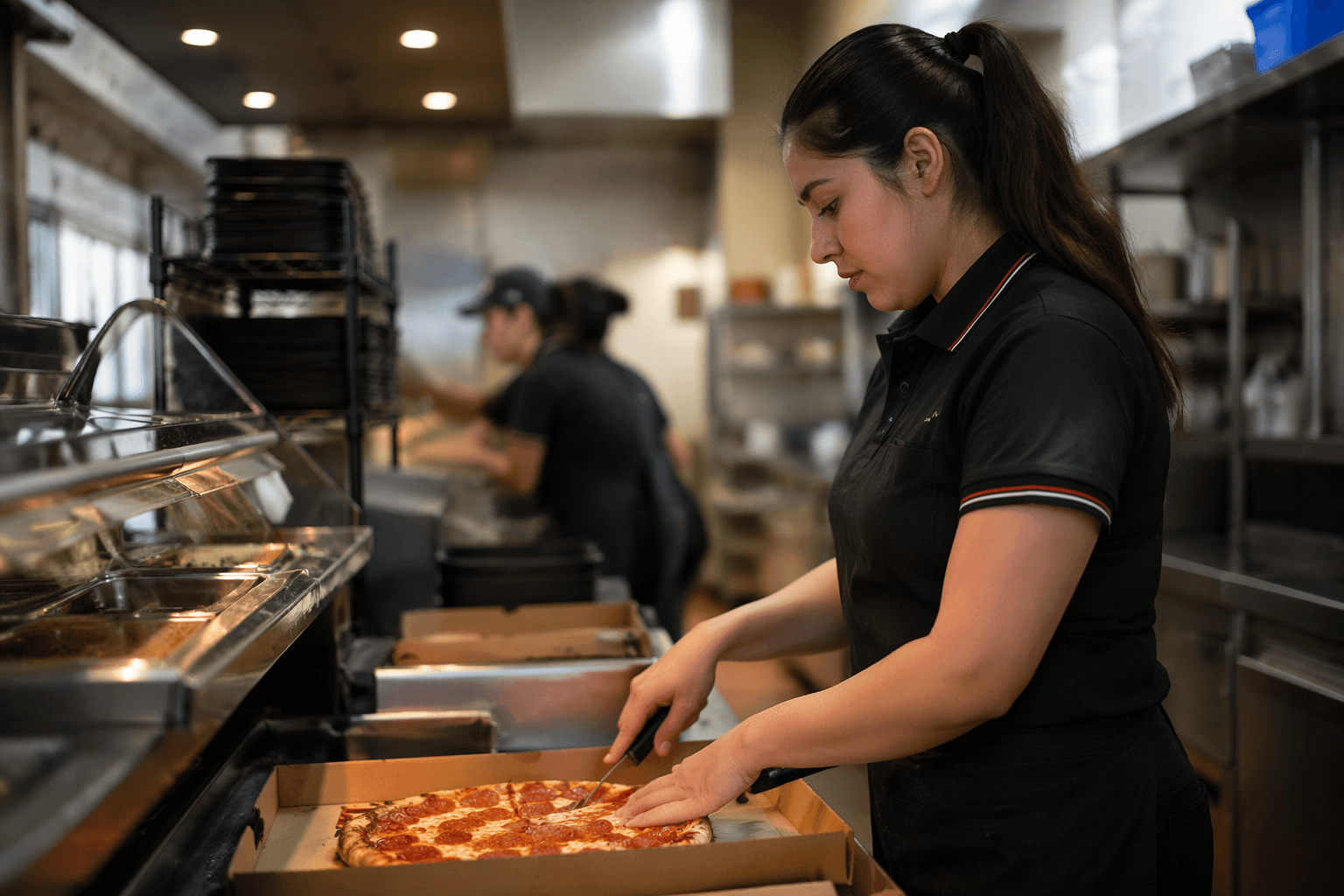
Pizza Hut faces pressure to rethink late-night hours as family dining shifts daytime
Pizza Hut’s late-night bet is colliding with weaker traffic, rising labor costs, and a chainwide reset, turning closing time into a profit decision for managers.

The fastest way a Pizza Hut store gets into trouble is by staying open for a few customers after the rush while labor, utilities, and management attention keep running. What used to look like good service can turn into a bad close if the last hours do not generate enough contribution to cover the shift.
Why the closing hour now matters more
Pizza Hut is being pushed to answer a simple question that many operators avoid until the P&L forces it: when does being open stop paying for itself? Technomic’s 2026 Top 500 Report said chain restaurant sales still topped $450 billion in 2025, but family-dining chains serving breakfast, lunch, and dinner posted average sales declines of 0.3 percent, while breakfast-and-lunch-only concepts grew 11.6 percent. That gap matters because the growth is concentrating in formats that close earlier, run leaner labor models, and turn tables faster.

For Pizza Hut managers, the takeaway is not abstract. Late-night service only makes sense if the final hours are still producing enough delivery and carryout volume to justify the staff on hand, the ovens running, the driver schedule, and the manager tied to the store. If traffic after 8 p.m. is thin, the store may be spending more to remain open than it brings in.
The numbers behind Pizza Hut’s reset
Pizza Hut already made a different bet when it announced in October 2023 that thousands of U.S. locations would stay open until midnight or later, with some open until 2 a.m., to capture late-night demand and lift delivery and carryout sales. That strategy made sense in a brand built around convenience and a younger late-night customer base. It also made sense in a market where pizza competes with DoorDash and Uber Eats for the same impulse orders.
Now the chain is under pressure to rethink that promise. Yum! Brands launched a formal review of strategic options for Pizza Hut on Nov. 4, 2025, and in February 2026 said about 250 U.S. restaurants would close in the first half of the year as part of the reset. Trade reporting also showed Pizza Hut’s U.S. system sales fell 7 percent in 2025 and same-store sales fell 5 percent, while the company wrote off $5 million in franchise incentive assets tied to rationalizing the estate.
That combination is the real warning sign for operators. When corporate is reviewing the brand, closing weaker restaurants, and writing off incentives, local managers should assume that every extra hour of operation will be measured more sharply than before.
What a Pizza Hut GM should watch before cutting hours
A smart cut is not about shutting the doors early on instinct. It is about reading the store’s daypart economics with enough discipline to know when the late shift has crossed the line from coverage to drag.
Watch these signals closely:
- Sales after 8 p.m. stop covering the crew. If the last two or three hours cannot pay for the scheduled labor, that is not a quiet night, it is a margin leak.
- Driver miles and wait times rise while orders stay flat. Late-night delivery can look busy on the screen even when each run is less profitable than it appears.
- The closing manager is spending more time managing leftovers than sales. When the final hour becomes reset work instead of revenue work, the store is paying management wages for housekeeping.
- Utilities and equipment run for a weak trickle of demand. Ovens, lights, HVAC, and make-line labor do not get cheaper just because the dining room is empty.
- Teen-worker scheduling gets awkward. Late hours can create extra compliance risk if a store is juggling minors, overtime mistakes, or exemption errors at the end of a long shift.
If those signals show up together, the issue is not just whether customers want pizza at night. It is whether the store can justify the full cost of staying open for them.
How shorter hours can protect the business, not shrink it
The best case for earlier closes is not austerity. It is redeploying labor to the hours that actually sell pizza. A store that trims weak late-night coverage can protect staffing, reduce burnout, and keep labor dollars available for the lunch and dinner peaks that matter most.
That can also improve service quality. When a team is not stretched thin into the overnight hours, the kitchen can start the next day cleaner, the driver pool can be more reliable, and the manager can spend more time on coaching than on emergency coverage. In a franchise system, that matters because local management often feels every bad hour immediately, while the corporate benefits of a late-night promise are less visible to the people closing the store.
The lesson from the broader market is that limited-hour concepts often win because they are simpler to run. They offer a cleaner value proposition, a tighter labor footprint, and fewer chances for the schedule to drift into unprofitable coverage. Pizza Hut does not need to become a breakfast chain to learn from that model. It only needs to decide which hours are worth staffing at a full cost.
What the brand’s history says about this moment
Pizza Hut was founded in 1958 in Wichita, Kansas, by brothers Frank and Dan Carney, who started what they thought would be a small pizza joint at the corner of Bluff and Kellogg. That origin story matters because the brand has always been about a local store serving a neighborhood need. The business later grew into a global chain with a much heavier reliance on delivery and carryout, which made late-night expansion seem like a natural extension of the model.
But a brand built on convenience still has to match its hours to demand. As family dining shifts toward daytime and faster service, Pizza Hut’s strongest move may be to treat closing time as a strategic lever, not a fixed promise. The stores that survive the reset will be the ones that use hours, staffing, and daypart focus to protect the shifts that actually make money, while refusing to subsidize the ones that do not.
This article was produced by Prism’s automated news system from verified source data, official records, and press releases, then run through automated quality and moderation checks before publishing. The system is built and supervised by the people who set the standards it runs under. Read our full AI policy.
Did this article answer your question?