Pizza Hut franchisees face slower growth amid high rates and soft traffic
High rates and softer traffic are making Pizza Hut franchisees slower to hire, remodel and expand. The real pressure is at store level, where every dollar now has to prove a quick return.
Franchising is still growing, but Pizza Hut teams are operating in a much tighter market
The fastest way a Pizza Hut store gets squeezed is when capital gets expensive and traffic goes soft at the same time. That combination is already changing how franchisees think about hiring, delivery staffing, remodels and whether a local market can support one more store or one less.

The big franchise picture still looks positive on paper. On Feb. 5, 2025, the International Franchise Association projected franchising would add more than 20,000 new units and 210,000 jobs in 2025, with total U.S. franchise units reaching 851,000 and output topping $936.4 billion. But the same outlook also acknowledged economic uncertainty, inflation and interest-rate pressure, and that is the part Pizza Hut managers feel first, long before any corporate presentation turns cautious.
Why the growth story has gotten harder to trust
For Pizza Hut, the slowdown is not an abstract macro story. When borrowing costs stay high, aspiring franchisees have a harder time buying in, existing operators have a harder time refinancing, and everyone becomes more selective about where they spend. That usually shows up in the same places across the store: slower hiring, delayed training, fewer hours, postponed equipment upgrades and more hesitation around local marketing that is supposed to boost traffic.
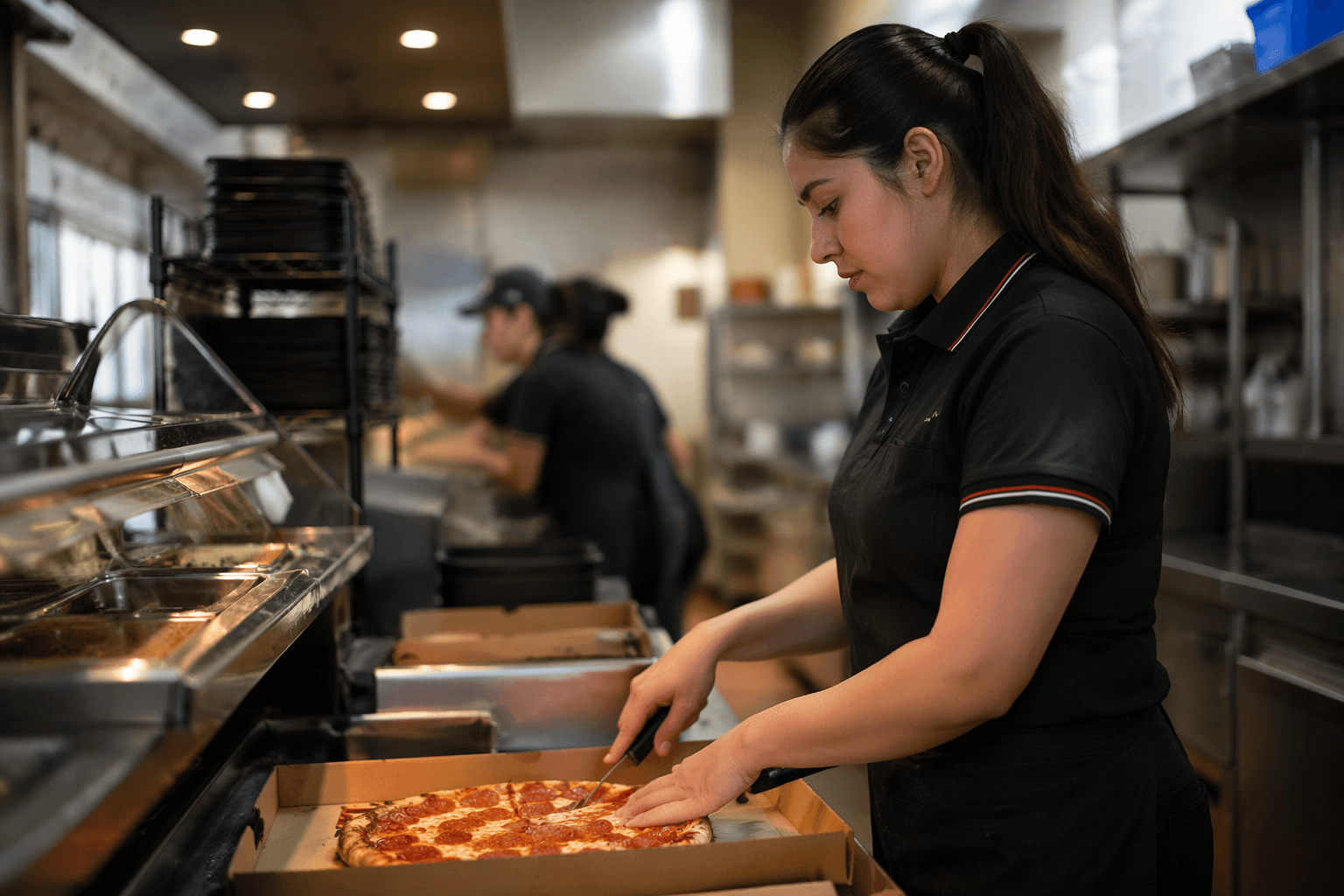
Traffic itself has also become more fragile. Operators are taking pricing customers are not always willing to accept, which means the old assumption that higher menu prices will automatically cover labor and food costs is no longer safe. In a Pizza Hut dining room, on the make line or in the delivery dispatch flow, that means managers have to watch every labor decision twice, because one weak Friday night can erase the margin from several decent shifts.
There is one possible upside in a softer labor market. Layoffs in white-collar jobs could create a pool of workers who may be more open to franchising or restaurant careers, which matters for future general managers, district leaders and multi-unit operators. Still, that is a long-term gain, not an immediate fix, and it does little for a franchisee trying to make this month’s payroll work.
Pizza Hut is feeling the pressure inside a huge franchised system
Pizza Hut is not a company that can absorb a slow franchise market quietly. Yum! Brands said on Nov. 4, 2025, that it had begun a formal review of strategic options for Pizza Hut, saying the goal was to help the brand reach its full potential for franchisees, consumers and employees. Yum! also said Pizza Hut has strengths, including deep consumer love, a global footprint and a growing technology platform, but acknowledged ongoing business and category challenges.
That review matters because Pizza Hut sits inside a very large system. Yum! said it operates more than 62,000 restaurants in more than 155 countries and territories, through brands that depend on roughly 1,500 franchisees. In its 2024 annual report, Yum! said system-wide restaurant count surpassed 61,000 globally, with $7.549 billion in total revenues and $2.403 billion in operating profit. That is a reminder that Pizza Hut’s local economics are never just local; they ripple through a giant franchise network.
For store teams, the practical effect is easy to see. If a franchisee is worried about access to capital or the pace of new openings, they get conservative fast. That can mean tighter labor models, slower adoption of new ordering tools, smaller marketing budgets and fewer reinvestment dollars for aging stores that need new counters, ovens, dining-room work or delivery infrastructure.
Pizza Hut’s own footprint shows why caution runs deep
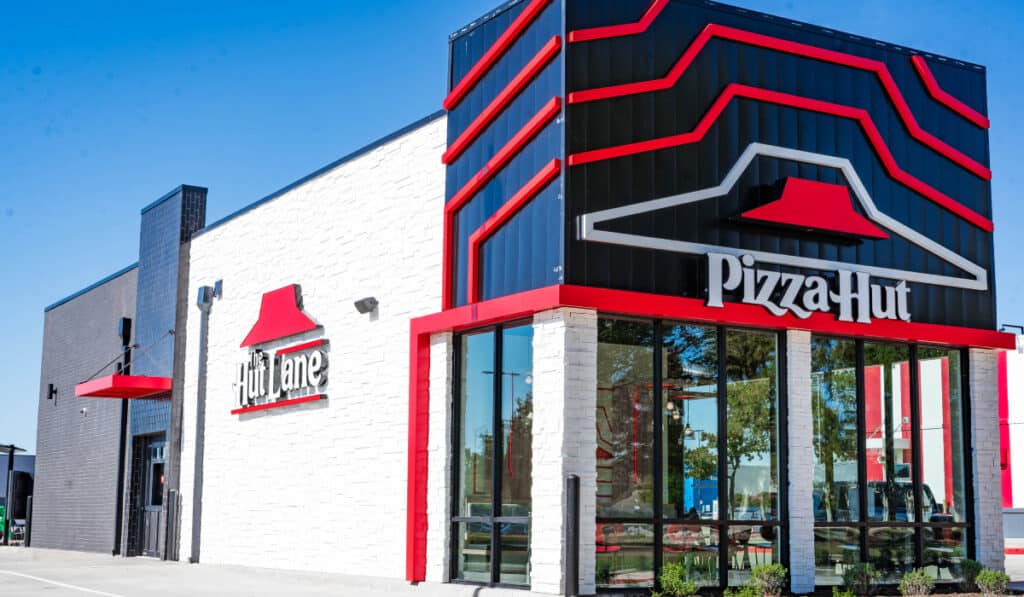
Pizza Hut has already been living through a long transformation, and that history makes today’s slowdown more consequential. In 2019, Yum! launched a $130 million transformation agenda aimed at moving the brand away from legacy dine-in, Red Roof restaurants and toward smaller delivery-and-carryout formats. At the time, investors were told the U.S. store count could fall as low as 7,000 during the shift, and close to 90% of the business was already flowing off-premises.
The transition has not been painless. According to PMQ Pizza, Pizza Hut’s U.S. footprint stood at 6,474 restaurants at the end of Q1 2025, down 83 locations year to date. The chain also had 13,312 international units, for 19,786 total restaurants globally, and 19,763 of those locations were franchised. PMQ also reported that Pizza Hut’s U.S. footprint had declined by 1,085 locations from Yum!’s 2019 transformation outline through Q2 2025.
The past few years underline how disruptive that reset has been. PMQ reported that in 2020, Pizza Hut shuttered 1,745 restaurants globally and opened 682, ending the year with 17,639 locations worldwide. That is the kind of shakeout that teaches franchisees to be cautious, because it shows the brand can grow and shrink quickly depending on the economics in each market.
What this means at store level, right now
For delivery drivers, kitchen crew and managers, the real story is not whether franchising is healthy in the abstract. It is whether the store has enough stable volume and enough cheap enough capital to keep hours, service and morale from slipping. When financing is expensive and traffic is uneven, franchisees have less room to make mistakes, and that usually tightens everything from driver schedules to training time for new hires.
It also changes how local competition feels. Pizza Hut stores are not just fighting the store down the street, they are fighting the expectations set by DoorDash, Uber Eats and other app-driven delivery habits that train customers to compare fees, speed and convenience in real time. If a franchisee pulls back on labor or marketing, drivers can feel it in fewer shifts and thinner tip pools, while the store feels it in slower tickets and weaker repeat traffic.
What matters now is discipline. Every operational change has to earn its keep, whether it is a staffing adjustment, a new ordering tool or a menu push designed to bring in more orders without blowing up the labor budget. Pizza Hut can still grow, but the era of easy growth is over, and the brands and operators that survive it will be the ones that treat each store like a capital decision, not just a sales unit.
This article was produced by Prism’s automated news system from verified source data, official records, and press releases, then run through automated quality and moderation checks before publishing. The system is built and supervised by the people who set the standards it runs under. Read our full AI policy.
Did this article answer your question?