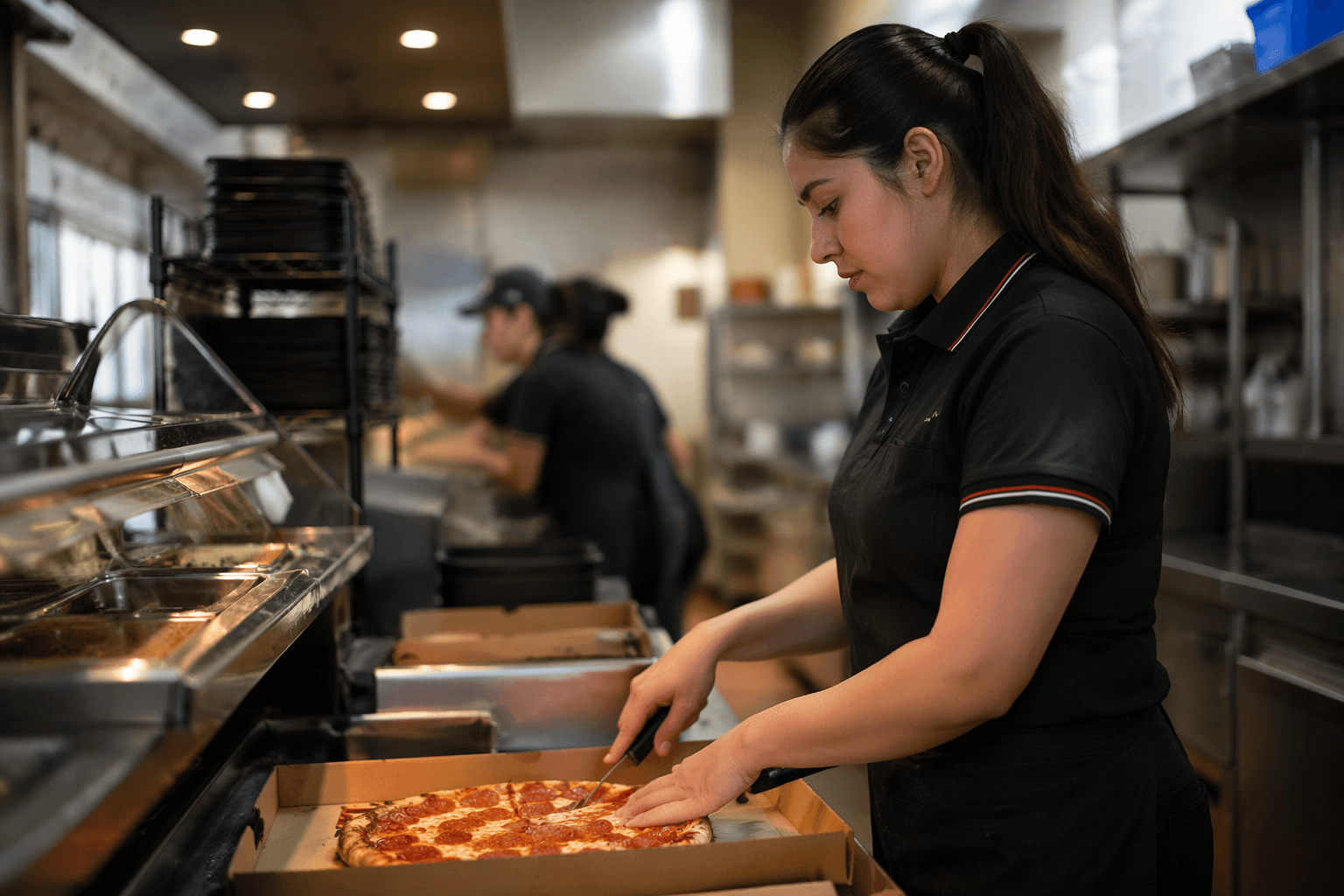
Pizza Hut managers must win workers back, one shift at a time
Pizza Hut’s labor fight is now about the daily shift: predictable schedules, real coaching and a believable path up, not just more job ads.

Pizza Hut operators are competing for workers in a market that no longer behaves like the old restaurant pipeline. The industry employed 15.7 million people in 2026, or about 10% of the U.S. workforce, yet eating and drinking places were still only 71,400 jobs above their February 2020 peak and full-service restaurants were 193,000 jobs below pre-pandemic levels in March 2026. That gap is why a store’s biggest advantage is no longer just a sign on the door. It is whether a shift feels stable, respectful and worth coming back to.
That matters inside Pizza Hut because the chain has long depended on the same labor pools now under pressure from gig work, population shifts and immigration uncertainty. DoorDash and Uber Eats offer the kind of flexibility many drivers want. A Pizza Hut store that cannot match that flexibility with predictable schedules, quicker problem-solving and better treatment on the floor will lose people, especially in markets where franchise owners are all chasing the same cooks, drivers and shift leads.

The National Restaurant Association says restaurants remain the nation’s second-largest private-sector employer and expected the industry to add about 200,000 jobs in 2025, reaching 15.9 million workers. Even so, the staffing shortage is still structural. In 2025, operators needed to fill nearly 900,000 open jobs each month. That is the backdrop for Pizza Hut’s own hiring push in September 2021, when the company and its franchisees said they wanted 40,000 new permanent team members, mostly cooks and drivers.

The lesson from Pizza Hut’s own leadership is that retention is personal. Chequan Lewis, the company’s chief operating officer, said restaurants need a “culture of belonging” and “pathways for something more” to keep employees. For a delivery driver or line cook, that means a manager who knows who shows up early, who handles pressure and who needs a shot at more hours, better routes or a promotion. It also means training assistant managers to recognize effort, not just correct mistakes.
The labor pool itself is changing. Nearly one-half of U.S. adults say their first regular job was in restaurants, and operators report that roughly one in four openings were filled by people for whom it was their first regular job. Restaurants remain the largest employer of teenagers, with 1.9 million 16- to 19-year-olds working in the industry in 2024, and 1 in 3 employed teens working in restaurants. Yet teen labor-force participation fell from 52% to below 35% between 2000 and 2010, leaving about 2.5 million fewer teenagers in the workforce. That shortage has made every good first-job experience more valuable.
Immigration adds another layer. The NRA says immigrants make up over 20% of restaurant and foodservice workers, and nearly 1 in 4 current restaurant workers were born outside the United States. With that much of the workforce in motion, Pizza Hut stores cannot afford the old assumption that someone will stay because it is an entry-level job. The stores that win will be the ones that make each shift feel organized, human and worth repeating.
This article was produced by Prism’s automated news system from verified source data, official records, and press releases, then run through automated quality and moderation checks before publishing. The system is built and supervised by the people who set the standards it runs under. Read our full AI policy.
Did this article answer your question?