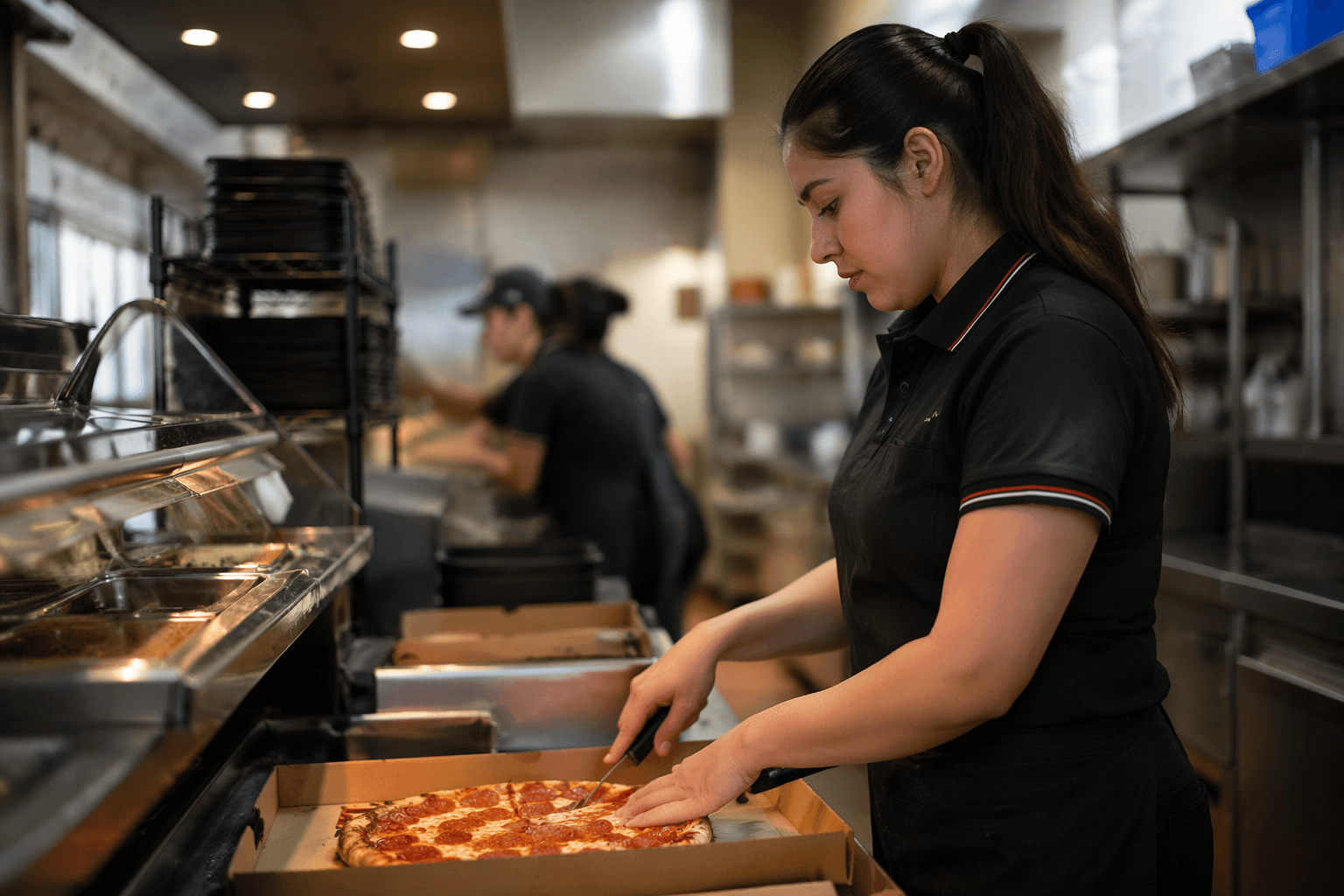
Pizza Hut workers have federal rights to discuss wages, organize together
Pizza Hut workers can talk pay, hours, safety, and unions together, and federal law backs them. Recent NLRB cases show those rights are already in play.

Pizza Hut workers do not need permission to talk together about wages, schedules, safety, or the way a store is run. Federal labor law gives most private-sector employees the right to join together to improve working conditions, with or without a union, and that protection applies whether the store is unionized or not. For a franchise chain where staffing, tips, and local operator pressure shape daily life, that right matters on the floor, not just in theory.
What the law protects inside a Pizza Hut store
The National Labor Relations Act was enacted in 1935 to protect employees, encourage collective bargaining, and curb private-sector labor and management practices that can harm the general welfare. The National Labor Relations Board says that most private-sector workers are covered, and that includes the people taking orders, making pies, delivering food, and closing the line at a Pizza Hut store.
That protection is broader than many workers realize. The Board says employees can talk with coworkers about wages, benefits, and other terms and conditions of employment, and they can also act together to raise complaints or seek help. In plain shop-floor terms, that can mean comparing hourly rates, pushing back on cut hours, or trying to get a manager to address a chronic understaffing problem before the dinner rush becomes unmanageable.
What concerted activity can look like on the shift
The NLRB’s guidance is direct: protected concerted activity can include talking with coworkers about wages and benefits, circulating petitions for better hours, refusing unsafe work together, and bringing complaints to an employer, a government agency, or the media. At Pizza Hut, that could look like drivers comparing mileage pay and tip practices, kitchen crew members asking for more help on close, or a night shift group deciding together that a broken prep table or unsafe loading area needs to be fixed before work continues.
Workers also have the right to distribute union literature, wear union buttons or shirts in most situations, sign authorization cards, and discuss union activity with coworkers. Those are not abstract rights. In a store where the schedule changes from week to week and one manager’s decision can cut a paycheck in half, the ability to talk openly with coworkers is often the first step toward making a complaint harder to ignore.
What managers cannot do
The line for management is clear. Supervisors and managers may not spy on workers, coercively question them, threaten them, or bribe them over union activity. That matters in a franchise system because employees often feel pressure from a local owner or store leader who controls shifts, breaks, and discipline, even when the brand name above the door is national.
If a Pizza Hut manager starts hovering over breakroom conversations, asking who organized a group chat about wages, or hinting that better shifts depend on silence, that is exactly the kind of interference the Board warns against. The NLRB also says that if an employer interferes with the right to discuss wages, workers can contact a regional office or file an unfair labor practice charge. For employees trying to figure out whether the line has been crossed, that is the practical next step.
Why franchise pressure makes these rights more important
Pizza Hut sits inside a franchise model that can blur power on purpose. Employees may assume they cannot push back because the company is big, or because a local operator is the one writing the schedule, but the Board’s guidance makes clear that the legal right to act together survives that structure. That is especially relevant for drivers, cooks, and shift leaders dealing with understaffing, scheduling issues, or disputes over pay practices.
The franchise system also helps explain why these fights keep coming up. Bloomberg Law reported that the International Franchise Association, whose members include Yum! Brands, has opposed the NLRB’s joint-employer rule. That broader industry fight matters at store level because it reflects a central question workers know well: who actually controls the conditions of the job, and who can be pressured when those conditions go bad? At Pizza Hut, the answer is often shared between the brand and the franchise operator, which is exactly why workers need clear rights when they act together.
Delivery work makes the pressure more immediate. When pay is tied to hours, tips, and route volume, and when app-based competition from DoorDash and Uber Eats reshapes customer expectations, workers have even more reason to compare notes with one another. The law does not require each person to fight alone.
The Pizza Hut cases show these rights are not theoretical
The NLRB’s own docket shows these issues have already surfaced in Pizza Hut disputes. A case involving a Pizza Hut in Commerce, Georgia, was filed on June 3, 2022, with allegations including retaliation for concerted activities and coercive statements, and it closed after a conformed settlement agreement dated December 20, 2022. That kind of filing shows how quickly a store-level dispute can become a federal labor issue when workers say they were punished for acting together.
A separate case involving Southern California Pizza Company, LLC d/b/a Pizza Hut in Los Angeles was filed on June 4, 2024, by the SEIU National Fast Food Workers Union, with allegations including discharge and changes in terms and conditions of employment. That case was later closed after a withdrawal request was approved on January 15, 2025. Another Pizza Hut case involving Ampex Brands, LLC d/b/a Pizza Hut in Bedford, Texas, was filed on July 28, 2021 and closed with a unilateral settlement agreement in September 2021, with coercive rules and surveillance-type allegations among the issues raised. A CFL Pizza, LLC d/b/a Pizza Hut case in Celebration, Florida was filed on May 5, 2016 and later closed in January 2019.
Taken together, those cases show why the Board’s plain-language rights pages matter. The law is not just about union elections or big public campaigns; it shows up when workers compare wages, challenge unsafe conditions, question schedule changes, or try to organize a response to a manager’s pressure.
For Pizza Hut workers, the practical lesson is simple: talking with coworkers about pay, hours, safety, and organizing is protected territory, and federal law gives employees a path to push back if management tries to silence it. In a franchise chain built on local control and constant labor pressure, that shared conversation is often where real workplace power begins.
This article was produced by Prism’s automated news system from verified source data, official records, and press releases, then run through automated quality and moderation checks before publishing. The system is built and supervised by the people who set the standards it runs under. Read our full AI policy.
Did this article answer your question?