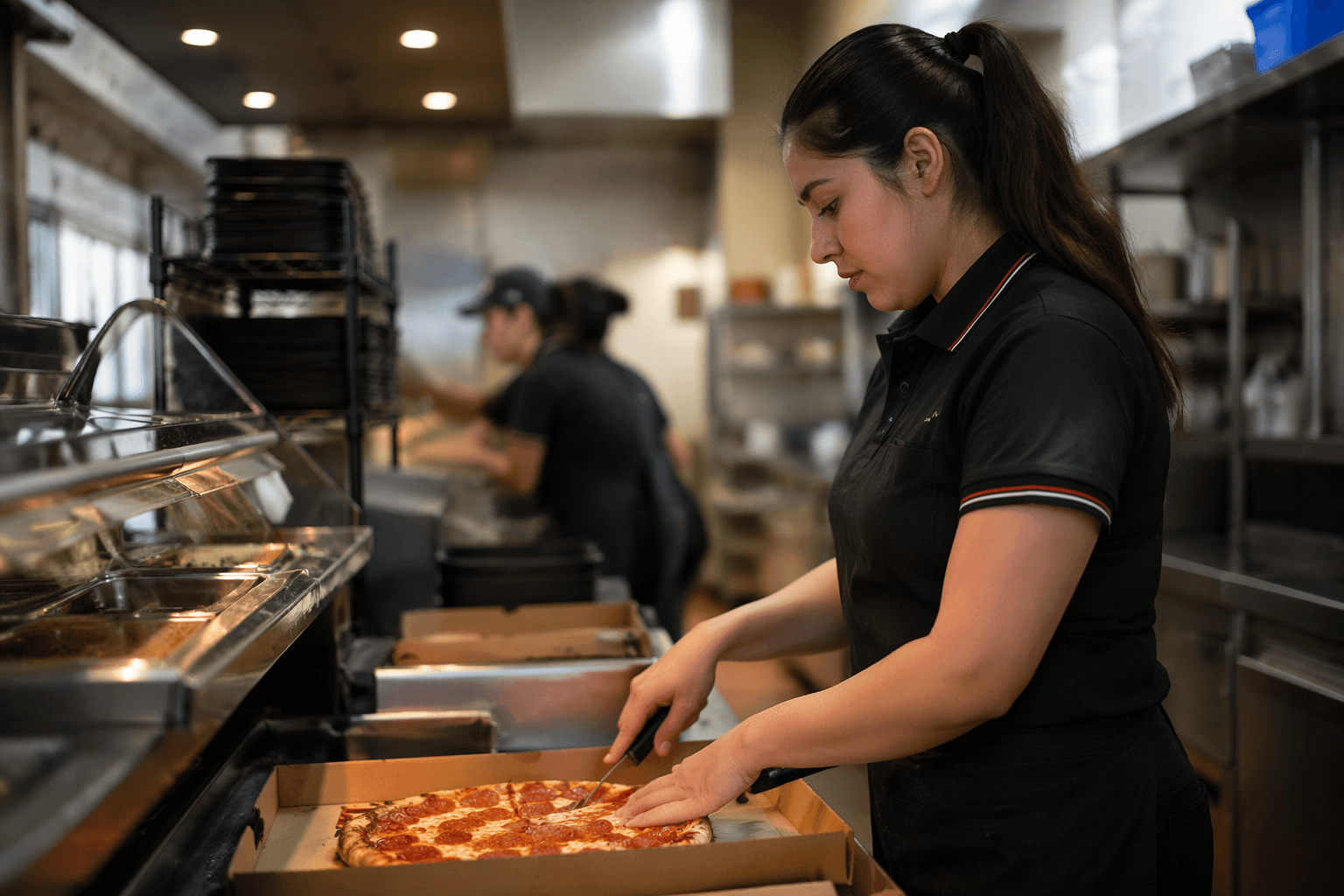
Yum Brands policy sets labor standards across Pizza Hut stores
Yum’s labor policy does not solve store-level abuse, but it gives Pizza Hut workers a company-backed benchmark for safety, scheduling, respect and grievance handling.

Pizza Hut workers do not have to treat bad scheduling, unsafe conditions or disrespect as just part of the job. Yum! Brands’ Human Rights & Labor Practices Policy sets a companywide baseline that says the business wants a workplace that respects, protects and supports the human rights of employees, suppliers and local communities, and that baseline can be used to measure what is happening inside a store against what the parent company says should happen.
What the policy actually gives workers
The value of Yum’s policy is not that it replaces labor law. It is that it gives delivery drivers, kitchen crew and managers a common language for pushing back when the floor reality falls short of the corporate standard. If a store’s break practices, scheduling, discipline, or treatment of complaints feels arbitrary or retaliatory, the policy lets workers frame the issue as a failure to meet the brand’s own stated labor expectations, not just a personal dispute with a shift lead.
That matters in food service because problems are often local and immediate. A driver dealing with missed reimbursements, a cook facing rushed shifts, or a manager told to ignore repeated safety complaints may not see a simple legal fix in the moment. But Yum’s language around human rights, respect and support gives those workers a documented benchmark to use in conversations with franchise leadership, human resources or the parent company’s broader compliance channels.
Why the franchise model changes the leverage
Pizza Hut is not a small chain with a single operating structure. Yum says the brand has more than 19,000 restaurants in 108 countries, and it describes Pizza Hut as part of a primarily franchise-operated system. That scale is exactly why a corporate policy matters, but also why the gaps can be wide: the brand can set expectations centrally while the day-to-day decisions about hours, staffing, discipline and break compliance are often made by local operators.
Yum’s own 2024 Global Citizenship & Sustainability Report says its disclosures cover Yum and its subsidiaries, including Pizza Hut, but not franchisees or suppliers unless otherwise indicated. That distinction is important for workers because it explains the fault line between corporate promises and shop-floor enforcement. The company can define the standard, but franchisees independently manage and run their businesses, which means the path from policy to practice depends on how seriously local operators take it.
For managers, that is a warning as much as a reminder. Corporate labor standards are not just legal risk management from Louisville, Kentucky. They are part of the expectation system the parent company says applies across the network, and they can become a problem for operators who assume labor issues stop at the store door.
The standards Yum says it is built on
Yum says its human-rights approach is grounded in the company’s Global Code of Conduct, its Supplier Code of Conduct and international human rights principles, including the UN Guiding Principles on Business and Human Rights and the International Labour Organization’s Declaration on Fundamental Principles and Rights at Work. Its Supplier Code of Conduct is a mandatory annual declaration for all suppliers seeking to work with Yum, which makes the company’s labor expectations more than vague branding language.
That supplier piece matters to Pizza Hut workers even if they never deal directly with vendors. It shows the company sees labor and ethics as systemwide issues, not just store-level concerns. In practice, that gives workers another point of leverage when they ask whether the company’s standards are being applied consistently across the broader network that feeds, staffs and supplies the brand.
Yum also says employees and suppliers are required to confirm compliance with the Global Code of Conduct and Supplier Code of Conduct each year. That is a useful detail for workers who are trying to press an issue through internal channels: when a company requires annual confirmation of compliance, it is harder for local management to pretend labor standards are optional or purely symbolic.
When the policy collides with reality
Recent disputes show why the policy has practical weight. In Los Angeles, a National Labor Relations Board case involving Southern California Pizza Company, LLC d/b/a Pizza Hut was filed on June 28, 2024 and later closed on January 15, 2025. The docket listed alleged 8(a)(3) discharge and changes in terms and conditions of employment, along with an 8(a)(1) retaliation and concerted activity allegation, and the charging party was SEIU National Fast Food Workers Union. That is the sort of case that turns a policy document into a test: does the company’s stated respect for workers line up with how it handles organizing, discipline and workplace complaints?
The same tension surfaced in Scotland, where Unite said on March 25, 2025 that workers at 23 Pizza Hut takeaway outlets were facing wage theft and denial of breaks. Unite said about 200 workers were affected after Glenshire Brands took over the stores in 2022, and it said the operator removed a drivers’ commission worth £1.45 per delivery, or roughly £70 to £80 a week for some drivers. For delivery workers, that is not an abstract labor argument. It is the difference between a route that barely covers the cost of being on the road and one that turns a shift into a loss.
There is also a broader labor pattern in Pizza Hut delivery work. A franchisee with more than 300 locations reached a $4.75 million settlement in a delivery-driver wage case that was filed in April 2023 and covered drivers in multiple states. The plaintiffs alleged they were under-reimbursed for vehicle expenses and pushed below minimum wage once gas, repairs, insurance and phone costs were factored in. That dispute is a reminder that delivery drivers often carry real operating costs while depending on reimbursement systems that may not match the true cost of doing the job.
What workers and managers can do with the company’s own language
The smartest way to use Yum’s policy is to turn it into a checklist for shop-floor reality. Ask whether the store is respecting safety rules, whether schedules are humane and predictable, and whether complaints are handled in a way that reflects the company’s stated values. If the answer is no, the problem is not only a bad manager or a rough week. It is a disconnect between corporate standards and local practice.
That is especially important in a system where gig competition from DoorDash and Uber Eats keeps pressuring delivery work, tips can be unstable, and every cut to commissions or reimbursement hits workers immediately. In a franchise chain as large as Pizza Hut, corporate language will not fix every problem on its own. But it can give workers and managers something concrete to point to when they push for safer conditions, fairer treatment and a grievance process that is more than a box on paper.
Yum’s own corporate disclosures also say claims can arise from franchisees, suppliers, employees, customers and governments over operational or employment issues. That acknowledgement matters because it shows the company knows labor disputes are part of the business, not an exception to it. For Pizza Hut workers, the policy is most useful when it is treated as a floor that local practice has to meet, not a statement to admire from a distance.
This article was produced by Prism’s automated news system from verified source data, official records, and press releases, then run through automated quality and moderation checks before publishing. The system is built and supervised by the people who set the standards it runs under. Read our full AI policy.
Did this article answer your question?