DOL tip rules spell out restaurant employers’ wage obligations
The federal tip rules spell out when a restaurant paycheck is short, from side work and dual jobs to tip pools, overtime, and managers taking tips.
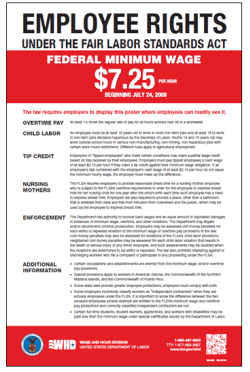
The federal tip credit only works if the math works. For restaurant workers, that means the cash wage, the tips, the hours, and the job duties all have to line up in the same workweek, or the employer may owe back wages. The Department of Labor’s tip-regulations page is useful because it does not treat tipped pay as one simple rule. It lays out the parts that usually cause trouble in restaurants: tip credit conditions, tip pooling, dual jobs, overtime calculations, recordkeeping, and who is legally allowed to touch tips in the first place.
How the tip credit is supposed to work
Under the Fair Labor Standards Act, an employer can count some tips toward minimum wage and overtime obligations for tipped employees. But the employee has to receive enough direct cash wages plus tips in each workweek to reach at least the federal minimum wage and any required overtime pay. The federal minimum wage is $7.25 an hour, and the maximum federal tip credit is $5.12 per hour, which means the direct cash wage can be as low as $2.13 per hour if tips fill the gap.
That is the first place to check when a paycheck looks wrong. If you are a server, bartender, busser, or any other tipped worker, the question is not just what your hourly rate says on paper. It is whether your total pay for that workweek actually gets you to the legal floor after all tipped and non-tipped time is counted correctly.
The DOL defines a tipped employee as someone who customarily and regularly receives more than $30 a month in tips. That threshold matters because it determines who can be treated under the tipped-employee rules at all. If a worker is misclassified, the employer may be using the tip credit where it does not belong.
Side work and dual jobs are where pay errors often hide
One of the most important issues for restaurant workers is whether non-tipped work is being paid correctly. Rolling silverware, cleaning stations, prepping side items, stocking, and other support tasks can become a problem when an employer treats all of that time as if it were tipped work. The DOL’s tip guidance is built to answer exactly that kind of question: is the employee really in a tipped occupation, and are non-tipped duties being handled under the right rule?
That question became especially volatile after the DOL issued a dual-jobs rule on October 28, 2021. The department said the rule set reasonable limits on how much time tipped employees could spend on non-tipped activities when an employer takes a tip credit. Then the U.S. Court of Appeals for the Fifth Circuit vacated that rule on August 23, 2024 in Restaurant Law Center v. U.S. Department of Labor, and the DOL later issued a final rule on December 17, 2024 restoring the pre-2021 dual-jobs language.
For workers, the practical takeaway is simple: if you are spending a lot of time on side work, that time may matter to your wages even if it happened on the same shift as your tipped work. If your section assignment changes, if you are pulled off the floor to do prep, or if your shift is mostly support work with little direct tipping, those details are worth tracking. That is exactly where wage violations tend to be buried.
Tip pools have strict limits
Tip pooling is another area where restaurant payroll can go off the rails fast. The DOL says that when an employer is taking a tip credit, the tip pool must be limited to employees who customarily and regularly receive tips. That is a bright-line rule worth remembering for anyone working in a house that splits tips among a broad group.
Managers and supervisors cannot keep employees’ tips. The DOL’s guidance makes that explicit, and it also bars employers from allowing managers or supervisors to take any portion of other employees’ tips. In a restaurant, that means ownership and management cannot quietly absorb part of the pool, whether the money is called a service charge, a house fee, or something else.
If your pay statement shows tip deductions, pooled tips, or tip-outs that do not match your floor role, check who is in the pool and who is not. The federal rule is about function, not just title. A valid tip pool is limited to employees who themselves customarily and regularly receive tips, not the whole staff.

Overtime has to be calculated on the right regular rate
Tipped workers are still covered by overtime rules. The FLSA requires time-and-a-half for overtime, and the DOL says the employer must make sure the employee receives enough direct wages plus tips in each workweek to satisfy that obligation. That means overtime is not a casual add-on at the end of the pay period. It has to be calculated using the proper regular rate, with the tipped-credit rules applied correctly.
This is where restaurant paychecks can get messy, especially when workers split time across positions. A bartender who also hosts, a server who does prep before service, or a line cook who sometimes fills in front of house can end up with hours that should not all be treated the same way. If overtime is based on the wrong rate, the worker may be shorted even when the paycheck looks close enough at first glance.
Why the stakes are so high in restaurants
The restaurant and foodservice industry is the nation’s second-largest private-sector employer, with 15.7 million jobs. That includes 12.5 million jobs at eating and drinking places, plus about 3.2 million foodservice jobs in other sectors. Industry materials also say 1 in 3 employed teens work in restaurants, which means these rules touch a huge workforce that often has little leverage and a lot of turnover.
Bureau of Labor Statistics data show the median hourly wage for waiters and waitresses was $16.23 in May 2024. That number can look much higher than the cash wage on a pay stub because tips make up so much of total earnings. It also shows why wage theft, missed overtime, or bad tip-pool practices can hit hard even when a restaurant claims compensation is competitive.
The broader fight over tipped pay is not new. Congress first created the federal tipped subminimum wage in the 1966 FLSA amendments, and labor advocates have long argued that the system leaves workers exposed to unstable pay and wage theft. Economic Policy Institute researchers, including Elise Gould and David Cooper, have argued that tipped workers are disproportionately women, people of color, women of color, single parents, and foreign-born workers. On the other side, the National Restaurant Association and the Restaurant Law Center have pushed back against DOL limits they view as too restrictive.
What restaurant workers should track on their own
The DOL’s recordkeeping rules matter, but workers should keep their own records too. That is especially true in a tipped workplace, where the difference between lawful pay and an underpayment can turn on a few hours of side work or a disputed tip-out. Keep track of shifts, hours, tip-outs, section assignments, and any time spent doing non-tipped duties.
If your paycheck seems off, the practical checklist is straightforward:
- Compare your cash wage, tips, and hours for each workweek against the $7.25 minimum wage floor.
- Flag any week where you spent significant time on support work, prep, or cleaning while being paid as tipped labor.
- Check whether your tip pool includes only employees who customarily and regularly receive tips.
- Make sure no manager or supervisor is taking any share of employee tips.
- Look at overtime separately and verify that time-and-a-half was calculated on the correct regular rate.
For restaurant workers, the federal tip rules are not just about whether you are getting tipped. They decide which tasks count, which people can share the money, and whether your paycheck actually adds up. That is why the details matter, and why a bad tip credit can turn a normal shift into unpaid labor.
This article was produced by Prism’s automated news system from verified source data, official records, and press releases, then run through automated quality and moderation checks before publishing. The system is built and supervised by the people who set the standards it runs under. Read our full AI policy.
Know something we missed? Have a correction or additional information?
Submit a Tip