Restaurant Automation in 2026 Reshapes Kitchen and Front-of-House Work
Robots are taking the fryer, AI is answering the drive-thru, and 21 states just raised minimum wage — here's what it actually means for your shift.
The global food automation market is barreling toward $28 billion in 2026, and the pressure point isn't Silicon Valley curiosity anymore. Twenty-one states raised their minimum wages on January 1, 2026, and 98% of restaurant operators have identified rising labor costs as a top business concern, according to the National Restaurant Association. The result is an acceleration unlike anything the industry has seen in a single year: robots at the fryer, AI answering the drive-thru, and intelligent kiosks reconfiguring the front-of-house floor. For line cooks, servers, and managers, this is not an abstract tech story. It's a shift change that's already started.
The Technologies Actually Hitting Restaurant Floors
Five categories of automation are seeing the most deployment activity right now, and they touch nearly every station in the building.
Voice AI ordering agents are handling inbound drive-thru and phone orders, reducing the need for dedicated order takers during peak windows while reportedly pushing order accuracy above 95% on leading platforms. Restaurants that have adopted AI phone ordering report a 26% increase in phone order revenue, partly because the system never misses a call and never rushes a customer. Bojangles became the first major fast-food chain to roll out an all-AI drive-thru ordering system, and over 10,000 locations globally are now running some form of voice AI ordering. Burger King's deployment of "Patty," an OpenAI-powered chatbot that monitors drive-thru conversations in real time, coaches workers on order accuracy and even flags whether staff say "please" and "thank you." That rollout covers 500 U.S. locations with a full national expansion planned by year's end.
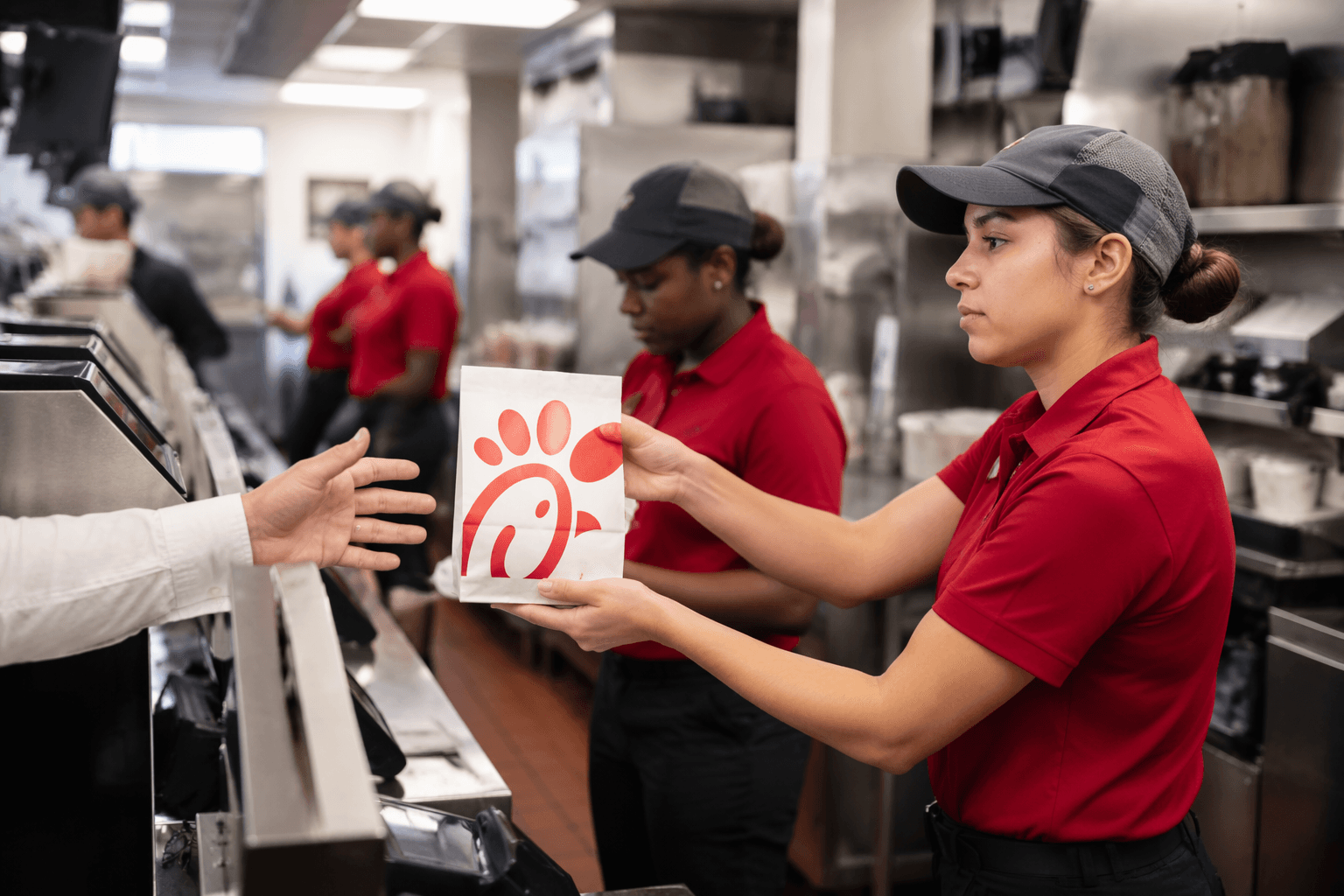
Intelligent self-service kiosks are compressing cashier headcount in high-traffic venues, but the flip side is a shift in job function rather than a clean elimination. Workers who once ran a register are increasingly being repositioned toward food running, upselling at the kiosk, and guest-facing hospitality tasks. Whether that repositioning comes with equivalent hours and pay is a separate question entirely.
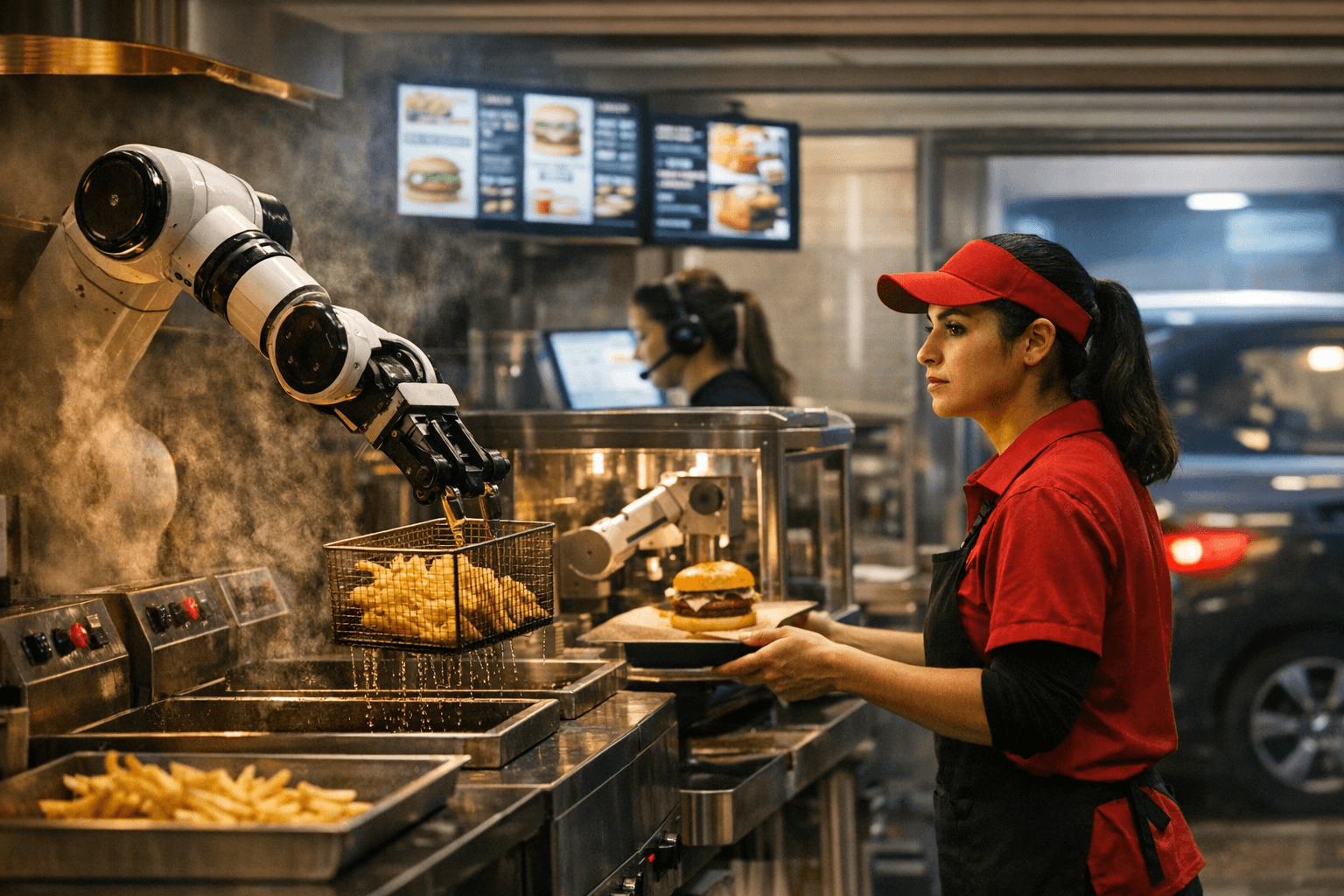
Back-of-house automation is where the physical work is changing most tangibly. Robotic fryers, automated portioners, and intelligent dispensers are reducing the repetitive strain that burns through kitchen staff, particularly at fry stations. Miso Robotics' Flippy, arguably the best-known kitchen robot, now integrates with a new AI operations dashboard called Zippy after the company's acquisition of the platform Zignyl. The combined system lets operators run labor scheduling, payroll, point-of-sale, and the robot itself through a single interface. Back-of-house "agentic AI" is also emerging that can autonomously adjust staffing schedules and menu offerings based on predictive inputs like weather patterns and local events.
Why Operators Are Moving Now
Short-order cooks are among the hardest roles to retain in fast food. Turnover costs operators more than $2,700 per hourly worker, with roughly 35% of that sum coming from new worker training alone, according to data from Black Box Intelligence. Fry stations are messy, physically punishing, and genuinely hazardous. Automation at those stations is partly a worker retention play, not just a cost-cutting one.
But the minimum wage acceleration has sharpened the financial calculus considerably. When 21 states raise wage floors simultaneously, the math on a six-person crew versus a four-person crew plus a robotic fryer changes fast. Operators are deploying technology to cover existing labor shortages in some cases, and to engineer smaller crews in others. These are not the same thing, and the difference matters enormously for anyone counting on a full week of shifts.
How This Reshapes Hours, Pay, and Safety
The impact on available hours is not uniform, and that's worth sitting with for a moment. In some restaurants, automation is filling gaps created by genuine staffing shortages, which can actually stabilize schedules and reduce the kind of mandatory overtime that burns people out. In others, technology enables a leaner crew that still hits the same service targets, and that directly compresses the number of hours available per worker.
Safety cuts both ways. Robotic fryers and automated portioners reduce the repetitive wrist, arm, and shoulder strains that sideline kitchen workers for weeks. But new equipment introduces new hazards: maintenance tasks, diagnostic software, and the physical risk of working alongside mechanical systems that weren't there before. Workers who are handed a new piece of equipment and told to figure it out are not in a better safety position than before; they're in a different but equally precarious one.
What You Can Actually Do
The research on this is consistent, and the workers who navigate automation transitions best are the ones who treat it as a skills and documentation problem, not just an employment threat.
- Upskill deliberately. Familiarity with POS integrations, inventory management software, and basic equipment troubleshooting is becoming table stakes. Workers who can operate and maintain automated systems are harder to cut and more valuable in redeployment scenarios.
- Document your role changes. If your job duties shift significantly after automation is deployed, keep written records of what you're doing versus what your original job description says. This matters in wage disputes, hours reductions, and any bargaining situation.
- Know your collective options. Collective bargaining has already produced contracts in several markets with explicit redeployment clauses, training guarantees, and automation-triggered protections. If hours are being cut at your location in the wake of new technology, worker advocacy organizations and unions are the most direct structural lever available.
- Ask for written training and safe work procedures. When new equipment is introduced, a verbal walkthrough is not sufficient. Formal documentation of how to operate and maintain the equipment is both a safety issue and a legal one in most jurisdictions.
The Honest Picture
Automation is not monolithic. Some operators genuinely position technology as a way to remove the most grueling, injury-prone tasks so workers can focus on the hospitality parts of the job that actually require a human. Others use it aggressively to shrink labor costs with no meaningful investment in the people who remain. The same robotic fryer can represent two very different realities depending on whether the operator reinvests in training and scheduling, or simply trims the crew and pockets the margin.
The $28 billion figure tells you how much capital is flowing into this space. It doesn't tell you which version your restaurant is running. That's the conversation worth having now, before the equipment is already bolted to the floor.
This article was produced by Prism’s automated news system from verified source data, official records, and press releases, then run through automated quality and moderation checks before publishing. The system is built and supervised by the people who set the standards it runs under. Read our full AI policy.
Know something we missed? Have a correction or additional information?
Submit a Tip