Taco Bell credits education benefits with boosting retention amid industry labor turmoil
Taco Bell says education benefits have driven retention and is ramping a training program to promote managers and area coaches after months of industry legal and labor turbulence.
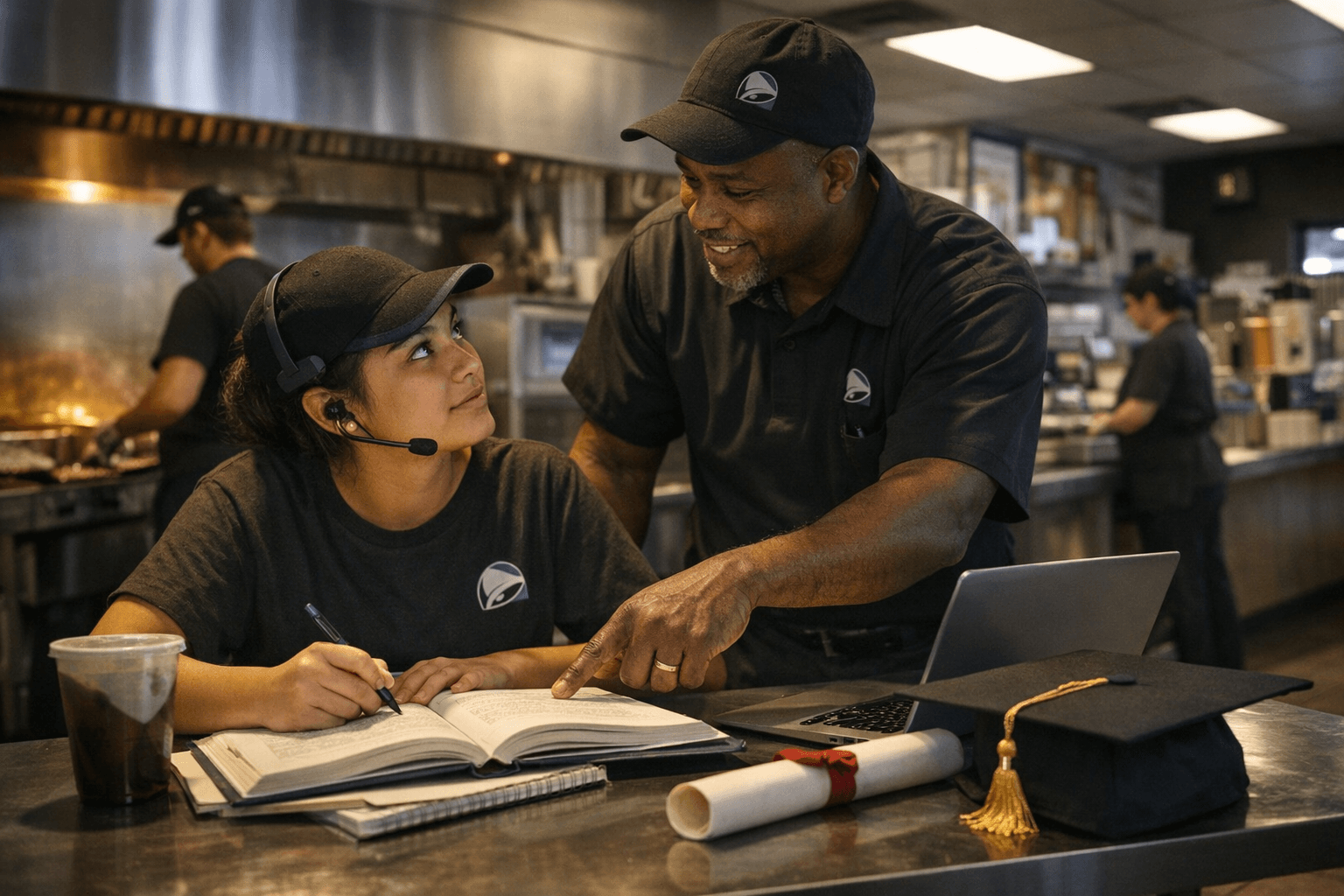
Taco Bell credits education benefits with improving retention and is emphasizing internal promotion through a training program meant to advance managers and area coaches, the company said in late October 2025. The chain singled out its education offerings as a retention lever even as competitors face high-profile settlements, testing of new roles and regulatory fights that are reshaping staffing strategies across the sector.
The industry backdrop includes a landmark New York City labor settlement in which Starbucks agreed to pay $39 million after the city alleged violations of its Fair Workweek rules "upwards of 500,000 times between 2021 and 2024." That settlement, announced in late September 2025, highlights enforcement and scheduling risks chains face while trying to stabilize hourly workforces.
Operational shifts at Starbucks reflect a parallel effort to redesign career ladders: the company has been testing an assistant manager role at 62 stores as a "step between hourly shift supervisor and salaried manager," with plans described as aiming to scale to roughly 8,000 hires if the pilot moves wider. The two moves together - heavy legal exposure on one hand and new middle-management roles on the other - underscore competing pressures on labor strategy.
Regulatory and legal turbulence extends beyond scheduling. The U.S. Department of Labor published a final rule on April 26, 2024 titled "Defining and Delimiting the Exemptions" that raised standard salary and highly compensated employee thresholds and added a mechanism for updating those earnings thresholds; the rule was vacated by the U.S. District Court for the Eastern District of Texas on November 15, 2024. Industry groups and legal coalitions have since filed challenges and responses, including reactions to a decision denying a stay in a "Dual Jobs" regulation challenge and appeals of orders allowing wage rules to take effect.
Other recent company-level developments show the range of compliance and labor pressures restaurant operators are managing. Panda Express agreed to pay $1 million to settle a Riverside County lawsuit that alleged the brand failed to adequately train staff in handling potentially hazardous materials related to soda fountains. P.F. Chang's resolved a claim the U.S. Equal Employment Opportunity Commission said involved a religious accommodation request after an applicant asked for Sundays off. Olo, the restaurant tech company, cut workers following its acquisition by Thoma Bravo - the third round of layoffs in three years for the firm. Yelp added AI Host and AI Receptionist products to its restaurant toolbox in December 2025, introducing another variable for front-of-house staffing and workflow.
At the same time, labor organizers in Washington, D.C., pushed in December 2025 for a $25 minimum wage and elimination of the tip credit, a campaign described as being "buoyed by the success of Zohran Mamdani and goaded by the revision of Initiative 82." Restaurant organizations have also pursued litigation aimed at DOL guidance on the tip credit.
Taco Bell's focus on education benefits and promotion pipelines comes as operators from quick-service to tech vendors balance settlements, regulatory uncertainty and experiments in staffing design. The chain's October 2025 emphasis on internal training and manager advancement provides a concrete example of how one national brand is responding to the labor and compliance turbulence rippling through the industry.
This article was produced by Prism’s automated news system from verified source data, official records, and press releases, then run through automated quality and moderation checks before publishing. The system is built and supervised by the people who set the standards it runs under. Read our full AI policy.
Did this article answer your question?