UC Santa Cruz Study Examines California's $20 Fast-Food Minimum Wage Effects
A UC Santa Cruz study found California's $20 fast-food wage law cut worker hours and benefits while accelerating automation at chains like McDonald's and Burger King.
A Burger King franchise owner in Northern California told UC Santa Cruz researchers they plan to close the lowest-performing 10% of their locations over the next two years — that's the kind of on-the-ground reality buried inside a new working paper that the university released this week, two years after California's $20 fast-food minimum wage took effect.
Economics lecturer Stephen Owen and a team of undergraduate researchers visited and studied more than 100 outlets in Santa Cruz and the Central Valley, producing what may be the most field-level assessment of AB 1228 yet. The researchers interviewed business owners and managers, reviewed financial and hiring records, and observed operations to get a sense for how things have changed since higher minimum wages were implemented.
The law mandated pay of at least $20 an hour for employees at franchise restaurants with 60 or more locations in California, firmly above the $16.90 an hour 2026 statewide minimum wage. The bill also established the Fast Food Council to set future wage increases, up to 3.5% annually, through 2029.
What Owen's team found was not a clean victory for workers. Employees faced fewer job opportunities, reduced hours, elimination of overtime, new eligibility challenges for healthcare and other benefits, and a wave of automation including order kiosks, mobile apps, and AI drive-through ordering systems being tested and deployed across the industry. Burger King, McDonald's, and Taco Bell all invested in automated kiosks to take orders and payments, and some locations were also piloting AI voice ordering systems and automated dishwashing.
The ripple effects reached beyond the franchise chains the law was designed to target. Even though the fast-food minimum wage applied only to franchised restaurants, independent restaurant owners in Santa Cruz said they faced mounting pressure to raise their own wages and increase menu prices in order to compete for employees, and they were concerned about the effects on the long-term sustainability of their business models.
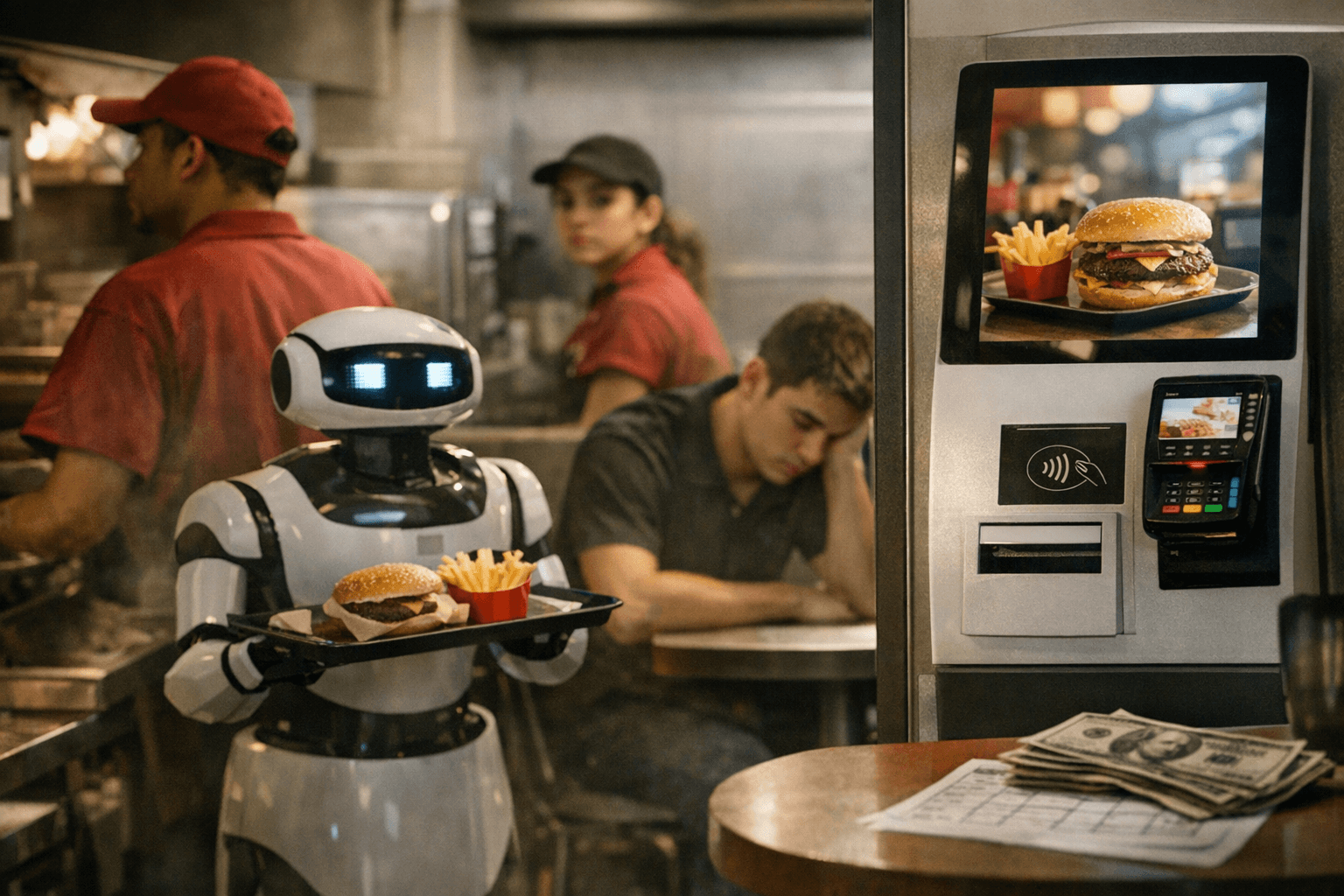
"Based on what we've found, I think this legislation is a classic case of 'no good deed goes unpunished,'" UC Santa Cruz Economics Lecturer Stephen Owen said in a March 18 news release. "There are unintended consequences and knock-on effects, and overall, I think the results have definitely not been as positive as policymakers had been expecting."
The governor's office pushed back hard. "The 'analysis' is based on a handful of interviews on one street in Santa Cruz. It isn't peer-reviewed, and its claims are flat wrong," said Tara Gallegos, a spokesperson for the governor's office.
That methodological critique has merit worth weighing. The study is a working paper, not peer-reviewed research, and its primary data came from interviews with owners and managers, a group with obvious financial interest in the law's repeal. The UC Santa Cruz report also took aim at a UC Berkeley study, faulting it for failing to account for the accelerated use of automation by fast food outlets as they reduced their staffs — a dispute that illustrates how contested the empirical ground remains.
Similar sector-specific minimum wage increases have since been implemented statewide for healthcare workers and passed into law at the city level for hotel workers in Los Angeles and hospitality workers in San Diego, meaning California's fast-food experiment is already a template for other industries. Owen's findings, however limited in scope, are exactly the kind of data those future fights will need to reckon with.
This article was produced by Prism’s automated news system from verified source data, official records, and press releases, then run through automated quality and moderation checks before publishing. The system is built and supervised by the people who set the standards it runs under. Read our full AI policy.
Did this article answer your question?