California's $20 Fast-Food Wage Law Shows Mixed Results, New Studies Find
Two UC studies clash on California's $20 fast-food wage: Berkeley finds zero job losses, while Santa Cruz flags eliminated overtime and cut hours at 100+ outlets studied.
The gap between an 18% jump in hourly pay and an 11% rise in weekly wages may be the single most operator-relevant number to come out of California's two-year review of AB 1228. That arithmetic, buried inside UC Berkeley's new analysis, tells Taco Bell general managers something no headline will: workers are earning more per hour and taking home less per week, which means the labor cost math and the crew-morale math are moving in opposite directions.
On April 1, 2026, exactly two years after the $20 fast-food minimum wage took effect for chains with 60 or more U.S. locations, two University of California research teams published findings that reached sharply different conclusions. The split is not academic noise. It maps directly onto decisions that Taco Bell GMs, area coaches, and franchisees in California need to make this quarter around scheduling, menu pricing, and retention.
Professor Michael Reich and Dr. Denis Sosinskiy at UC Berkeley's Center on Wage and Employment Dynamics released a study concluding the policy "did not reduce employment." Their research drew on Glassdoor job postings, Square payroll data, prices scraped from more than 2,000 restaurants, and mobile device data tracking the number of workers present at each location. The topline findings: average weekly wages for fast-food workers have increased by 11%, prices increased by 1.5%, and employers passed on roughly 50% of the higher wage costs to consumers. The policy increased average hourly pay by 18%, from a pre-law average of roughly $16.96 to $20 shortly after implementation.
On the same day, UC Santa Cruz economics lecturer Stephen Owen and a team of undergraduate researchers released a working paper based on visits to more than 100 fast-food outlets in Santa Cruz and the Central Valley. Where Berkeley used broad payroll and mobility data to measure aggregate employment, Owen's team went location by location. Their findings pointed to reduced worker hours, higher menu prices, and growing pressure on franchise owners to cut costs or automate. The paper states the law has created "fewer job opportunities, reduced employee hours, elimination of overtime, and new eligibility challenges for healthcare and other benefits," alongside accelerating adoption of order kiosks, mobile apps, and AI.
The methodological divide is what operators must reconcile before acting. Berkeley's statewide aggregate data smooths over operator-by-operator responses; Santa Cruz's ground-level survey captures what individual franchise owners actually did to absorb the cost shock. Both findings are likely accurate at their respective scales. A franchisee who cut 20 hours a week across five crew members does not show up as a job loss in statewide employment data, but that crew member notices it on their paystub.
For Taco Bell GMs, the settled facts are: hourly wages are up 18% from their pre-law baseline, and roughly half of that cost increase has been passed through to menu prices. What remains disputed is whether hours compression and automation adoption are localized responses by stressed operators or a systemic industry shift. The Santa Cruz paper directly challenged the Berkeley team's earlier 2024 working paper for not accounting for hours reduction, a methodological argument that has yet to be resolved in the literature.
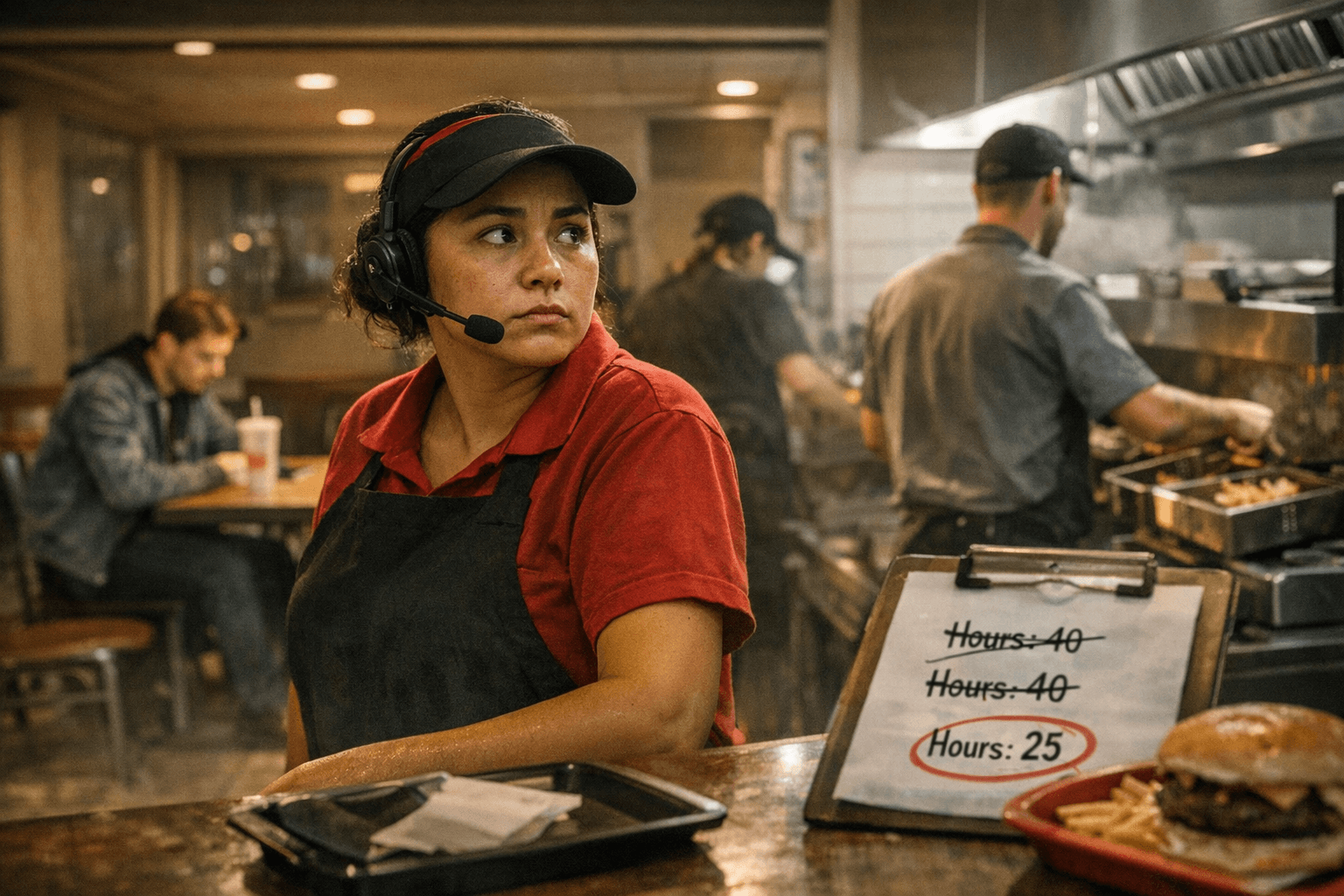
What does this mean for operators this quarter? On the labor model: audit weekly hours per crew member, not just headcount. If your location has held employment steady by cutting shifts, you are living inside the Santa Cruz finding regardless of what the Berkeley aggregate shows. On scheduling: franchise owners facing cost pressure are consolidating shifts and shortening store hours during low-traffic windows, a move that saves dollars short-term but increases turnover risk when crew members find more predictable hours elsewhere. On menu pricing: with prices up only 1.5% on the Berkeley measure and cost pass-through at roughly 50%, there is likely still room for targeted price adjustments on high-margin SKUs before elasticity becomes a concern, but that window narrows with each competitor that moves first. On retention: the 11%-vs.-18% spread between weekly wage growth and hourly rate growth is where turnover hides. A crew member earning $20 an hour for 28 hours a week is not better off than they were earning $16.96 for 35 hours.
The indicators area coaches should be watching in real time are not the ones in either study. Track weekly hours per crew member month over month, not just whether the position is filled. Watch overtime elimination as a leading signal of hours compression before it shows up in morale or turnover. Monitor whether your location's price increases are outpacing the Berkeley 1.5% benchmark, which could signal your franchisee is absorbing more than 50% of the labor cost rather than passing it through. And watch kiosk utilization rates: accelerating automation investment in the form of order kiosks and AI-driven ordering is one of the clearest documented responses to the $20 floor, and locations that shift significant order volume to self-service are also, quietly, reducing the hours their crew can log.
AB 1228 applies to fast-food chains with 60 or more U.S. locations, a threshold that covers Taco Bell's entire California footprint, meaning there is no opting out of this policy environment. The Fast Food Council retains authority to recommend further wage standards to the Legislature. With the two-year review now producing competing findings rather than consensus, another legislative or regulatory move before 2027 is a realistic scenario operators should model for. The operators who are already tracking the right indicators will have the data to respond. Those relying on aggregate studies alone will be reacting to headlines.
This article was produced by Prism’s automated news system from verified source data, official records, and press releases, then run through automated quality and moderation checks before publishing. The system is built and supervised by the people who set the standards it runs under. Read our full AI policy.
Did this article answer your question?