Krispy Kreme turnaround highlights franchise and logistics shifts for Taco Bell
Krispy Kreme's turnaround shows how refranchising and outsourced logistics can boost results, but Taco Bell managers need to watch who absorbs the complexity.
What Krispy Kreme just proved
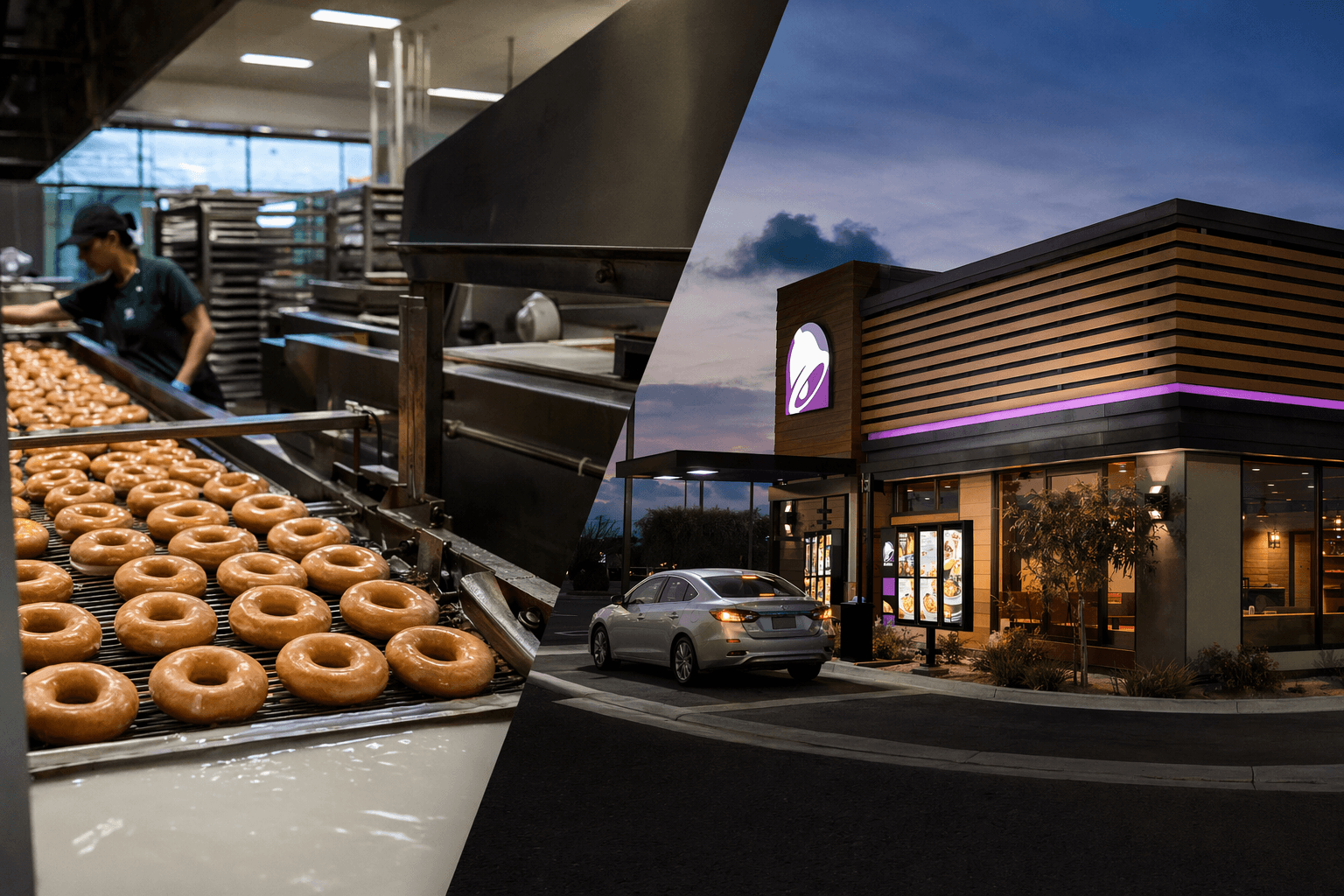
Krispy Kreme’s latest quarter is a useful reminder that a chain can get leaner on paper before it looks healthier in the field. Net revenue fell 2.2 percent to $367 million, mostly because the company closed underperforming doors, yet systemwide sales still rose 0.7 percent in constant currency excluding the ended McDonald’s partnership. Adjusted EBITDA climbed 38 percent, cash from operations improved sharply, and free cash flow turned positive.
The biggest operational signal came from CEO Josh Charlesworth: the company accelerated outsourcing of its U.S. logistics, and that work is now complete. Krispy Kreme also closed two refranchising transactions, including one in Japan and another in its western U.S. joint venture. For restaurant operators, that is the real lesson in turnaround math: shrinking some company-controlled work can create better economics, but only if the remaining system runs cleaner than before.
Why Taco Bell should care
This matters to Taco Bell because Yum! Brands is built on a model where the parent company depends on scale, delegation, and partner execution. Yum! says it has more than 63,000 restaurants in 155 countries and territories, operated primarily by about 1,500 franchisees, and it says it opens a new KFC, Taco Bell, Pizza Hut or Habit Burger Grill restaurant about every two hours. That kind of growth is not powered by corporate kitchens alone. It depends on how well the system divides responsibility between the brand, franchisees, vendors, and store teams.
Taco Bell has been leaning into that same logic with its R.I.N.G. The Bell strategy, unveiled on March 4, 2025. The company said it reached $1 billion in operating profit in 2024, generated $6 billion in digital sales, and opened 347 gross-new locations across 25 countries to reach 8,757 restaurants. The signal for workers is simple: Taco Bell is not just adding restaurants, it is redesigning how the brand runs, from menu execution to digital ordering to development.
Where complexity lands on the restaurant floor
When a chain refranchises more stores or outsources logistics, the parent company can become more flexible, but the store rarely gets simpler by default. The complexity usually moves downstream into inventory flow, prep timing, and handoff discipline. If deliveries come from a different partner, if ordering lives in more than one channel, or if supply moves through a new logistics vendor, the restaurant team is the one that feels late trucks, missing product, or mismatched counts first.
That is where Taco Bell’s own operating model becomes important. Yum! launched Byte by Yum! on February 6, 2025 as an AI-driven SaaS platform that folds together online and mobile ordering, point of sale, kitchen and delivery optimization, menu management, inventory, labor tools, and team member tools. Yum! says Taco Bell U.S. already uses Byte for integrated online ordering, point of sale, and back-of-house technology, and that its U.S. brands were processing more than 300 million digital transactions a year through Byte elements. The upside is visibility. The risk is that one weak handoff can cascade faster when the whole store is more connected.
Delivery is a good example. Taco Bell’s own help pages say delivery is available through the app and through third-party partners including Uber Eats, Postmates, DoorDash, and Grubhub. That setup can protect the customer relationship while outsourcing the actual last-mile handoff, but it also means the store is managing more than one operational path at once. For a shift manager, the question is not whether digital traffic is good, it is whether the kitchen, the app, and the delivery driver are all working from the same clock.
How to tell simplification from complexity shuffling
The best chains use refranchising and outsourcing to sharpen execution, not to hide problems. A turnaround is real when the company can close weak doors, lighten central overhead, and still improve cash flow without making store life harder. It is less convincing when the brand declares victory while the restaurant absorbs more vendor confusion, more app exceptions, and more blame for things it does not control.
Taco Bell managers should watch for a few practical signs:
- One owner for each handoff. If no one can clearly say who owns inventory, delivery timing, or issue resolution, complexity has simply been repackaged.
- Cleaner product flow. When a store is running well, the handoff from supply chain to line crew to driver is predictable, even when volume spikes.
- Fewer surprises in the back of house. Integrated tools are useful only if the counts, labor plan, and ticket flow match what is actually happening in the kitchen.
- Franchisee alignment. Since Yum! operates mainly through franchisees, the economics of any change need to work for operators, not just the parent company.
- Faster recovery when something breaks. A simpler system should make it easier to fix a missed truck, a wrong inventory pull, or a failed delivery order.
That is also why Taco Bell’s leadership changes matter. On September 22, 2025, the company promoted leaders including Sean Tresvant, Joe Park, Taylor Montgomery, Luis Restrepo, Dane Mathews, Amy Ellis Durini and Julie Davis to sharpen focus on Brand, Digital & Technology, and Development. The message is that growth now depends on tighter specialization, not just bigger scale. For crew members and managers, that usually means more systems to learn, but also clearer expectations about who owns what.
The real takeaway for Taco Bell teams
Krispy Kreme’s turnaround says simplification can work, but only if the chain is honest about where the work goes. If franchising and logistics changes reduce cost, improve cash flow, and make store execution smoother, they are doing their job. If they just move complexity away from headquarters and into the restaurant, the line crew ends up carrying the difference.
Taco Bell has been built on expansion since the first restaurant opened in 1962 in Downey, California, and the brand’s newest growth strategy suggests it wants that expansion to be more connected, more digital, and more disciplined. For the people running the shift, the test is not whether the model sounds modern. The test is whether food gets out faster, counts stay cleaner, and the store can keep moving without losing control of the handoff.
This article was produced by Prism’s automated news system from verified source data, official records, and press releases, then run through automated quality and moderation checks before publishing. The system is built and supervised by the people who set the standards it runs under. Read our full AI policy.
Did this article answer your question?