Taco Bell managers face patchwork state wages, overtime rules across markets
One missed local wage rule can turn a routine schedule into a payroll problem. Taco Bell managers need to check the correct rate, overtime triggers, and records before the next post goes live.
Start with the local rate, not the state headline
The costly mistake is simple: assuming the state minimum wage is the only number that matters. For Taco Bell managers, that shortcut can create payroll errors fast, because wage floors and overtime rules can change from one market to the next, even inside the same franchise system.
The Department of Labor’s state minimum wage page lays out just how wide the spread can be. Arizona is listed at 15.15 dollars an hour, California at 16.90 dollars with daily overtime rules after eight hours, Colorado at 15.16 dollars with overtime provisions for retail, food and beverage, and related industries, Connecticut at 16.94 dollars with premium pay for a seventh consecutive day in restaurants, Delaware at 15 dollars, and the District of Columbia at 17.95 dollars. That means the difference between a low-rate and high-rate market in this set alone is 2.80 dollars an hour, or 112 dollars over a 40-hour week before overtime even enters the picture.
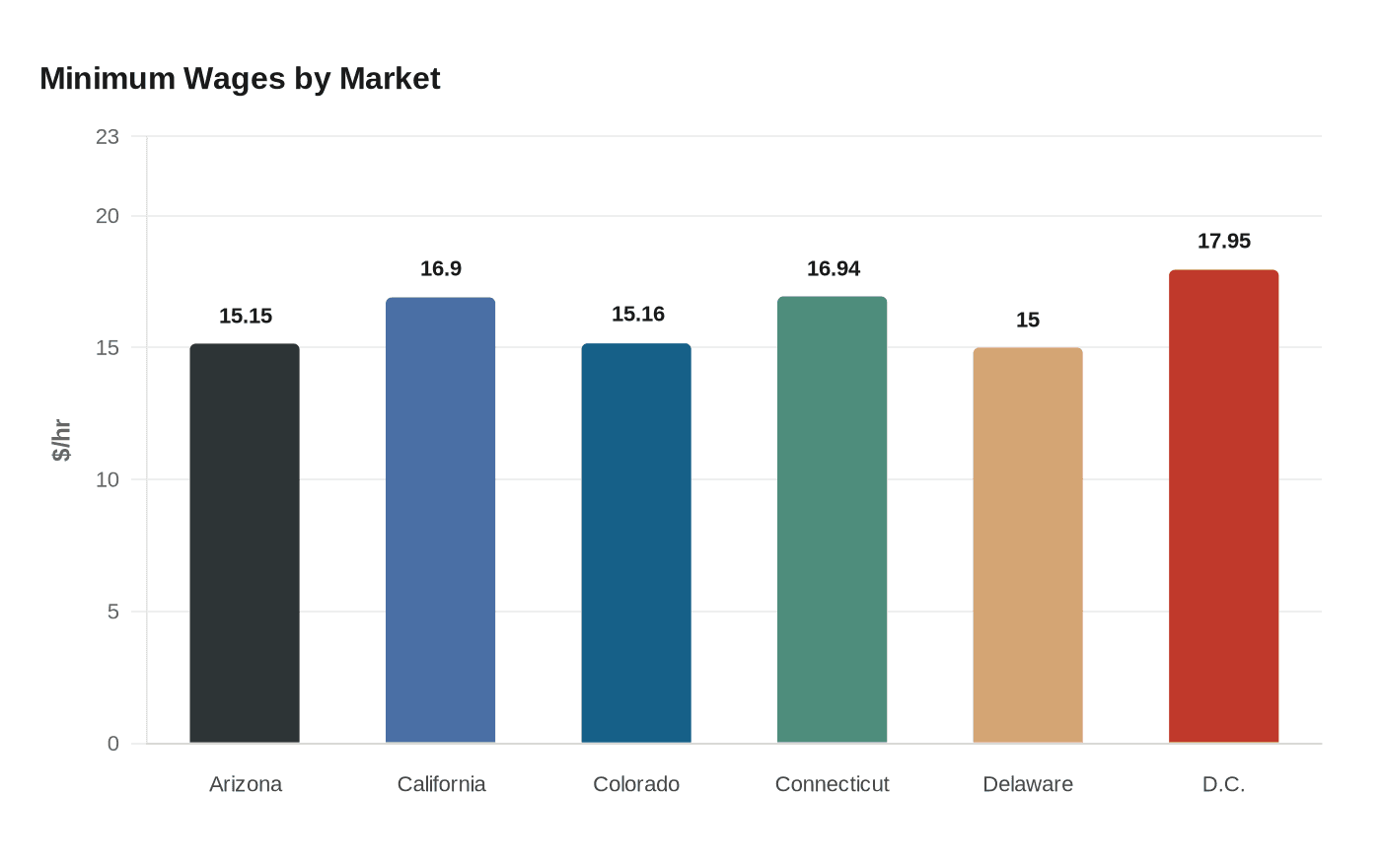
For crew members, that gap is not abstract. It affects the rate on the paycheck, the cost of picking up extra shifts, and whether a store can legally stretch the week the way it always has in another market. For shift managers, it means wage compliance is part of day-to-day labor control, not a back-office issue to solve later.
Why Taco Bell stores cannot run one wage rule everywhere
Taco Bell’s footprint makes this issue more complicated than it looks from a single store. A crew member in one market may be covered by a very different wage floor or overtime standard than a crew member in another, and franchise operators need to keep that straight in payroll, scheduling, and offer letters. That is especially important for stores near state borders and for large multi-state franchise groups that can be tempted to standardize labor decisions too aggressively.
The risk is not only underpaying someone by mistake. If managers use one rule set across several jurisdictions, they can build a schedule that looks fine on paper but triggers overtime premiums, daily overtime, or seventh-day premium pay once the hours are actually worked. In a fast-food setting, that can happen when a callout forces a long shift, when staffing gets thin during a peak window, or when the team keeps extending coverage because the line is busy and no one wants a second handoff.
Build a three-step compliance workflow before the schedule posts
The safest approach is to make wage checks part of the scheduling routine. Managers should not wait until payroll closes or a worker questions a paycheck. The better habit is to verify the applicable wage rule before hours are assigned, then carry that rule through every labor decision tied to the schedule.
A simple workflow helps:
1. Check the local rate first.
Pull the current state minimum wage page and confirm whether the store is operating under a state rule, a city rule, or a more specific local standard that may be higher than the state floor.
2. Confirm overtime triggers for that market.
Do not assume overtime only starts after 40 hours in a week. California, for example, uses daily overtime rules after eight hours, and Connecticut’s restaurant rule can trigger premium pay on a seventh consecutive day. Colorado’s listed overtime provisions also show that some standards apply by industry, not just by headcount or weekly total.
3. Load the rate into payroll and keep the paperwork.
Update payroll settings, make sure offer letters reflect the correct starting rate, and save the documentation that shows which rule applied and when it changed. If the store is changing hours, adding managers, or opening in a new jurisdiction, the wage review needs to happen before the next schedule posts.
That recordkeeping matters because labor changes move quickly in restaurant operations. If a manager has to explain why one shift was paid under one rule and the next under another, the paperwork should already tell the story.
What the examples mean on the floor
The state examples from the Department of Labor show the kinds of decisions Taco Bell managers face in real time. California’s 16.90 dollar minimum is only part of the equation, because the daily overtime rule after eight hours changes how a long closing shift should be built. A manager who keeps one crew member past the ordinary end of a shift to cover a rush can create an overtime cost that was never in the original labor plan.
Connecticut raises a different issue. Premium pay for a seventh consecutive day in restaurants means the weekly pattern matters, not just the day’s clock-in and clock-out. That can matter when a short-staffed store leans on the same workers too many days in a row, especially during a busy stretch when the instinct is to keep the strongest crew on the floor.
Colorado is another reminder that industry-specific rules can shape pay exposure. Its listed overtime provisions apply to retail, food and beverage, and related industries, which makes it a direct concern for a quick-service chain. Delaware and the District of Columbia show the other side of the problem: even where the overtime issue may not be the same as California’s or Connecticut’s, the base wage itself can move enough to change labor budgets and starting pay decisions.
How franchise operators keep pay equity from drifting
For workers, wage compliance is also a pay-equity issue. If one Taco Bell location across a border pays by a different minimum or overtime standard, crew members notice quickly, even if they never see the underlying rule. That is one reason managers need to be careful when they borrow scheduling habits from another market or copy a pay structure from a neighboring store.
Franchise operators have the hardest version of this problem because one labor playbook can fail in another jurisdiction. Corporate teams and franchise leaders alike need to make sure local rules are built into the system instead of patched in after a complaint. The biggest risk comes when a group tries to standardize too much, too fast, and assumes the same hourly wage logic works everywhere a Taco Bell sign is lit.
A manager’s practical checklist before the next labor week
- Verify the correct wage floor for the store’s exact location, not just the state name on the map.
- Check whether overtime is weekly, daily, or tied to consecutive days of work.
- Review whether the store is in a city, county, or special jurisdiction with a higher rate.
- Update payroll settings before the next schedule posts.
- Save a dated record of the rate used, the effective date, and any change in hours or location.
- Recheck the rule whenever a store opens, expands hours, or adds leadership coverage.
The managers who stay ahead on wage compliance treat the DOL chart like a scheduling tool, not a reference link. In a chain as large and geographically spread as Taco Bell, that discipline is what keeps a busy shift from turning into a wage problem.
This article was produced by Prism’s automated news system from verified source data, official records, and press releases, then run through automated quality and moderation checks before publishing. The system is built and supervised by the people who set the standards it runs under. Read our full AI policy.
Did this article answer your question?