Taco Bell workers’ rights page explains protected workplace speech
Taco Bell crew members can talk pay, organize together, and report retaliation. California also gives most retaliation complaints a one-year filing clock.
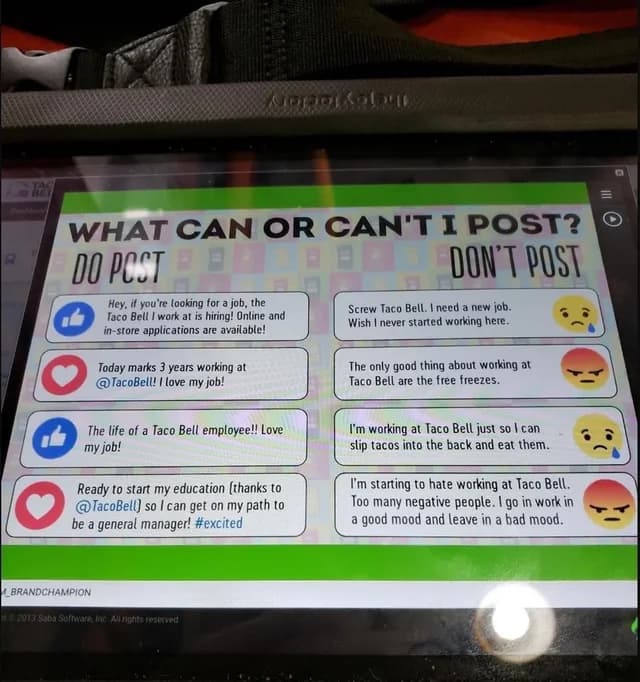
A Taco Bell crew member talking with coworkers about pay, schedules, workload, or safety is protected by federal labor law. California adds retaliation rules that matter the moment a complaint turns into a write-up, a cut shift, or a threat from management.
What federal law protects
The National Labor Relations Act has been on the books since 1935, and the National Labor Relations Board was created that same year to enforce it. Protected concerted activity covers employees acting together to improve terms and conditions of employment, and workers have the right to discuss wages. For a Taco Bell crew member, that covers talking with coworkers about pay, schedules, workload, safety, assignment fairness, and other conditions that shape the job.
That protection matters in the exact moments fast-food workers run into management pressure. A group chat about short staffing, a conversation in the parking lot after a bad close, or a shift huddle where several workers raise the same issue can all fall into the category of workers acting together. The law does not require a union for that protection to exist, and a September 2016 NLRB training presentation archived by UCLA Labor states that workers can act together to try to improve pay and working conditions with or without a union.
Where the legal line gets crossed
The line is not whether management likes the conversation. The line is whether workers are acting together to improve the job, and whether a response from management starts looking like punishment for that protected activity. In a restaurant, retaliation can show up fast: a supervisor snapping at a crew member after a wage discussion, a sudden schedule change after coworkers complain as a group, or a write-up that lands right after someone organizes a petition.
In California, employees and applicants for employment have the right to exercise labor rights without retaliation or discrimination. The Labor Commissioner’s Office enforces more than 45 labor laws that specifically prohibit discrimination and retaliation, which gives workers another layer of protection when a store supervisor overreaches. Retaliation complaints generally must be filed within one year of the retaliatory act unless a law says otherwise, so the clock matters as soon as a worker thinks a manager crossed the line.
How this applies on a Taco Bell shift
Fast-food problems usually start small. A break gets missed, a closing shift keeps running late, one worker gets a better section than everyone else, or nobody will answer a question about pay. Those moments are exactly where workers can decide whether they can speak up together instead of treating the issue as a private gripe.
That is especially important at Taco Bell, where franchise and corporate lines can make accountability murky. A 2015 handbook published for K-Mac Enterprises, Inc., a Taco Bell franchisee, shows how restaurant workers can be governed by franchise-level policies rather than only corporate materials. That means a store rule, a manager practice, or a payroll issue may come from the local operator even when the brand on the building is the same, and workers should not assume the answer lives only in a corporate memo.
California’s fast-food rules raise the stakes
These protections sit inside a larger California fight over wages and working conditions in fast food. Governor Gavin Newsom signed AB 1228 on September 28, 2023, raising the hourly minimum wage for certain fast-food workers to $20 effective April 1, 2024, and creating a Fast Food Council. Before that, the California Legislature passed the FAST Act, AB 257, in 2022, a law workers and labor advocates framed as a way to force standards-setting into the open.
Those changes affect Taco Bell stores on the ground because payroll, scheduling, and staffing all shift when the wage floor changes. In a business where labor costs often drive how many people are on a line or how many hours a shift gets, a higher minimum wage can change the pace of a close, the number of bodies on a lunch rush, and the way managers allocate hours. A February 2024 report from California fast-food worker training efforts identified worker-rights trainings as a pathway to improving conditions in the industry.
Workers have already used these rights
Taco Bell workers have already shown how quickly a local fight can turn into a rights issue. In June 2020, Michigan Taco Bell workers circulated a petition and held a press conference demanding hazard pay, thermometers, and paid sick leave, and they won those demands.
California fast-food workers have also been more public about organizing. California fast-food workers formed a union backed by SEIU, the subject of a Los Angeles Times article dated February 9, 2024. On November 24, 2022, fast-food workers struck to protect the labor law they said had been hard-won from corporate attacks; Knock LA published an article on the strike that day.
What to do if management pushes back
The safest approach is to treat the moment seriously as soon as a manager reacts badly to protected speech. Keep copies of schedules, texts, group chat messages, write-ups, and any note showing when you raised the issue and who was present. If a supervisor says not to talk about pay, not to compare schedules, or not to bring up a group concern, that warning is worth documenting immediately.
On a California fast-food rights account hosted by Fast Food Justice Ahora, a worker named Crystal said she learned her rights through the California Fast Food Workers Union, filed a wage claim with the state, and received $11,363.66 in back pay and penalties. She also said coworkers were frightened when a store manager threatened to call immigration.
This article was produced by Prism’s automated news system from verified source data, official records, and press releases, then run through automated quality and moderation checks before publishing. The system is built and supervised by the people who set the standards it runs under. Read our full AI policy.
Did this article answer your question?