OpenAI’s policy proposals and what they could mean for retailers like Target and their employees
OpenAI's 13-page "robot tax" blueprint could shift how Target weighs automation against payroll, with 18,000 HQ employees and frontline store teams directly in the frame.
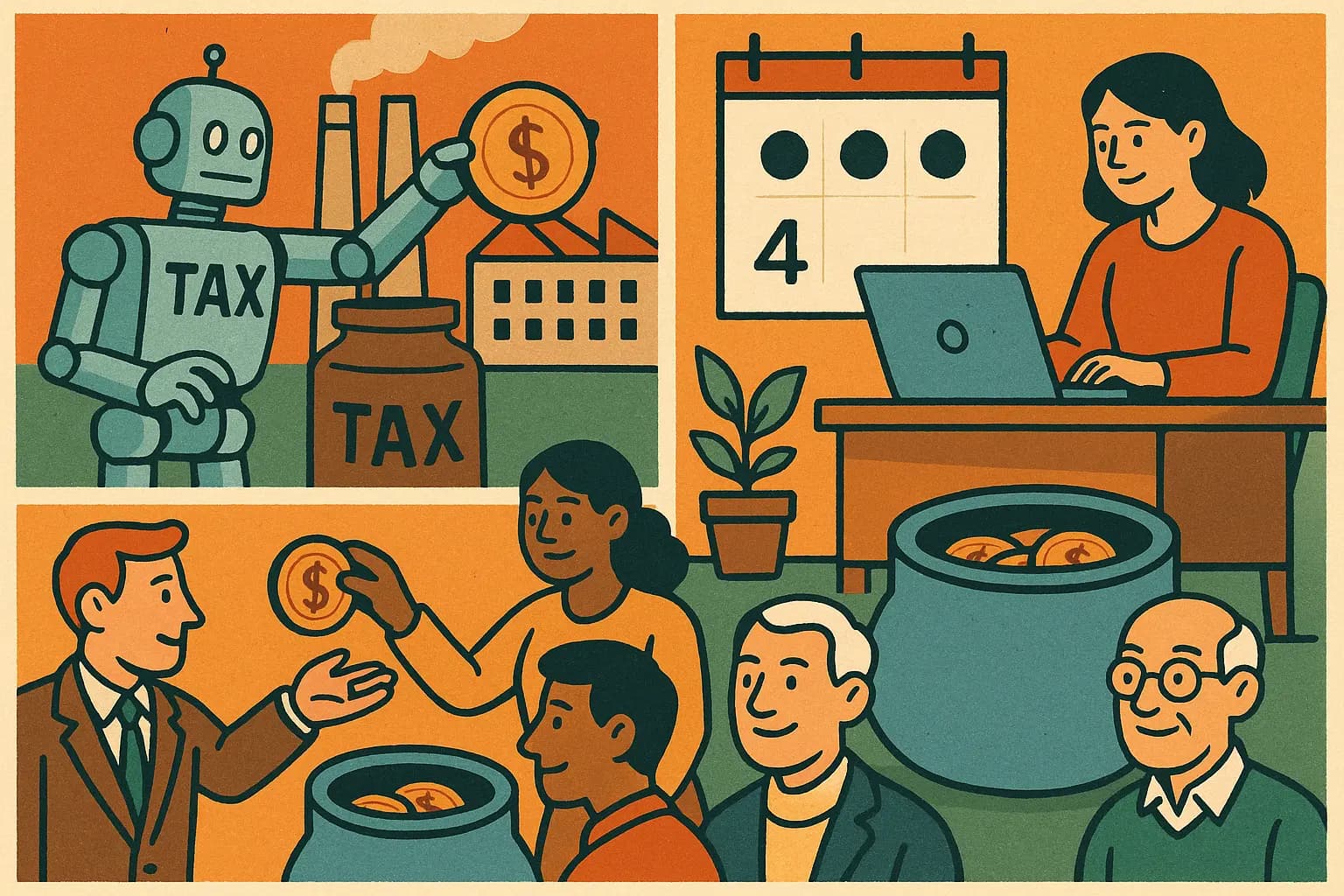
OpenAI built the technology that 18,000 Target headquarters employees use every day. Now it wants to reshape the laws governing how companies like Target pay for that technology, and what happens to the workers it changes.
On April 6, OpenAI released a 13-page policy document titled "Industrial Policy for the Intelligence Age: Ideas to Keep People First," framed by CEO Sam Altman as a starting point for public debate rather than a finished prescription. But the proposals inside are anything but modest. The document calls for robot taxes on automated labor, a national public wealth fund seeded partly by AI companies, and government-supported pilots of a 32-hour workweek with no cut in pay. For most companies, a policy paper from a Silicon Valley lab would be easy to set aside. For Target, it is harder to ignore.
What OpenAI is actually proposing
The document covers five major ideas that, taken together, would fundamentally restructure how AI-driven productivity gains are taxed and distributed:
- A public wealth fund, seeded by governments and AI companies, invested in AI-linked assets, with returns distributed directly to citizens as a dividend from the intelligence economy
- Robot taxes on automated labor: levies on companies that replace human workers with software or machines, shifting the tax burden away from wages and toward capital
- A 32-hour workweek with no loss in pay, piloted in time-bound trials by employers and unions, with the option to convert reclaimed hours into a permanently shorter week or banked paid time off
- Expanded social safety nets, including auto-triggering income support programs designed to activate as jobs are disrupted across industries
- Shifted tax treatment of AI-derived corporate returns, meaning companies would pay more on gains generated through automation
Altman acknowledged that changes to the tax system are among the more politically realistic proposals in the document, describing them as "in the Overton window, but near the edges." OpenAI's Chief Global Affairs Officer Chris Lehane framed the urgency more sharply, arguing that policy responses must be "as transformative" as the technology itself. The proposals blend left-leaning mechanisms, such as public wealth funds and expanded safety nets, with a fundamentally market-driven framework, a combination that reflects the political complexity OpenAI is navigating. The company simultaneously opposes state-level AI regulations while seeking federal infrastructure subsidies, and the document makes no attempt to resolve that tension.
Why this lands differently at Target
Target is not a passive observer to OpenAI's policy ambitions. It is one of OpenAI's most publicly named enterprise partners, with a deployment footprint that is already operating at scale.
ChatGPT Enterprise has been rolled out across Target's Minneapolis headquarters, where 18,000 employees now use it to accelerate workflows, cut administrative noise, and expand creative bandwidth across departments. In stores, the AI footprint is equally direct. Store Companion helps frontline team members instantly surface the most relevant information for guest interactions, covering everything from price matching to returns processing. Agent Assist supports service center teams with the same goal: faster, more accurate answers. The JOY tool, trained on more than 3,000 FAQs, provides instant vendor support. Target has also deployed a Shopping Assistant, a Gift Finder, a Guest Assist tool, and List Scanner, which allows guests to photograph handwritten lists and convert them into shoppable digital carts. Beyond customer-facing tools, the company is using AI to support supply chain forecasting and streamline broader store operations.
That is a significant and growing suite of tools, all of which directly change the daily task flows of people working at Target. That is exactly what makes OpenAI's policy proposals relevant to every team member and store leader.
The cost-benefit math that policy could shift
Here is the mechanism worth understanding: right now, replacing a task with software is cheaper than maintaining human labor for that task, partly because labor carries payroll taxes and benefits costs that software does not. A robot tax or a higher effective tax rate on AI-derived corporate returns would change that equation. If policymakers adopt a meaningful levy on automated labor, the after-tax savings from replacing roles with AI tools would shrink, potentially pushing retailers toward maintaining more human staffing in areas that would otherwise be handed off to software.

The reverse holds too. If retraining and upskilling programs receive federal funding, as OpenAI's document proposes, the employer incentive to invest in internal career development would increase, since some of that cost would be offset publicly. For Target, which is simultaneously investing over $1 billion in technology and store operations in 2026 as part of its broader turnaround strategy, these are not abstract fiscal questions. Any shift in the tax treatment of automation investment, or in the effective cost comparison between labor and software, would feed directly into capital allocation decisions made at the highest levels of the company.
What store leaders and HR partners should do now
Tracking the policy debate is useful, but there are concrete steps worth taking regardless of what Congress ultimately does.
Store leaders and HR partners should stay current on what Store Companion and Agent Assist are actually capable of today versus what is on their development roadmap. Target has publicly described these tools as speeding up Q&A, price matching, returns handling, and broader store processes. Understanding the real scope of those capabilities, and where human judgment remains essential, helps leaders accurately forecast training needs and communicate clearly with their teams about what the tools do and, critically, what they do not do.
The value of that communication cannot be overstated. When tools change task flows without adequate context, team members tend to fill the gap with anxiety. Clear, specific messaging from leaders about the role of AI, and the skills that will still matter most, consistently reduces that noise.
What this means if you work in a Target store or at HQ
The most immediately actionable guidance is straightforward: invest in learning how the AI tools available to you actually work. Store Companion and Agent Assist are designed to reduce repetitive lookups and free up time for the kind of guest interaction that AI cannot replicate: reading a situation, de-escalating a frustrated guest, or connecting someone to the right product through a real conversation. Those skills remain the core of the job.
If you have concerns about longer-term role changes, ask directly. Ask your manager or HR partner what upskilling opportunities exist and what career pathways look like as the AI toolkit expands. Target's public positioning frames AI adoption as augmenting store teams rather than reducing headcount outright, but the specifics of how individual roles evolve will depend on tools, timelines, and business conditions that are still being worked out. Staying engaged in that conversation is more productive than waiting for clarity to arrive on its own.
The bigger picture
OpenAI's 13-page document will not become law on its own. It is a policy wish list from a company with significant financial interest in shaping how AI is governed. But the ideas it contains are increasingly part of mainstream policy conversations as governments design AI regulatory frameworks on both sides of the Atlantic. White-collar payroll has been contracting for 29 consecutive months, a trend already underway before any of these proposals were written. The policy response to that trend is now beginning to take shape, and the companies and workers best positioned will be the ones who understand the landscape before the next shift arrives.
This article was produced by Prism’s automated news system from verified source data, official records, and press releases, then run through automated quality and moderation checks before publishing. The system is built and supervised by the people who set the standards it runs under. Read our full AI policy.
Did this article answer your question?