Ludwigia repens brings vivid color to low-maintenance aquascapes
Ludwigia repens is the quickest way to add red to a planted tank without signing up for a demanding high-tech routine.
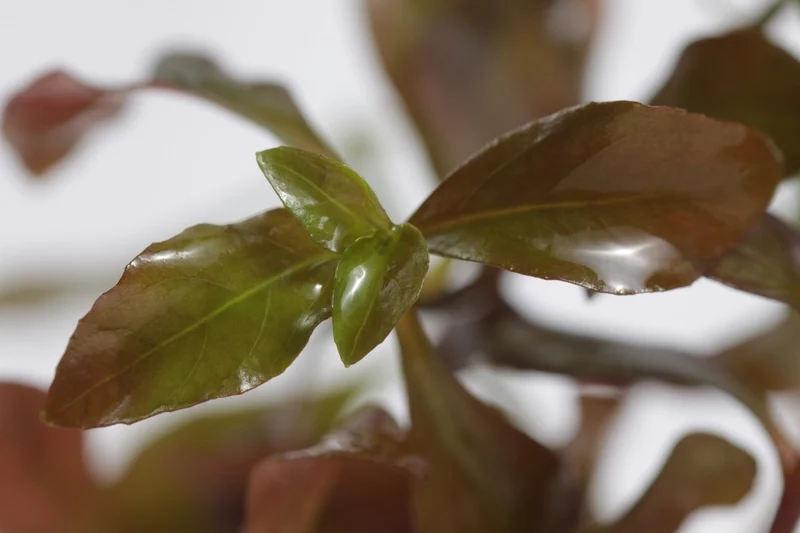
Ludwigia repens brings fast color to a planted tank without becoming another needy houseguest. It brings a warm, vivid tone that breaks up walls of green, and in the right spot it can make a basic community tank look deliberate instead of crowded.
Why it works in aquascapes
The plant has real range in the hobby because it is adaptable, fast-growing, and naturally useful in a peaceful freshwater setup. You will see it sold as Ludwigia repens, water primrose, or creeping primrose willow, and that matters because this is not just an ornamental name on a tag. The USDA lists it under the symbol LURE2 as a perennial forb-herb and wetland plant, which fits its real-world habit of growing in shallow water and marshy margins.
In the wild it shows up in ditches, pools, streams, and marshes across the Southeast, with a broader range that runs from North Carolina through Florida and west to Texas and northeastern Mexico, plus outlier populations farther west. In the tank, it tolerates normal planted-aquarium conditions far better than many red stems that look great for two weeks and then melt if the setup is not perfect.
Where it belongs in the layout
Ludwigia repens earns its keep most easily as a midground stem. That is the sweet spot where its red or reddish-bronze leaves can punch through a composition without swallowing the hardscape or crowding out carpeting plants. Put it behind a short carpet or beside darker wood and stone, and the color reads immediately.
The plant also earns its place in community tanks because it has utility beyond being pretty. Dense foliage gives smaller fish and shrimp a bit of cover, and the stem form lets you build rhythm into the layout by repeating small groups instead of planting one big block. If the tank is already heavy on green stems, this is the plant that keeps the whole scene from flattening into one color.
What the plant looks like when it is happy
Most water primroses are emersed plants, but Ludwigia repens is mostly submersed, which is why it looks more naturally at home under water than many of its relatives. It is also commonly found in marshes nearly throughout Florida and blooms from spring to fall.
In the aquarium, that submersed habit shows up as a dense, leafy stem that can be shaped into a tight thicket or a looser patch. It is not a carpet plant and it is not a centerpiece rosette, so treat it like a stem plant and it rewards you with a clean, vertical line.
How to keep the color rich
Color is the whole game with Ludwigia repens, and light is the biggest lever. Brighter lighting deepens the red tones; lower light tends to keep the leaves greener, and in some tanks it will even push the plant toward leaf drop. If you want the red to show, do not bury it in the shade of a canopy or let taller stems block the light once it starts climbing.
The practical trick is to treat the plant like a color accent, not a filler. Give it enough light to keep compact growth and decent internode spacing, then place it where the beam actually reaches the upper leaves. Medium light can keep it alive and presentable, but stronger light is what turns it from “nice green stem with a hint of red” into a true contrast piece.
- Plant it where the light is unobstructed, especially in the midground.
- Keep it in a stable, nutrient-fed substrate so the lower stems do not thin out.
- Trim before it shades itself and starts looking sparse below.
- Replant healthy tops to keep the group full and compact.
A simple setup that usually works looks like this:
When low maintenance stops feeling low maintenance
Ludwigia repens is easy compared with many red stems, but the moment you push it for stronger color, it starts asking for more from you. Bright light makes the reds better, but it also speeds up growth, which means more trimming and a steadier nutrient supply to keep the plant from going leggy or dropping lower leaves.
If you want the most vivid color and the densest growth, you are signing up for regular pruning, a substrate that feeds roots, and enough stability that the lower half of the stem does not deteriorate while the top races for the surface.
Planting, trimming, and propagation
Treat planting like any other stem plant job. Separate the stems, bury the lower nodes lightly, and leave enough spacing for water to move through the group so the bottom does not go stale. In a newer setup, Ludwigia repens usually settles quickly, but in a mature tank it looks best once the trimmed tops are replanted and the base has filled in.
Pruning is where the plant really becomes an aquascaping tool. Cut above a healthy node, replant the tops, and you can build a thicker group without starting over.
Propagation is as straightforward as the rest of the plant. Stem cuttings root readily, which is why the species keeps earning a place in planted tanks that need repeatable, predictable color. Once you have a healthy patch, it is easy to turn one bunch into several accents across the hardscape.
This article was produced by Prism’s automated news system from verified source data, official records, and press releases, then run through automated quality and moderation checks before publishing. The system is built and supervised by the people who set the standards it runs under. Read our full AI policy.
Did this article answer your question?