Penn State updates backyard poultry deworming guidance for worm signs
Penn State’s new poultry guide says don’t dose on autopilot: confirm worm burdens with fecal testing, because the wrong sign can lead to the wrong treatment.
Backyard worm problems are easy to misread. A flock can look a little off, lay fewer eggs, or drop weight for reasons that have nothing to do with parasites, and Penn State Extension’s updated guidance is a blunt reminder that deworming is not a reflex action. The smarter move is to look for the pattern, confirm it with a fecal check, and treat the right issue instead of guessing.
What Penn State wants backyard keepers to notice
Penn State’s June 15, 2026 update puts the warning signs in plain sight: diarrhea, depression, reduced weight gain, weight loss, anemia, worms in eggs, and lower egg production. Those are the signals that should make you stop assuming a bird is “just molting” or “just having a bad week.” Worms can be present in a healthy-looking flock at low levels, and that is exactly why eyeballing the birds is not enough.
The main parasites Penn State calls out for Pennsylvania flocks are roundworms, cecal worms, threadworms, and tapeworms. That list matters because different worm loads show up differently, and a small number of worms often does not create obvious illness. Once the burden grows, though, the flock starts telling on itself: you see the drop in performance before you ever see a worm.
Why testing beats guessing
This is where a lot of small-flock owners go wrong. The signs of worms overlap with other diseases and basic management problems, so Penn State says the diagnosis should be confirmed with microscopic examination of feces for worm eggs or larvae. That is the part that saves you from dosing birds for the wrong problem.
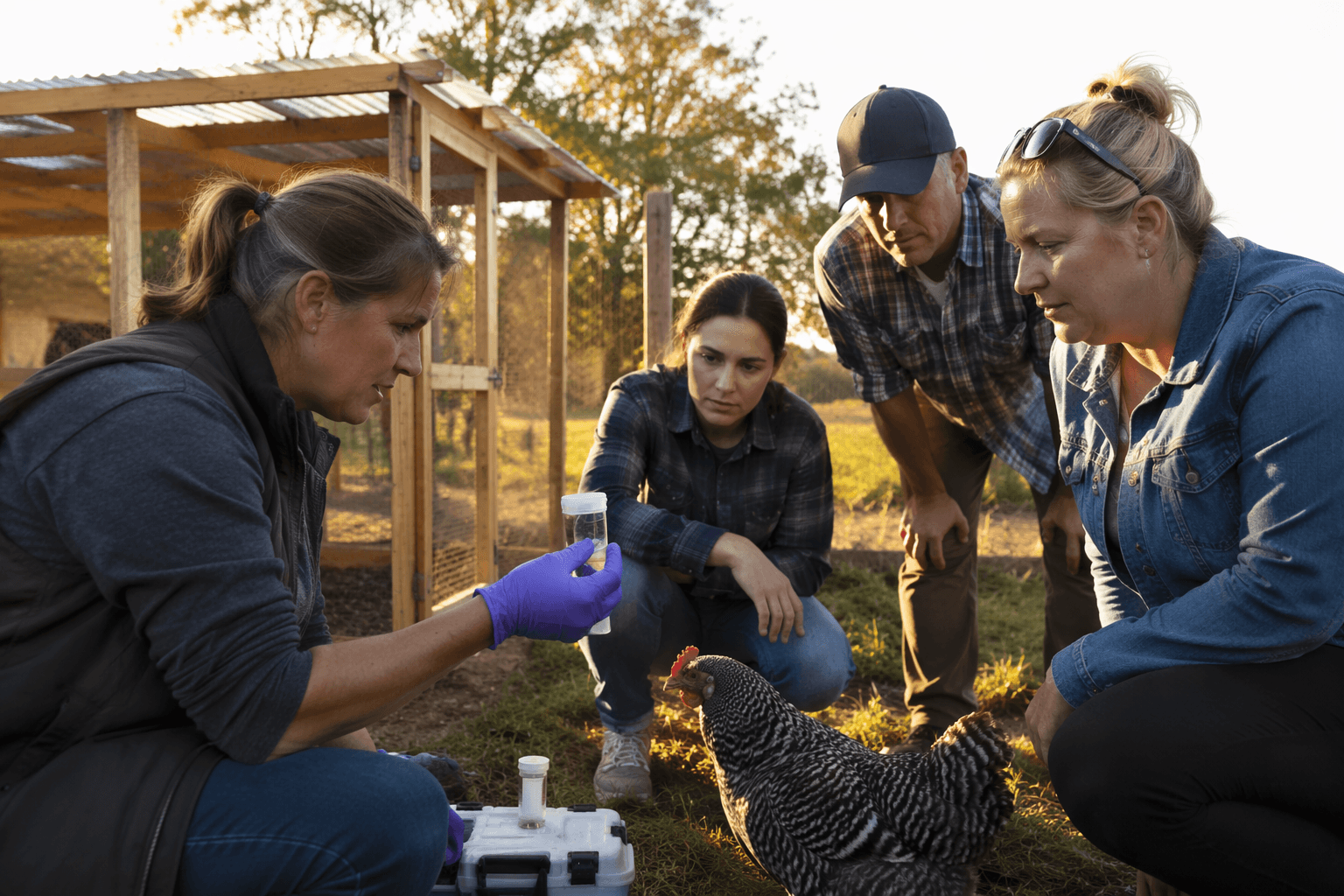
If you are seeing loose droppings, pale combs, poor growth, or a hen that has quietly stopped laying like she used to, fecal testing gives you something solid to work from. It also helps you separate a true parasite load from stress, nutrition issues, or some other disease process that looks suspiciously similar from across the run.
The part that makes worms so stubborn
Worm control is not just about what is happening inside the bird. Penn State emphasizes that worm eggs can survive in the environment for long periods and are resistant to common disinfectants, which is why a parasite issue does not disappear because you scrubbed the coop floor and sprayed the walls. Once eggs are in the litter, feed area, or yard, the cycle can keep going.
That is the hard reality for backyard setups with pasture access, high stocking density, and a lot of fecal buildup. Birds pick up infection by ingesting worm eggs from contaminated feed, water, litter, or grass. They can also get infected by eating intermediate hosts, including earthworms, grasshoppers, snails, slugs, flies, and beetles. In other words, the parasite pressure is not confined to one dirty corner of the coop. It can be in the grass, in the bugs, and in anything a chicken naturally pecks.
Why cecal worms are a special problem
Cecal worms deserve extra attention because they do more than bother chickens. Penn State notes that they can carry the protozoal parasite that causes blackhead in turkeys, a disease for which there is no treatment. Chickens are more resistant and may act as carriers, which is why a mixed backyard flock can become a turkey problem fast if cecal worms are left unchecked.
That detail changes the way you should think about species separation and parasite management. If you keep turkeys anywhere near chickens, cecal worms are not just another barnyard nuisance. They are one of those hidden links between a mild chicken issue and a serious turkey health problem.
Routine deworming or targeted treatment?
Penn State lays out two broad strategies: deworm on a routine schedule, or only deworm when testing suggests a high worm burden. Neither approach is magic, and the right choice depends on your setup, your pressure from parasites, and how disciplined you are about monitoring. What the guidance rejects is automatic treatment with no evidence that the flock actually needs it.
That caution matters because deworming without a clear reason can treat the wrong issue, create a false sense of security, and make you less likely to look for the real cause of a decline. In small flocks, that can mean you keep repeating the same mistake while the birds still lose condition.
What product Penn State points to
Penn State names fenbendazole as the only product currently approved in the United States for roundworms and cecal worms in chickens and turkeys, and notes that a prescription is required if the drug is used off-label. FDA records show Safe-Guard AquaSol, the fenbendazole oral suspension, was originally approved in 2015 and received supplemental approval in 2018.
Merck Animal Health’s current labeling says Safe-Guard AquaSol is indicated for adult Ascaridia galli in broiler chickens and replacement chickens, and for adult A. galli and Heterakis gallinarum in breeding chickens and laying hens. Merck also markets a poultry product for growing turkeys that covers roundworms and cecal worms. That specificity matters, because poultry drug labels are not interchangeable, and using the wrong product for the wrong bird is a fast way to complicate an already messy parasite problem.
The practical backyard takeaway
If your flock looks a little off, the first question should not be “What dewormer do I have on hand?” It should be whether the signs actually point to worms and whether a fecal exam can confirm them. That approach is more work up front, but it keeps you from treating by habit, missing another disease, or feeding parasite resistance with sloppy use.
Penn State’s updated guidance reads like advice from someone who has seen too many flocks chased through the same cycle: dirty yard, growing worm load, vague symptoms, random dosing, then more confusion. The better habit is to watch for the signs, test when it matters, and remember that worm management is a long game tied to pasture pressure, fecal buildup, flock density, and the stubborn fact that parasite eggs do not vanish just because the coop looks clean.
This article was produced by Prism’s automated news system from verified source data, official records, and press releases, then run through automated quality and moderation checks before publishing. The system is built and supervised by the people who set the standards it runs under. Read our full AI policy.
Know something we missed? Have a correction or additional information?
Submit a Tip