How Bonsai Judges Score Trees at Club and National Shows
Most hobbyists lose points they didn't know were on the table; understanding exactly how judges read a tree from nebari to apex changes how you train, time, and present.
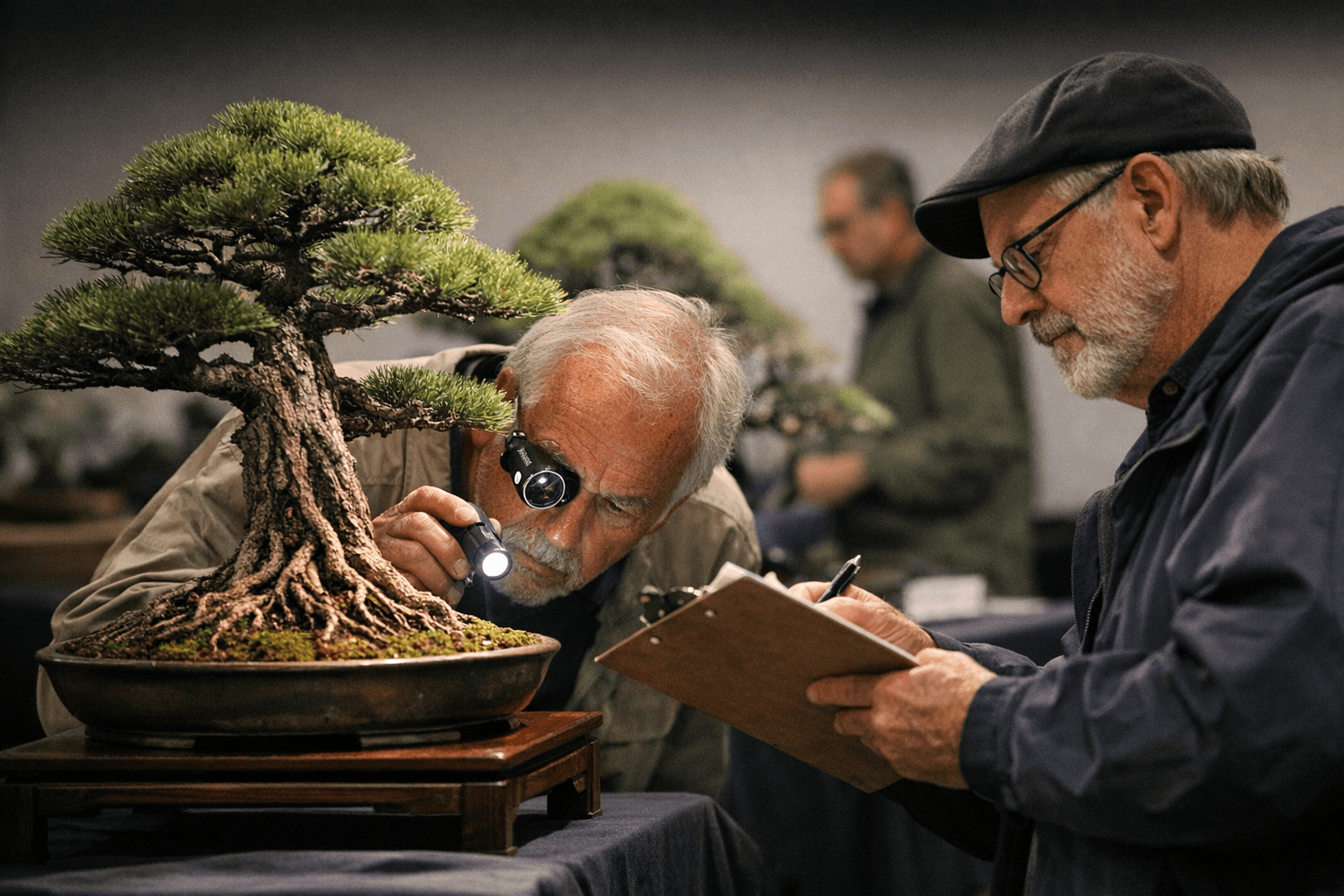
The tree that wins a club show rarely wins because it is the most styled. It wins because it convinces a judge, at every stage of the viewing, that everything in the display is where it should be. That distinction matters more than most exhibitors realize. To show how judges actually move through a tree, walk through a single representative entry: a mature Japanese maple in informal upright (moyogi) form, mid-size class, autumn show. This is the kind of tree that looks strong in a backyard photo but can unravel quickly under a trained eye.
The First Five Seconds: Overall Impact and Silhouette
Before a judge reads species, class, or age, they read silhouette. The question is instant and unconscious: does this look like a tree? A convincing moyogi should taper from a wide, grounded nebari through a progressively narrowing trunk line to a defined apex that closes the composition. Correct form requires only one apex, and the trunk should taper as it ascends with no reverse taper acceptable, widening near the base and becoming gradually thinner toward the top. If the maple's top third is heavy or blunt, that registers before any single branch is examined.
The silhouette also tells judges about time. A flat, compressed canopy with dense tertiary ramification signals years of patient clip-and-grow work. A leggy, open canopy with thick secondary branches but little fine branching signals a tree still in development. Neither is disqualifying on its own, but the second tree should not be entered in a competitive class if the show values refinement, and judges will note it clearly.
Nebari: Where Judges Spend More Time Than You Think
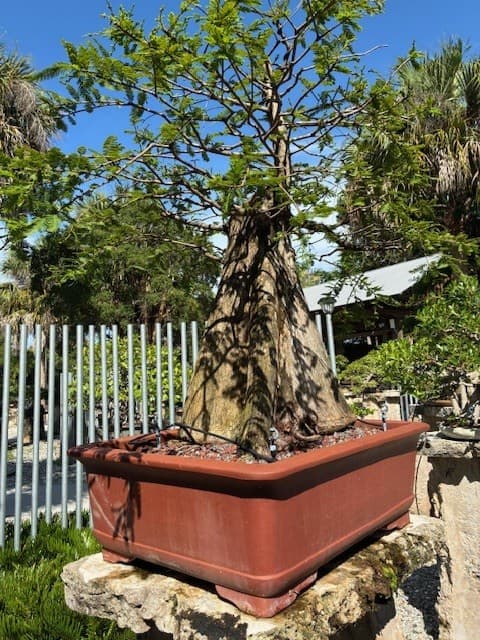
Most hobbyists focus on branches. Experienced judges spend a disproportionate amount of time looking at the base. Roots should radiate from the flare, look natural, and be visible on the surface of the soil; anchor wiring should not be visible, and no roots should point directly at the viewer. For our maple, a well-developed nebari spreading evenly in multiple directions signals age and health simultaneously. A one-sided nebari, or one that is buried under moss that looks suspiciously strategic, signals a problem being concealed.
This is one of the most common invisible penalties in club shows: moss applied heavily to hide soil surface defects or root problems. Judges who have seen thousands of trees read that immediately. Nebari should be well developed, with roots evenly distributed along the trunk that match the scale of the trunk and the overall image the tree presents. A modest root prune done months before a show is always a better strategy than last-minute cosmetic work at the soil surface.
Reading the Trunk and Tachiagari
The section of trunk between nebari and first branch, the tachiagari, sets the tone for everything above. On our maple, judges are checking that the lower trunk shows genuine movement in the style claimed, that the taper is continuous and not interrupted by a thick straight section, and that the bark texture is consistent with the tree's claimed maturity. Bark scarring from old wire bites, if unhealed, signals neglect; healed wire scars that have begun to integrate into bark texture are far less penalized and in old material can even read as character.
Branch Placement and Negative Space
This is where judging becomes genuinely subjective, and where the myth that bonsai judges apply a rigid formula collapses. Judges are not checking branches against a template. They are asking whether the branching choices are consistent with how this species grows in nature, whether the negative spaces feel deliberate rather than accidental, and whether the first, second, and third branches create a coherent sense of depth.
Bonsai should evoke a sense of natural beauty, as if it were a fully mature tree in a natural landscape. For a Japanese maple specifically, that means fine, twiggy tertiary branching that catches light through the canopy rather than dense foliage pads more appropriate to junipers. Judges penalize forced stylistic choices that disregard species habits. An autumn maple entered when leaves are still dense and green is hiding its ramification, which is precisely the feature that justifies a maple's place at a show in the first place. Timing a maple entry for late autumn, when leaf color is at peak or foliage has dropped to reveal structure, is a strategic decision that the most competitive exhibitors make years in advance.
Pot, Stand, and Display: The Story Everything Tells Together
A good pot blends with the image the tree portrays but does not steal the show, and should provide a sense of stability. For our maple, a rectangular unglazed pot in a muted earth tone reads as appropriate; a showy glazed pot in a competing color pulls the eye away from the tree. Pot depth matters too: convention ties pot depth roughly to trunk base diameter, though style and species modify that rule. A pot that is visually too heavy makes the tree look young; one too shallow makes a large tree look precarious.
The overall impact of the tokonoma display, including the correct form for the tree species and scale appropriate to the class, is evaluated from the first moment. Stand height should complement the tree's viewing angle, typically placing the nebari at or near eye level for medium and large trees. An accent plant, where shows permit one, should reinforce the season and the story, not compete with the main tree. A late-season grass kusamono alongside an autumn maple works; a flowering spring accent alongside the same tree in October does not.
What Judges Actually Write Down: The Feedback Hobbyists Miss
Judges at club shows typically focus their written critique on four recurring areas: scale relationships between pot and tree, visible structural weaknesses such as an unrefined apex or a heavy straight section in the trunk, seasonal readiness, and display coherence. Scoring every tree in an exhibit provides an overall view of which trees stand out within their categories, and critiques allow members to ask questions to help them understand bonsai conventions and learn tangible ways to improve their trees.
The most useful feedback is not about the show you just entered; it is a training roadmap for the next two to three years. A judge noting that the apex needs another season of selective wiring is telling you exactly what the tree requires before it competes again. Repeated show feedback across multiple seasons is one of the fastest routes to measurable improvement, precisely because it forces you to compare how your tree read one autumn versus the next.
The Long View: Rotating Trees Through Show Seasons
One habit that separates experienced exhibitors from beginners is approaching shows as a collection strategy rather than a single-tree event. Seasoned exhibitors typically rotate several trees: some that are consistently show-ready, others being trained specifically toward a target show two or three years out, and some used exclusively for demonstration and education. The trunk is generally treated as the most important element in scoring frameworks, typically weighted highest among all evaluated criteria. That weighting means trees with genuinely exceptional trunk material are worth developing toward shows over long timelines, even if branching and refinement are still years from competitive standard.
Understanding judging criteria does not mean chasing scores. It means making smarter training decisions: timing repotting so nebari reads cleanly at show season, selecting pot dimensions that complement rather than compete, and entering trees at the stage in their development where their strongest features are visible. The maple that wins is the one where nothing in the display contradicts anything else, and where the tree's best qualities are precisely the ones the judge encounters first.
This article was produced by Prism’s automated news system from verified source data, official records, and press releases, then run through automated quality and moderation checks before publishing. The system is built and supervised by the people who set the standards it runs under. Read our full AI policy.
Did this article answer your question?