Cuba’s cash shortage leaves banked salaries inaccessible amid collapse
A salary on a card is not the same as cash in hand. In Cuba, empty ATMs and blackouts are turning banked pay into a daily dead end.
The moment the card stops working
The ugliest part of Cuba’s cash crunch is not the balance on the screen. It is the moment you stand at an ATM in Havana, tap your card, and find the machine empty, broken, or useless because the power or network has failed. That is the contradiction now shaping daily life: money exists, wages exist, but the cash side of the system often does not.
That failure is more than an inconvenience. It turns a routine withdrawal into a long wait, then a loss of time, then a forced detour to another branch, another machine, or an informal workaround. In a country where salaries are already too small and prices keep moving, losing access to cash means losing control over the day.
How Cuba built a banked-pay economy that still cannot deliver cash
Cuba has spent the past decade pushing people toward a more digital, card-based system. The Banco Central de Cuba has public pages for Bancarización and Pagos digitales, both framed around expanding modern, inclusive, secure financial services through digital and in-person channels. On paper, that is supposed to make life easier: pay electronically, move money with Transfermóvil, and use QR codes in neighborhood shops, pharmacies, and state payment offices.
The problem is that the system was built to reduce cash in circulation faster than the state could keep the cash infrastructure healthy. In many sectors, workers are paid through bank cards, so the salary arrives, but the conversion from a digital balance to physical bills depends on ATMs, bank branches, electricity, and functioning networks. When any one of those breaks, the whole chain breaks with it.
The state made that push more aggressive in August 2023, when the Central Bank published regulations meant to steer Cubans and companies toward electronic payments wherever possible. That pressure intensified again with the arrival of the Clásica card, which Financiera CIMEX S.A. said would work nationwide from January 24, 2024 across the commercial network where electronic point-of-sale terminals operate. The message was simple: spend by card, not by cash. The reality has been messier.
Why a balance on paper cannot become buying power
This is where the contradiction bites hardest. Cuba has different card types for Cuban pesos, foreign-currency deposits, and the Clásica card tied closely to dollar-linked payments. That arrangement creates layers of access, but it does not solve the basic problem of getting banked money into circulation as usable cash for ordinary purchases.
Even the Central Bank’s own website now reflects the strain. It shows current exchange-rate information and news about new high-denomination banknotes in 2026, which is a useful reminder that small notes and cash availability have become part of the policy problem, not just the household problem. The system is still trying to patch itself while people are trying to buy lunch, pay a driver, or settle a bill.
Economist Omar Everleny Pérez put the diagnosis bluntly to AP in April 2024: “There is money, yes, but not in the banks.” He linked the shortage to the fiscal deficit, the lack of banknotes above 1,000 Cuban pesos, high inflation, and the fact that cash was not returning to banks. That is the core of it. The state has money moving through the system, but too much of it is trapped, redirected, or simply unavailable at the point where people need it.
What the shortage does to ordinary life
The cash squeeze is not isolated from the rest of Cuba’s collapse. It slows food purchases, makes transport harder to arrange, and complicates the informal transactions that still keep neighborhoods moving. If a corner shop has power but the QR system is down, or if a driver wants bills instead of a transfer, the difference between a bank card and folded pesos can decide whether a deal happens at all.
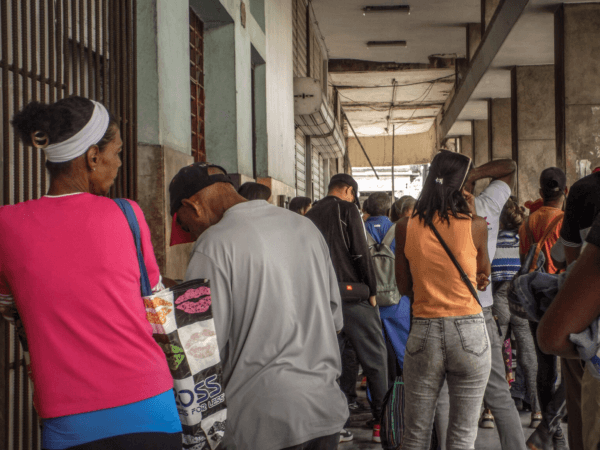
AP reported long lines outside banks and ATMs in Havana in April 2024, with some people leaving empty-handed after hours of waiting. That image has become the most practical summary of the crisis: a person may have a banked salary, yet still spend an afternoon chasing access to the money. In a normal economy, the card is a convenience. In Cuba now, it can be a bottleneck.
The shortage also distorts trust. People start planning around machine outages, branch limits, and the odds that a withdrawal will fail. That means more time away from work, more uncertainty at the market, and more pressure to hold onto whatever cash can be found, because nobody wants to be the last person in line when the ATM runs dry.
Why the power crisis makes the cash crisis worse
Cuba’s cash shortage cannot be separated from its energy collapse. Without stable electricity, ATMs stop, point-of-sale terminals stall, and mobile payment tools become unreliable just when the state is asking people to use them more. In March 2026, DW reported that Cuba had suffered four nationwide blackouts in two years and 10 widespread outages since February 2024, a brutal record for a system that depends on steady power to move money.
PBS reported in February 2025 that authorities suspended classes and work activities for two days because electricity generation shortages exceeded 50 percent. That is not a side issue. When schools and workplaces shut down, when fuel runs short, and when the grid cannot hold, the banking system loses the basic support it needs to function.
The United Nations said in April 2026 that humanitarian needs in Cuba remain acute and persistent amid fuel shortages and energy shocks. That wider context matters because the cash shortage is not some separate financial glitch. It is one more broken link in the chain that turns wages, savings, and electronic balances into food, medicine, and transport.
What this leaves Cuba with now
Cuba’s banking push was supposed to modernize daily life. Instead, it has exposed a country where digital promises and physical shortages sit side by side. Transfermóvil, QR codes, card payments, and bancarización all work on the same assumption: the system will be there when you need it. Too often, it is not.
That is why the failed withdrawal at an ATM matters so much. It captures the whole mess in one scene: a salary that exists, a bank that has the record, a machine that gives nothing, and a citizen left to solve the rest of the day with less certainty than before. In Cuba right now, access to money is no longer just about earning it. It is about whether the country can still make cash real.
This article was produced by Prism’s automated news system from verified source data, official records, and press releases, then run through automated quality and moderation checks before publishing. The system is built and supervised by the people who set the standards it runs under. Read our full AI policy.
Did this article answer your question?