Holguín airport rents parking spaces to businesses amid tourism slump
Holguín’s airport is renting out parking-area food spaces, a blunt sign that one of Cuba’s main tourist gateways is chasing revenue while passenger flow stays weak.

Holguín’s Frank País International Airport has started treating its parking lot like a storefront. The airport called on “todas las formas de gestión no estatal de la provincia” to sign contracts for “arrendamiento de espacios gastronómicos” in the parking area, a move that says as much about Cuba’s tourism slump as it does about one airport’s scramble for cash.
The airport is still open and still functional. ECASA manages the facility, and official airport channels continue to promote flight schedules, terminal contacts and VIP services. But the new push to lease out food space in a parking zone shows a terminal built around traveler flow now trying to monetize whatever corner it can while traffic stays soft.
The numbers behind that pressure are hard to miss. ONEI says its tourism publications track arrivals, overnight stays, occupancy rates and other indicators used for economic analysis, and the latest Cuba-wide data show the sector still lagging badly. By February 2025, the island had received 496,858 travelers, including 374,267 international visitors, with international arrivals down 29.1% from the same period in 2024.
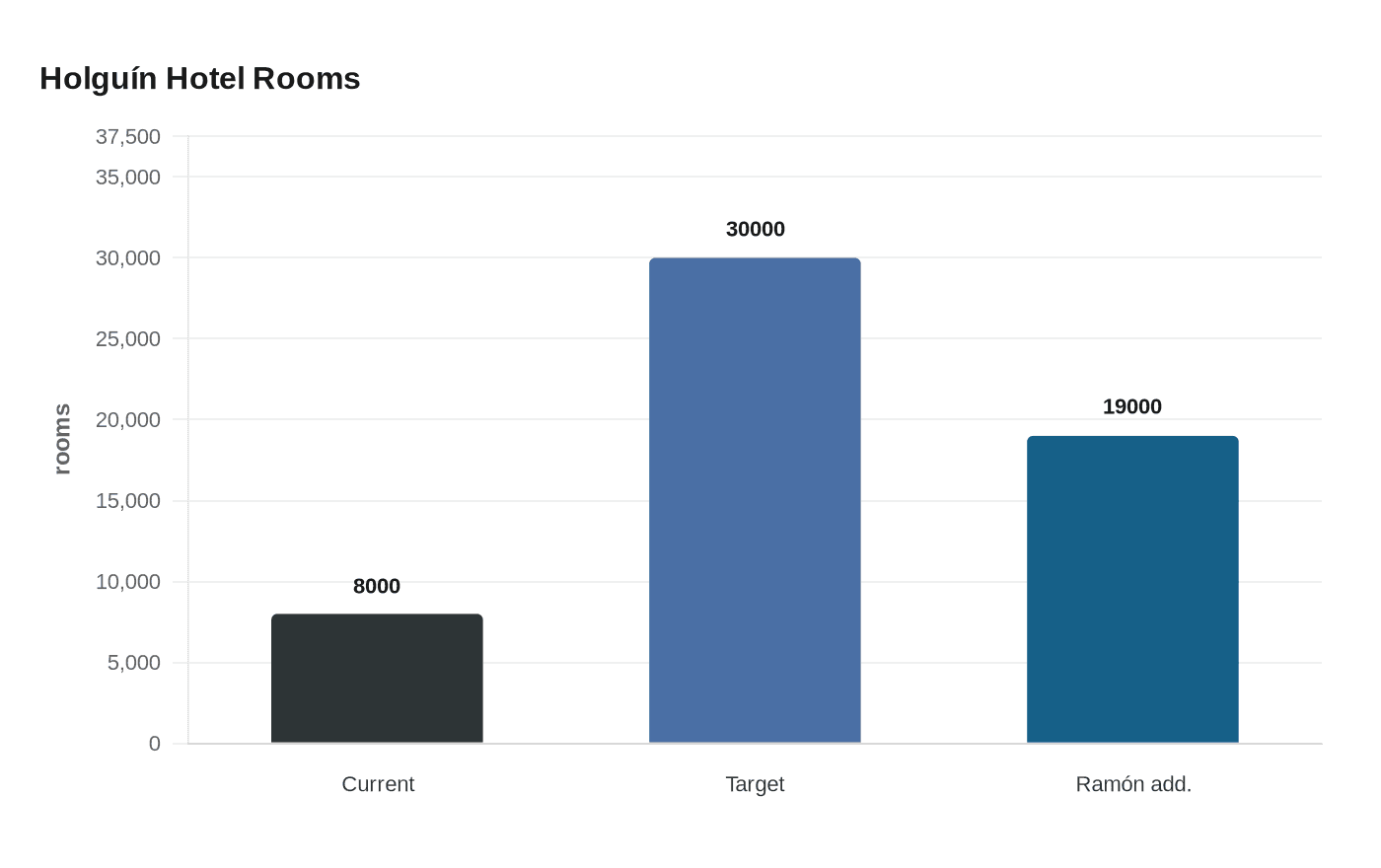
Holguín has long been sold as one of the island’s big tourist poles, but even there the expansion plans now collide with weak demand. Local tourism reporting put the province’s hotel plant at almost 8,000 rooms in 2024, all four- and five-star, with a target of 30,000 rooms within seven years. Officials have said the Ramón de Antilla investment program could eventually add more than 19,000 rooms, while Holguín also advertises more than 57 kilometers of beach and more than 27 immersion areas.
That makes the airport’s parking-area leasing proposal more than a simple business notice. It is a small but revealing sign of how the province is trying to keep infrastructure useful while the travel economy slows. For private vendors, it opens a foothold in one of Holguín’s most visible public spaces. For the airport, it turns idle pavement into rent. For the wider region, it underlines how much now depends on whether planes keep coming.
The tactic was not new. A 2023 solicitation from the same airport set a registration window from April 20 to June 20 and required applicants to file paperwork with the business department at km 11.5 on the Carretera Central via Bayamo, a process that drew criticism on social media for its bureaucracy. Similar appeals have also surfaced at Antonio Maceo Airport in Santiago de Cuba, where local merchants were asked to help support fine gastronomy. Holguín now looks less like an exception than part of a wider airport-level search for non-state operators to fill empty commercial space.
This article was produced by Prism’s automated news system from verified source data, official records, and press releases, then run through automated quality and moderation checks before publishing. The system is built and supervised by the people who set the standards it runs under. Read our full AI policy.
Did this article answer your question?