U.S. Coast Guard Rules eFoils Are Vessels, Requiring Registration and Safety Gear
The Coast Guard classifies eFoils as "Mechanically Propelled Personal Hydrofoils," triggering federal vessel rules, registration requirements, and mandatory safety gear for riders nationwide.
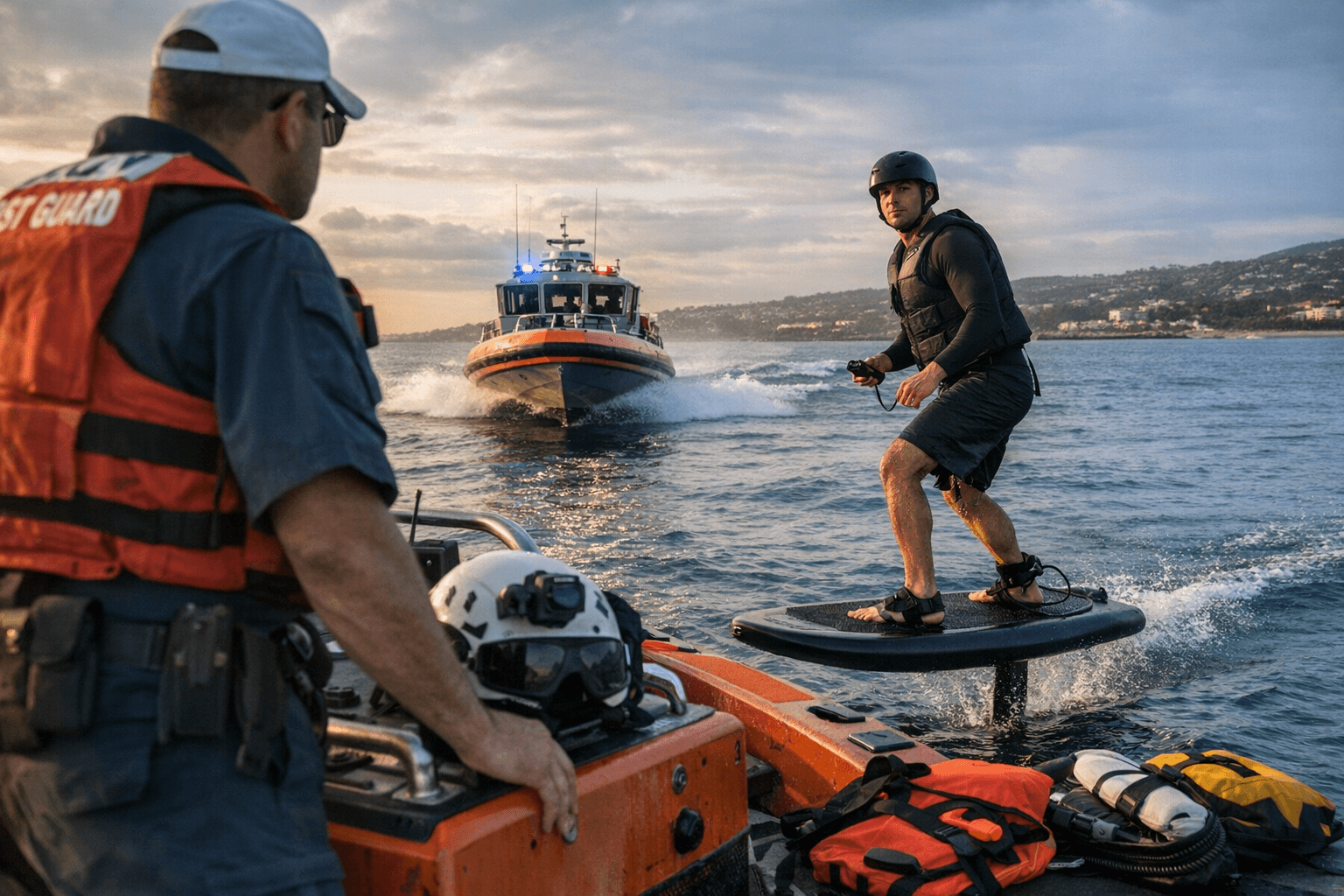
The U.S. Coast Guard has formally classified eFoils as vessels under federal law, a ruling with direct consequences for anyone riding a battery-powered hydrofoil on navigable U.S. waters. The classification, established through a vessel determination letter dated September 23, 2021, and codified in Coast Guard policy letter CG-BSX 22-02 signed by CAPT T.P. Glendye on October 5, 2022, designates powered hydrofoil boards as "Mechanically Propelled Personal Hydrofoils," or MPPHs, and motorized surfboards as "Mechanically Propelled Surfboards," or MPS. The policy cites speeds in excess of 35 mph as a key safety concern driving the regulatory framework.
The practical fallout runs deeper than a label change. Riders are now expected to carry a Certificate of Number (CON) while underway, display state vessel registration numbers, and obtain a Hull Identification Number (HIN) where required by their state. NASBLA's Vessel Identification Registration and Titling committee provided input on these policies, and states are responsible for their own enforcement regimes, which means requirements vary considerably depending on where you're riding.
Hawaii's Division of Boating and Ocean Recreation was ahead of the curve, having already required registration and visible numbering for eFoils before the federal policy landed. Other states are still working out their own frameworks, which creates genuine compliance uncertainty for riders who travel with their boards or operate across state lines.
The safety-equipment list mirrors what you'd expect on a small motorized vessel. Operators must carry or wear a USCG-approved PFD in compliance with state and federal rules. A fire extinguisher is required unless all persons aboard are already wearing an approved life jacket. Night or restricted-visibility sessions require navigation lighting per 33 CFR Part 83 Inland Navigation Rules, plus a sound-producing device. Manufacturers must also comply with engine cut-off switch (ECOS) requirements or secure a formal exemption from the Coast Guard.
The disconnect between federal policy and state-level implementation is where most riders run into trouble. The Coast Guard sets the classification and the baseline equipment expectations; your state boating agency decides whether registration is mandatory, what the HIN process looks like, and how actively local law enforcement, harbormasters, and park police are actually checking compliance on the water. Commercial operators, rental fleets, and guide services carry additional exposure and should verify their insurance covers vessels as defined under the updated classification.
NASBLA and individual state boating-safety programs are the practical starting point for building a compliance checklist. The Coast Guard's vessel-determination framework is the federal floor, not the ceiling, and with the eFoil market continuing to grow faster than uniform legislation can follow, riders who treat their boards as the regulated vessels they legally are will stay ahead of a regulatory landscape that is still actively evolving.
Know something we missed? Have a correction or additional information?
Submit a Tip