Fine line tattoos rise with social media and precision tech
Fine line geometry looks sharp on day one, but scale, placement and sun decide whether it stays readable or turns mushy.
A perfect hexagon on a healed forearm is a lot harder than it looks on a stencil photo. A sacred-geometry piece that reads clean in a feed can fall apart once the body bends, the line spreads, and summer sun gets involved. On July 11, 2026, Vita of Teddington Ink described the core tension: social media and precision tech helped fine line explode, but the style is still brutally unforgiving.
Why the style took off
Social media has been driving tattoo trend shifts for years. Rough Sands Tattoo made that point in 2023, and Fresno State’s March 2, 2026 research spotlight found Instagram, TikTok and YouTube changed how artists learn, promote work, and build client communities across the globe. InkedMag made the same point back in 2018 with “How Instagram Changed Tattoo Culture.”
That digital visibility favors fine line because it photographs cleanly. Crisp black geometry, thin scripts, and minimalist symbols hold attention on a screen better than heavy shading does, and better machine stability means more artists can hit those delicate lines consistently. The market backdrop is still expanding too, with the tattoo market projected to grow at a CAGR of 10.60% from 2024 to 2031, while Fortune Business Insights lists a tattoo market report last updated June 1, 2026 with coverage through 2034.
When fine line geometry is the right call
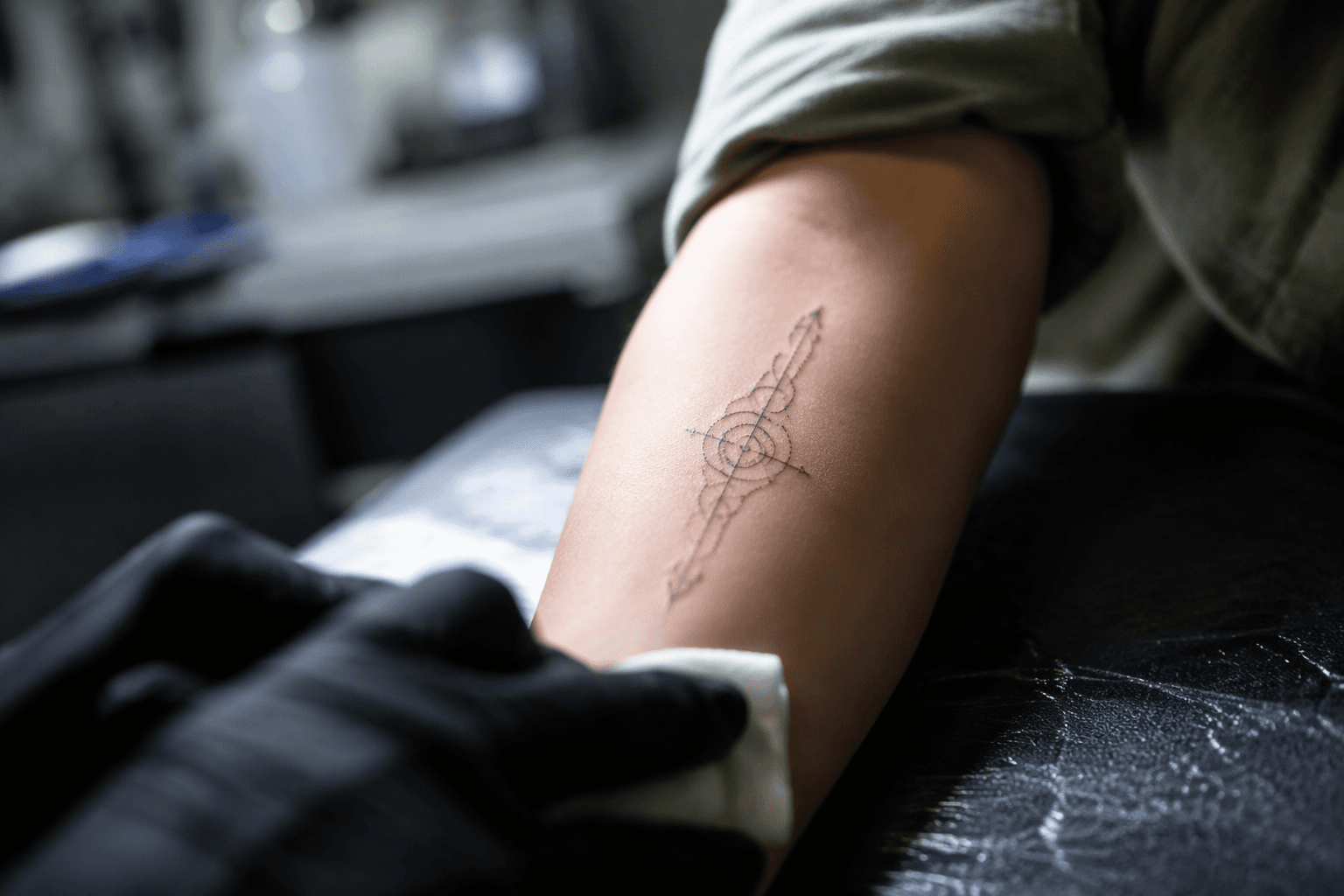
Fine line geometry works best when the design is small enough to keep its spacing intact, clean enough to read without bold outlines, and placed where the body does not fight the composition. Fine line geometry is usually done with lining needles or single-needle techniques, and single-needle and fine line tattoos are often more successful when scaled smaller.
That smaller-scale rule matters more in geometry than in almost any other style. A compact mandala, a tiny cube study, or a minimal sacred-geometry symbol can hold its structure if the intersections are few and the negative space has room to breathe. Once you start stacking too many spokes, dots, and micro-intersections into a tiny footprint, the tattoo stops being precise and starts becoming visual noise.
Good placements help the art do its job. The most forgiving spots are the inner forearm, calf, back of the arm, and outer thigh, and the forearm is a high-demand placement for everything from a first piece to a full sleeve. Those areas give fine line work a flatter surface and a little more visual stability, which is exactly what geometry needs.
Where the risk climbs fast
The danger zone is easy to spot if you’ve watched healed photos for long enough. Ultra-thin sacred-geometry lines can look elegant fresh and then soften into a blur once the line spread kicks in, especially when the design is too small for the placement. The problem is not just fading, it is readability: if one border thickens and the next one softens unevenly, the whole structure starts to look off.
Rounded muscle is where digital symmetry gets humbled. A design that looks mathematically perfect in Procreate can warp when it crosses a deltoid, wraps a forearm, or sits on a body part that expands and compresses with movement.
The smallest pieces are often the riskiest when they try to carry too much detail. Tiny dot density, tight line spacing, and hairline spokes are exactly the things that make a piece feel refined on day one and muddy later. If the geometry needs a microscope to read in the stencil phase, it is usually too ambitious for long-term clarity.
What actually makes the line hold
Technique matters here more than hype. Fine line work is usually built with lining needles or single-needle setups, and the goal is controlled ink delivery, not brute force. That precision only pays off if the machine is stable, the hand speed matches the skin, and the artist respects how much detail the placement can realistically hold.
A few practical filters separate a smart fine line geometry piece from a future regret:
- Keep the structure simple enough that a healed line can thicken a little without collapsing the design.
- Give dots and intersections breathing room, especially in sacred-geometry patterns.
- Favor flatter, fleshier areas like the inner forearm, calf, back of the arm, or outer thigh.
- Be cautious with very small wraps, dense mandalas, and anything that depends on absolute symmetry across a moving surface.
- If the piece only works when every line stays razor-thin forever, it is too fragile for the real world.
Aftercare is part of the design
The cleanest line in the shop still has to survive months of sun, sweat, and skin turnover. Sun exposure can make tattoos fade faster, and the American Academy of Dermatology recommends sun protection, which matters even more when the whole design depends on thin, crisp edges. On PubMed, a study on tattoo pigments localized in the epidermis and dermis of fresh and old tattoos, plus a paper on ultraviolet radiation causing premature fading of colored tattoos, point in the same direction: UV is not your friend.
There is also the broader degradation problem. A PubMed systematic review on tattoo pigment breakdown by sunlight, laser irradiation and metabolism makes plain that fine line work lives under the same chemistry as every other tattoo, just with less visual margin for error.
This article was produced by Prism’s automated news system from verified source data, official records, and press releases, then run through automated quality and moderation checks before publishing. The system is built and supervised by the people who set the standards it runs under. Read our full AI policy.
Did this article answer your question?