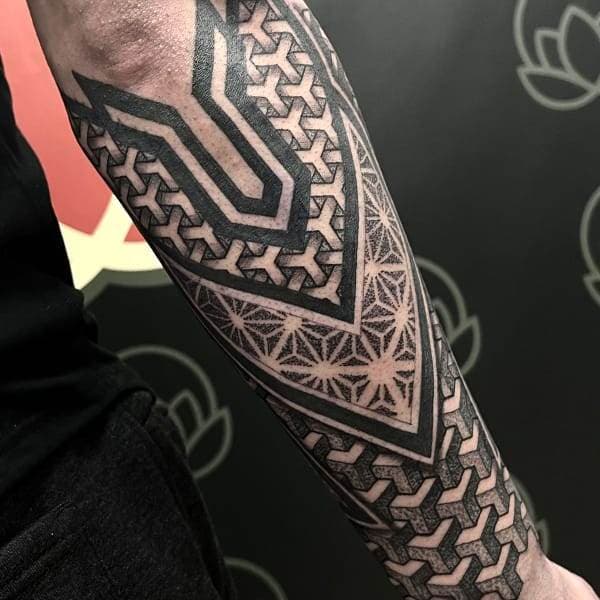
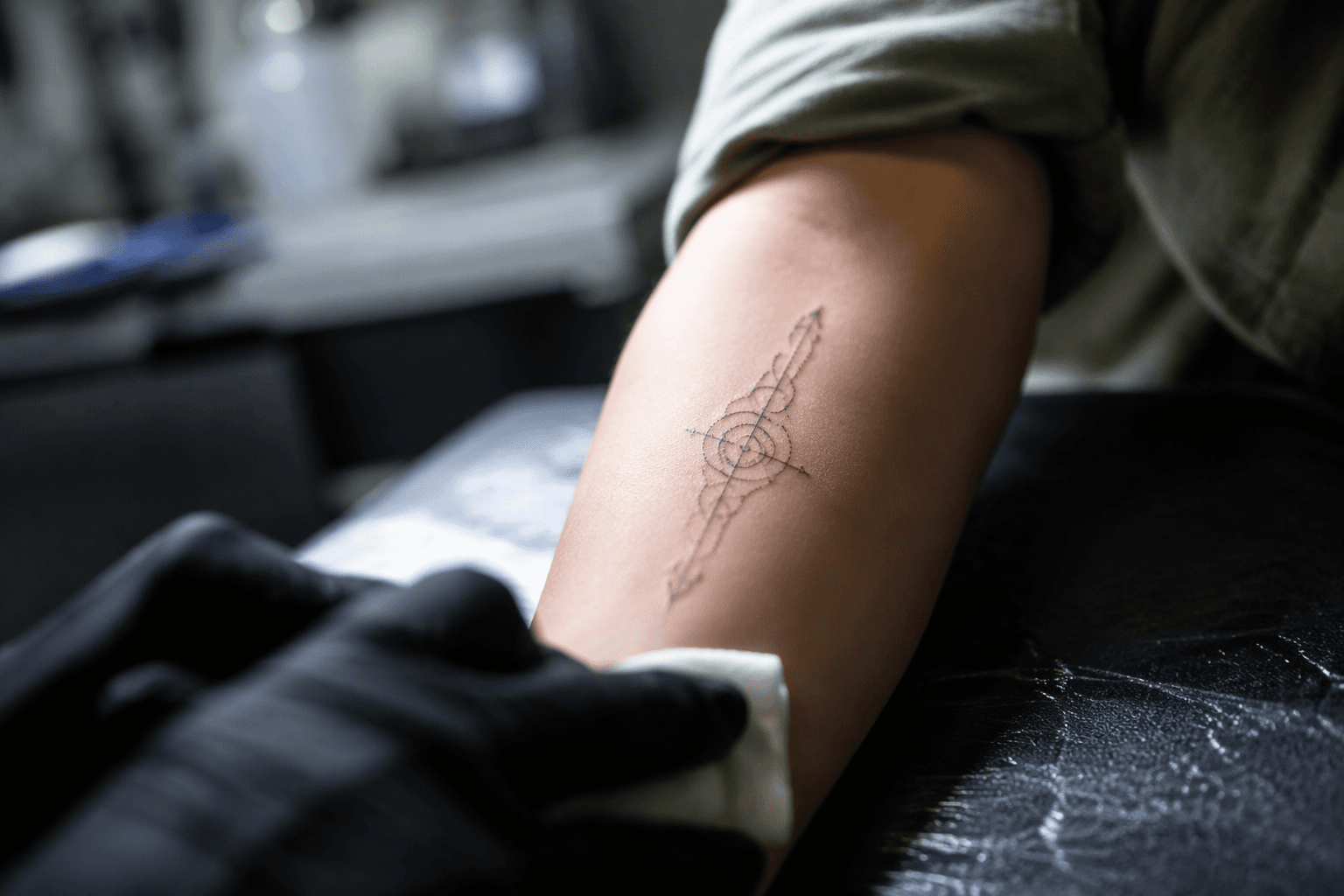
Geometric back tattoos spotlight symmetry, mandalas, and abstract design
Geometric ink gets its best read on the back, where mandalas, spine lines, and abstract fragments can breathe without fighting the body’s curves.
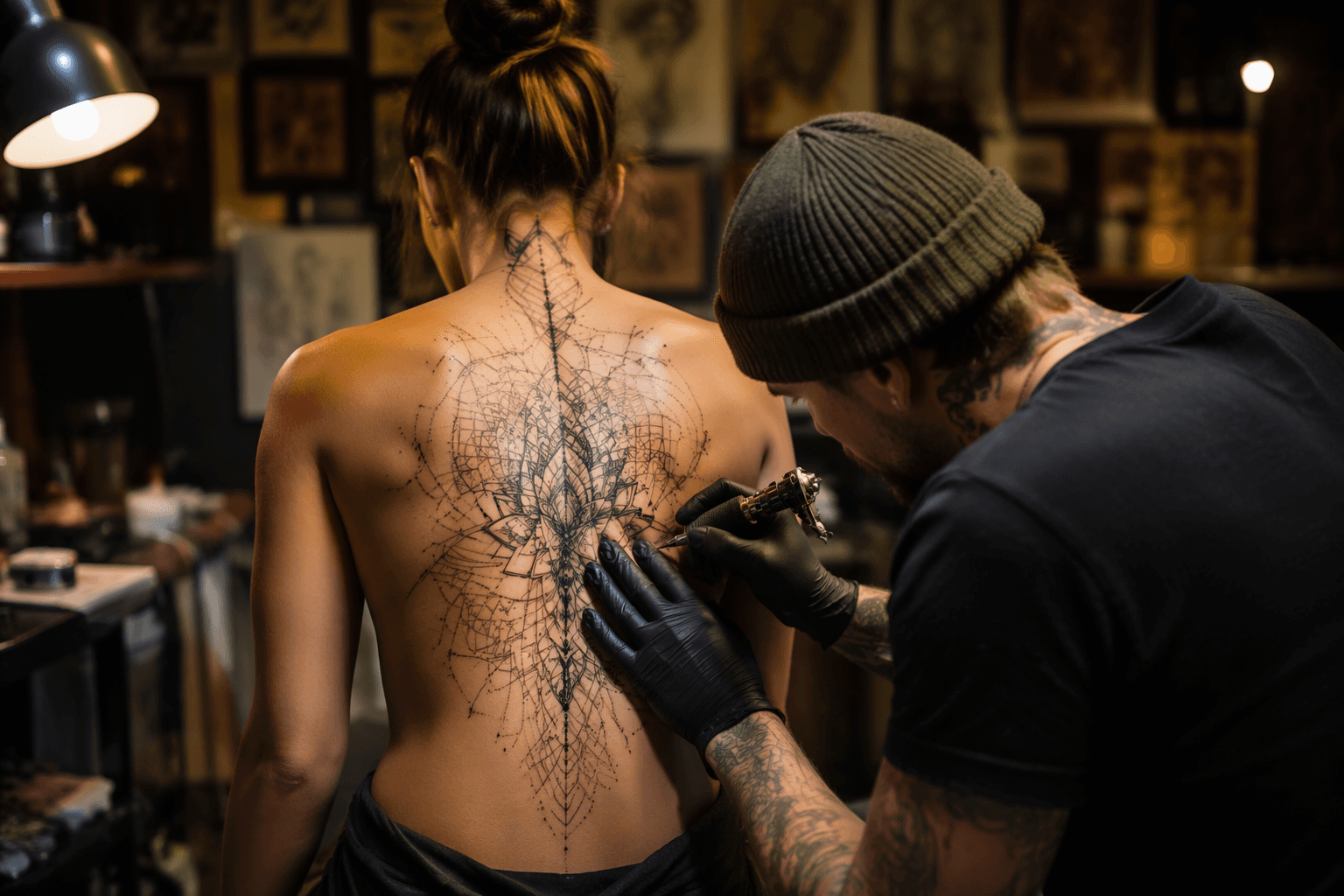
1. Upper-back mandala
The upper back gives a mandala enough room to stay centered without getting warped by the torso’s curves.
2. Spine-run geometry
The spine gives a geometric tattoo a strong centerline. Stack triangles, chevrons, or narrow mandala elements there and the body does half the composition work for you.
3. Shoulder-blade mirroring
Shoulder blades are built for mirrored layouts because the back already splits into two readable halves. That makes the spot ideal for paired geometry that opens and closes with your movement.
4. Full-back scale
A full-back piece is for designs that need to stretch, repeat, and breathe without collapsing into clutter.
5. Black-ink mandalas
Mandalas are elaborate geometric designs that embody wholeness, balance, and spirituality, and black ink gives that structure its hardest edge. On the back, the high contrast reads cleanly because there is enough room for every ring to hold its shape.
6. Soft-shaded mandalas
Shading changes a mandala from sharp architecture into something quieter and more meditative.
7. Fractured geometric abstracts
Abstract tattoos do not have to be loose or chaotic, because they can include fractured geometric art that breaks one form into several planes. The back gives broken shapes room to resolve before they look intentional.
8. Flowing brushstroke abstracts
The same abstract lane can move in a looser direction with brushstroke forms that soften the hard edges. On a moving back, those strokes add a second layer of motion, especially when the shoulders and ribs shift.
9. Mirrored fragments across the spine
Mirrored fragments use the spine as a seam, then echo the pattern on both sides.
10. Negative-space architecture
Negative space is what keeps a large back piece from turning dense and muddy. Leave enough skin open and the geometry stays calm, even when the pattern is detailed.
11. Centerline mandala stacks
Stacking geometric forms down the centerline gives you mandala logic without committing to one giant circle. The upper and mid-back handle that approach well because the eye can travel downward cleanly.
12. Rosette grids
Rosette grids work when repetition matters more than a single hero shape. Large anatomy makes that detail legible rather than overwhelming, which is exactly why the back can carry this kind of order.
13. Polynesian-inspired geometry
Polynesian tattoo traditions developed over millennia and often featured highly elaborate geometric designs that could cover the whole body.
14. French Polynesia scale
Smithsonian dates tattooing to at least 2,000 years ago throughout French Polynesia.
15. Symbolic panels
Traditional Polynesian geometric symbols often carried personal history, so a back panel can do more than decorate skin.
16. Social-rank markers
The same symbolism also conveyed social rank. A layered back composition can keep that ceremonial feel without needing to cover every inch.
17. Iceman precedent
The tattooed Iceman found on the Italian-Austrian border was carbon-dated to about 5,200 years old.
18. South Tyrol context
The Iceman is tied to the South Tyrol Museum of Archaeology.
19. Mandala as meditation
Mandalas are commonly used as a meditation aid.
20. Twenty-minute calm logic
A 2020 study of 120 older adults found that 20 minutes of mandala coloring significantly reduced anxiety compared with plaid pattern coloring, free drawing, and reading.
21. Readability in motion
The back is not static, so the design has to survive twisting, reaching, and breathing. Large geometry does that better than tiny detail work because the shape still makes sense when the body changes position.
22. Shoulder-blade movement
Shoulder-blade pieces are especially good if you want the tattoo to reveal itself in motion. The pattern can sharpen when the shoulders open and soften when the arms relax, which gives geometric work a built-in visual shift.
23. Upper-back restraint
The upper back gives the geometry room without forcing it to fight the lower back’s curves. It gives enough room for balance and symmetry without forcing the design to fight the lower back’s curves.
24. Spine and shoulder-blade pressure
The spine and shoulder blades are the spots that remind you the back is not one flat sheet of skin. If your design leans hard on those bones, the sit feels less forgiving than an upper-back field, so placement has to match your tolerance as much as your symmetry.
25. Large-piece healing reality
Larger tattoos and intricate color work usually take longer to heal. That makes placement part of the decision, because a bigger canvas also asks for more recovery time.
26. Multi-session planning
A full-back piece is rarely a one-and-done appointment, simply because there is too much surface to cover cleanly. Planning for multiple sessions keeps the linework crisp and prevents the design from feeling rushed.
27. Framing the body, not covering it
The best geometric back tattoos do not try to carpet every inch of skin. They frame the body with circles, bands, fragments, and open space so the tattoo still reads clearly when you move.
This article was produced by Prism’s automated news system from verified source data, official records, and press releases, then run through automated quality and moderation checks before publishing. The system is built and supervised by the people who set the standards it runs under. Read our full AI policy.
Did this article answer your question?