Geometric tattoos blend celestial symbols with precise modern structure
Geometric-celestial tattoos work when the math survives healing: clear center points, honest spacing, and enough scale for the stars to stay readable.

Pew Research Center found on August 15, 2023, that 32% of Americans have a tattoo, including 22% who have more than one. That helps explain why tattoo buyers keep looking for styles with both visual punch and personal meaning.
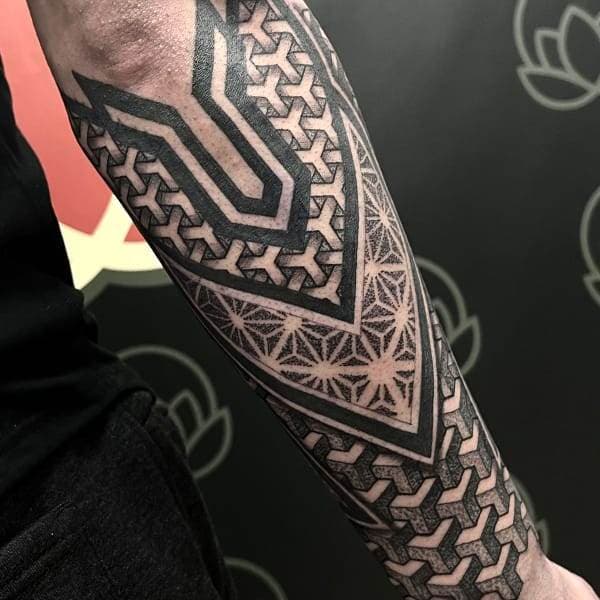
Geometric tattoos with celestial elements look strongest when circles, arcs, orbital rings, star maps, moons, and measured line systems hold the composition together. The style can feel sharp and symbolic at the same time, but only if the spacing, symmetry, and body placement are doing real work. Geometric-celestial work fits that brief because it offers a design language that can be scaled up, pared down, or built around a single anchor point without losing its identity.
Why the mix works when it works
Geometric tattoos use precise shapes and intricate patterns, and that is the right baseline for understanding this hybrid. The geometry gives the tattoo a framework, while celestial imagery supplies narrative: a moon can mark transition, a constellation can suggest navigation, and a starburst or orbital ring can turn the whole piece into something that feels measured rather than random.
That balance matters because the style is only convincing when its visual logic is consistent. A centered mandala with radiating lines feels meditative because the eye can track the symmetry, while an asymmetrical cosmic map feels exploratory because the composition is intentionally off-center.
Mandala language gives the style its backbone
A lot of geometric-celestial tattoos borrow from mandala and sacred-geometry traditions, and that connection carries real meaning. Mandala means “circle” in Sanskrit, and it is linked to wholeness, unity, balance, harmony, and the universe.
Mandala and sacred-geometry work are tied to Hinduism and Buddhism, so this is not just a visual trend lifted from a mood board. If you are drawn to those forms, the safest move is to understand what the symbols mean before committing them to skin.
Placement is where these tattoos succeed or fall apart
Symmetry-heavy work has very little room for sloppiness. Placement has to align with body flow, center points, and the radiating structure of the design, or the whole piece starts to read as crooked the moment it wraps over bone or movement. A sternum piece, spine tattoo, forearm panel, or back composition can be beautiful for this style, but each one asks the artist to place the design where the body naturally supports the symmetry.
Tattooing 101’s August 27, 2021 video, “Tattoo Design Flow: How to Make Your Art Fit the Body,” centers on making art fit the body. Hontattoo put it even more directly in its June 3, 2025 piece on ornamental tattoos: “A pretty pattern is not enough.” If the placement fights the anatomy, the symmetry will not survive the angle, the movement, or the healing.
Scale and spacing protect the detail
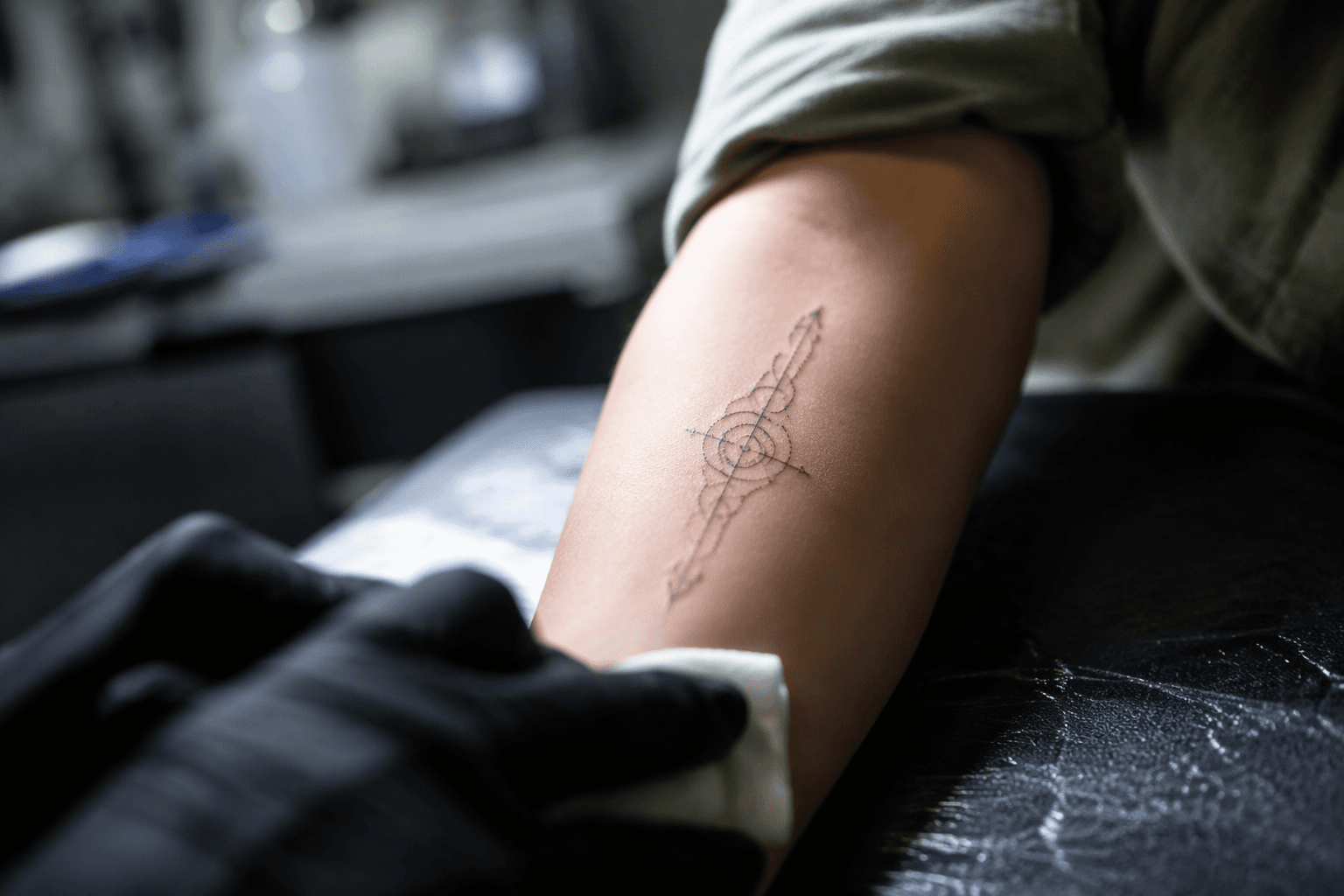
Geometric-celestial tattoos are especially vulnerable to over-compression. If the design is too small, the micro-lines, repeated shapes, and constellation marks start collapsing into visual noise as the skin settles, and the celestial elements lose the clarity that made them worth including. If the design is too large for the body area, the rhythm of the piece can feel broken, especially when rings, dots, or rays are spread too far apart to connect visually.
That means scale should be chosen for readability first, not for cramming in every idea you like. Allure’s 2024 tattoo trends coverage kept fine-line and highly detailed work in the conversation, but detail only holds when the artist gives it enough room. In practice, that usually means deciding whether the tattoo needs to be a compact symbol, a medium-size panel, or a full composition before the first stencil goes on skin.
What to ask your artist before you commit
The best geometric-celestial tattoos are planned like systems, not sketches. You want to know where the center point sits, how the symmetry will behave on your body, and which elements need to stay dominant so the piece does not become cluttered. If the design includes a moon, star field, or orbital ring, ask how those shapes will be balanced against the underlying geometry so the tattoo still reads cleanly at a glance.
- Does the composition still make sense if one side of the body moves more than the other?
A useful checklist looks like this:
- Is the line weight strong enough to survive healing without swallowing the detail?
- Does the negative space give the eye a place to rest, or is every inch filled?
- Is the symbolism clear enough that the piece feels deliberate, not decorative for decoration’s sake?
- Does the design fit your anatomy, or is your body being forced to fit the drawing?
Those questions are especially important if the tattoo draws from mandala or sacred-geometry language.
Why this style keeps staying relevant
Allure’s 2024 tattoo trends coverage treated tattoos as a major beauty trend and kept fine-line, highly detailed work in the conversation, while NAAMA Studios’ 2024 trend coverage specifically included geometric patterns among the top tattoo looks.
This article was produced by Prism’s automated news system from verified source data, official records, and press releases, then run through automated quality and moderation checks before publishing. The system is built and supervised by the people who set the standards it runs under. Read our full AI policy.
Did this article answer your question?