Moon tattoos mix sacred geometry, cosmic symbolism, and minimalist style
Moon tattoos work best when the moon is treated like a shape system: arcs, phases, and circles that stay clean, symbolic, and easy to scale.
Moon tattoos that still read clean in geometric work
Moon tattoos earn their keep when they behave like geometry, not decoration. The strongest versions use a crescent, a full circle, or a phase sequence as the structural core, then let symmetry, repetition, and spacing do the heavy lifting. That is why the style keeps sliding between whisper-thin minimalism and more built-out sacred compositions without losing its appeal.
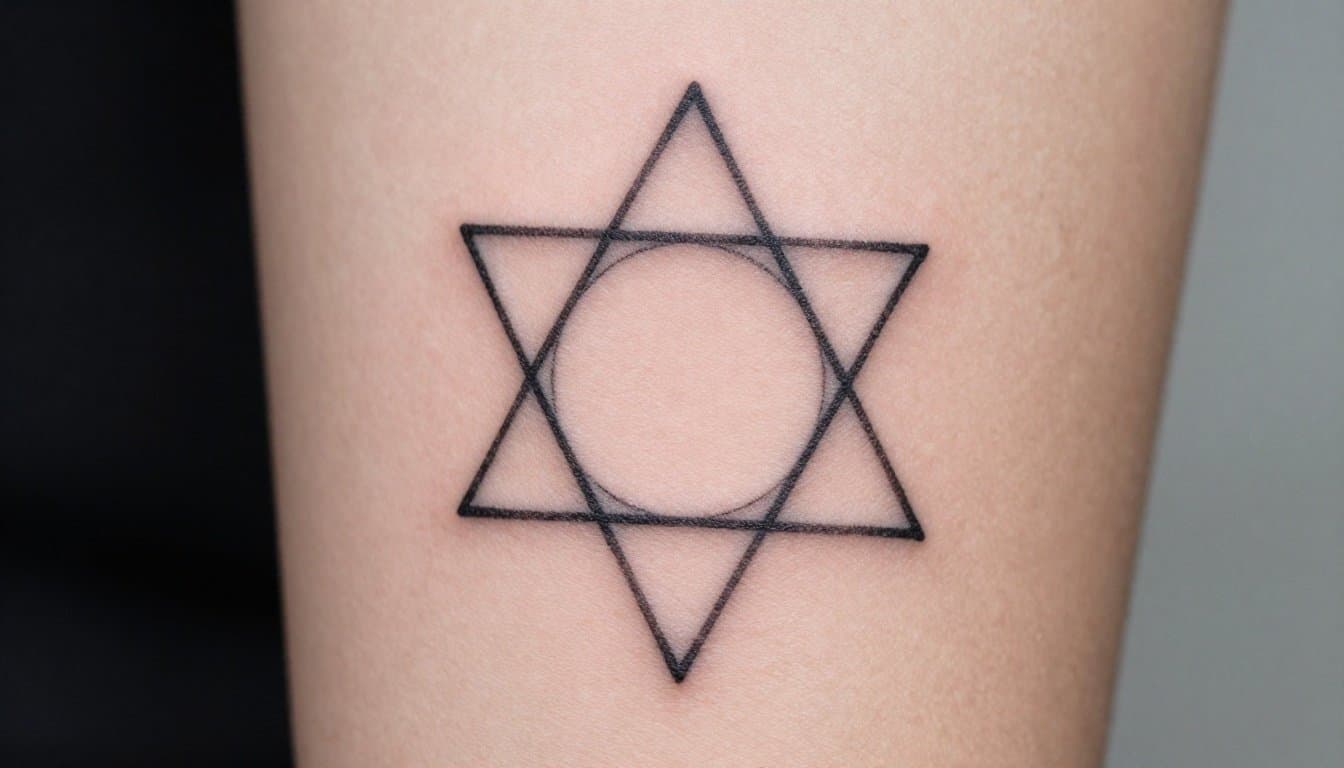
The sweet spot is simple: the moon gives you a readable symbol, and the geometric treatment keeps it from turning into generic flash. A crescent can sit inside a circle, a full moon can anchor orbit lines, and a phase row can become a spine-friendly rhythm instead of a loose decorative strip. When the design is built from clean arcs and deliberate spacing, it feels intentional on skin, not crowded on paper.
What lunar motifs actually do well in geometric tattooing
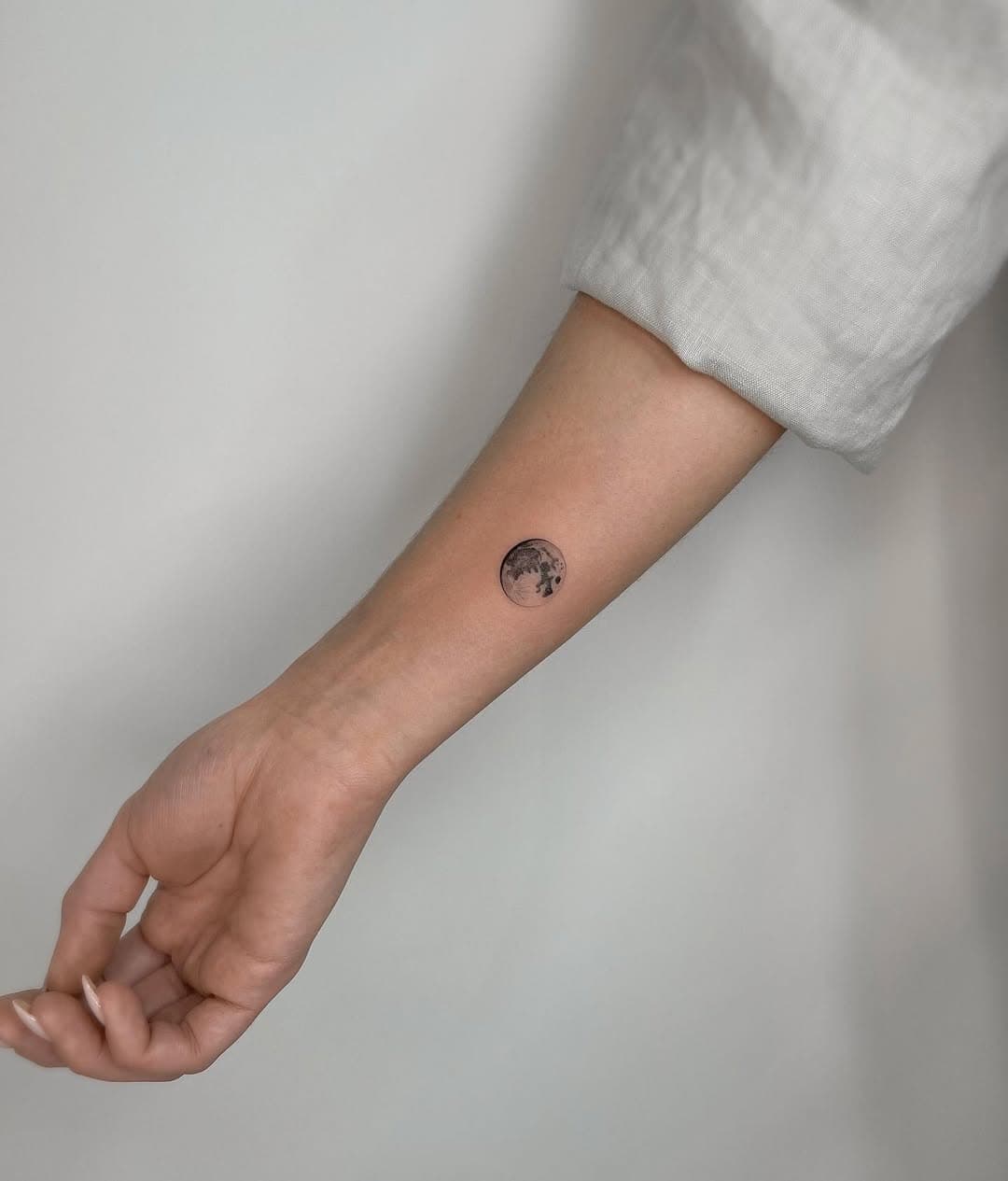
Crescent moons are the easiest entry point because they hold shape at small sizes and leave room for negative space. In a geometric layout, that crescent can be paired with dots, fine-line rays, or a mirrored second arc to create balance without clutter. Full moons work differently: they are stronger as anchors, especially when you want circles, halos, or orbital rings to frame the piece.
Moon phases are where the geometry starts to sing. A phase sequence can be stretched into a forearm band, stacked vertically for a calf or spine, or broken into evenly spaced elements that preserve rhythm from one section to the next. That structure makes the motif feel designed rather than just illustrated, which is exactly why it fits the geometric collector who wants the tattoo to build into something larger later.
Where the design stays elegant, and where it starts to fall apart
The cleanest moon tattoos respect line logic. Fine arcs, consistent circle sizes, and measured gaps between dots and stars keep the composition legible as skin moves and ages. Once the piece starts adding too many clouds, too many sparkles, or too many unrelated symbols, the moon stops reading as a sacred anchor and starts looking like overworked filler.
That is the trap with cosmic imagery. Stars, clouds, and extra celestial accents can deepen the mood, but they need a reason to be there. If they are only there to make the tattoo feel fuller, the design loses the disciplined geometry that gives it staying power. A single moon with orbital lines can look sharper than a crowded sky every time.
Sacred geometry is where moon tattoos get interesting
The most convincing lunar tattoos in this lane use the moon as the center of a larger system. Circles, phase progressions, radial symmetry, and orbit lines all translate naturally into sacred-geometry language, which is why moon imagery has become such a useful bridge between minimalist symbolism and more complex spiritual work. You get a design that feels personal without becoming literal.
One of the strongest examples is the seated Buddha surrounded by orbital lines, moon phases, sacred geometry, and cosmic elements. That kind of composition works because every part serves the same visual grammar. The Buddha gives the symbolic core, the moon phases create motion, and the geometry keeps the whole thing disciplined enough to read as a single design system instead of a collage.
Placement matters more than most people think
Moon tattoos stay clean when the placement supports the shape. Forearms, upper arms, sternum, spine, and calf all give you room to preserve symmetry and keep circular forms from warping too badly. A crescent tucked into a wrist or ankle can work too, but those smaller placements are best when the linework is minimal and the design does not depend on a lot of orbit detail.
If you want the piece to grow, think in terms of expansion routes. A small crescent can become the start of a sleeve path, while a moon-phase stack can extend across the forearm or down the spine without needing a redesign. That flexibility is a big reason moon tattoos keep showing up as entry points into larger geometric or spiritual projects.
Why the style is landing with more people now
The broader tattoo market helps explain the momentum. Pew Research Center found in 2023 that 32% of American adults have at least one tattoo, and 22% have more than one. Women are more likely than men to be tattooed, with Pew putting the figures at 38% for women and 27% for men, which matches the way moon tattoos are often framed as either soft and feminine or bold and dramatic depending on execution.
Meaning also matters. Pew found that 69% of tattooed adults said they got a tattoo to honor someone or something, and moon imagery fits that mindset almost too well. It already carries associations with cycles, femininity, rebirth, renewal, mystery, and personal meaning, so the design can be read as tribute, milestone marker, or private symbol without needing a long explanation.
Safety still belongs in the conversation
Fine-line moon tattoos may look delicate, but the risks are not. The U.S. Food and Drug Administration says tattoos and permanent makeup can carry infections and allergic reactions, and in October 2024 it issued final guidance on tattoo inks aimed at helping industry avoid contamination conditions and protect consumers. That matters even more when the design relies on delicate linework, because sloppy technique or poor ink quality shows up fast in a minimalist piece.
The Centers for Disease Control and Prevention has also documented tattoo-associated nontuberculous mycobacterial skin infections in an outbreak investigation involving 22 cases across four states. That is the part people ignore when they are focused on the stencil, but geometric work is unforgiving: clean circles, sharp dots, and thin arcs all depend on solid hygiene and stable materials. If the shop cannot keep the process clean, the prettiest moon in the world is not worth it.
The market is telling the same story
Tattoo demand is not standing still. One 2026 market report put the global tattoo market at about USD 2.69 billion in 2026 and projected growth to USD 5.86 billion by 2035. Another projected the market rising from USD 2.43 billion in 2025 to USD 5.99 billion by 2034. Different forecasts, same signal: the category is still expanding, and versatile symbols like moons sit right in the center of that growth.
That growth also tracks with how geometric styles are shifting in 2026. The conversation is moving toward fine-line minimalism on one side and structure-heavy blackwork on the other, with moon tattoos able to live in both camps. A crescent in whisper-thin linework feels restrained and modern; a full moon locked into blackwork orbit rings feels heavier, sharper, and more architectural.
Moon tattoos work because they can be reduced to pure shape without losing meaning. That is the real advantage for geometric collectors: the design can stay minimal, build into sacred geometry, or expand into a cosmic composition without breaking its logic. When the arcs stay clean and the symmetry stays intentional, the moon does what the best geometric tattoo elements always do, it turns symbolism into structure.
This article was produced by Prism’s automated news system from verified source data, official records, and press releases, then run through automated quality and moderation checks before publishing. The system is built and supervised by the people who set the standards it runs under. Read our full AI policy.
Know something we missed? Have a correction or additional information?
Submit a Tip