Ornamental Tattoos Reveal the Symmetry Behind Geometric Design
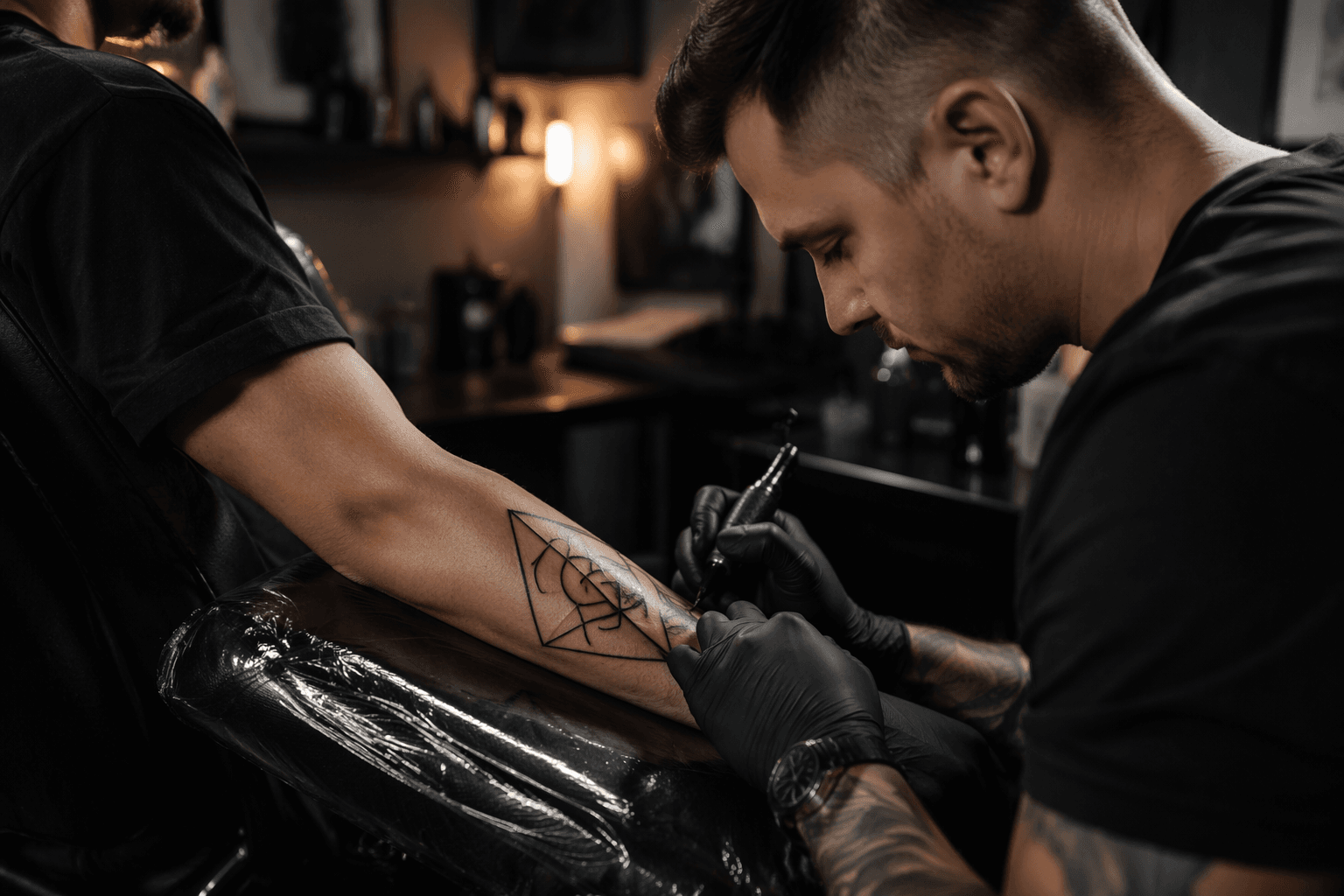
Ornamental tattoos often look decorative first, geometric second. The real test is symmetry, spacing, and how the design moves over the body.
Why ornamental sits so close to geometric
Ornamental tattoos are one of the easiest places to see geometric thinking hiding in plain sight. The style leans on symmetry, rhythm, and decoration, which is exactly why it keeps overlapping with sacred geometry, mandalas, dotwork, and blackwork. When the pattern is built well, it does not read like filler around a main image. It reads like structure.
That is the key difference worth paying attention to. Ornamental work can feel airy and elegant, but the best pieces are engineered with the same discipline as geometric tattoos. The spacing has to stay even, the arcs have to mirror each other, the line weight has to hold, and the whole composition has to survive the way skin moves, stretches, and heals.
Where ornamental becomes geometric
Pattern logic matters more than decoration
Tattoodo’s ornamental guide describes the style as geometry plus symmetry, often with black shading and delicate pointillism. That is already close to the geometric lane, but the overlap gets even clearer when you look at the motifs people actually build with. Mehndi, pattern work, and decorative styles all sit under the ornamental umbrella, which means the style is less about a single motif and more about how repeated shapes organize the surface of the skin.
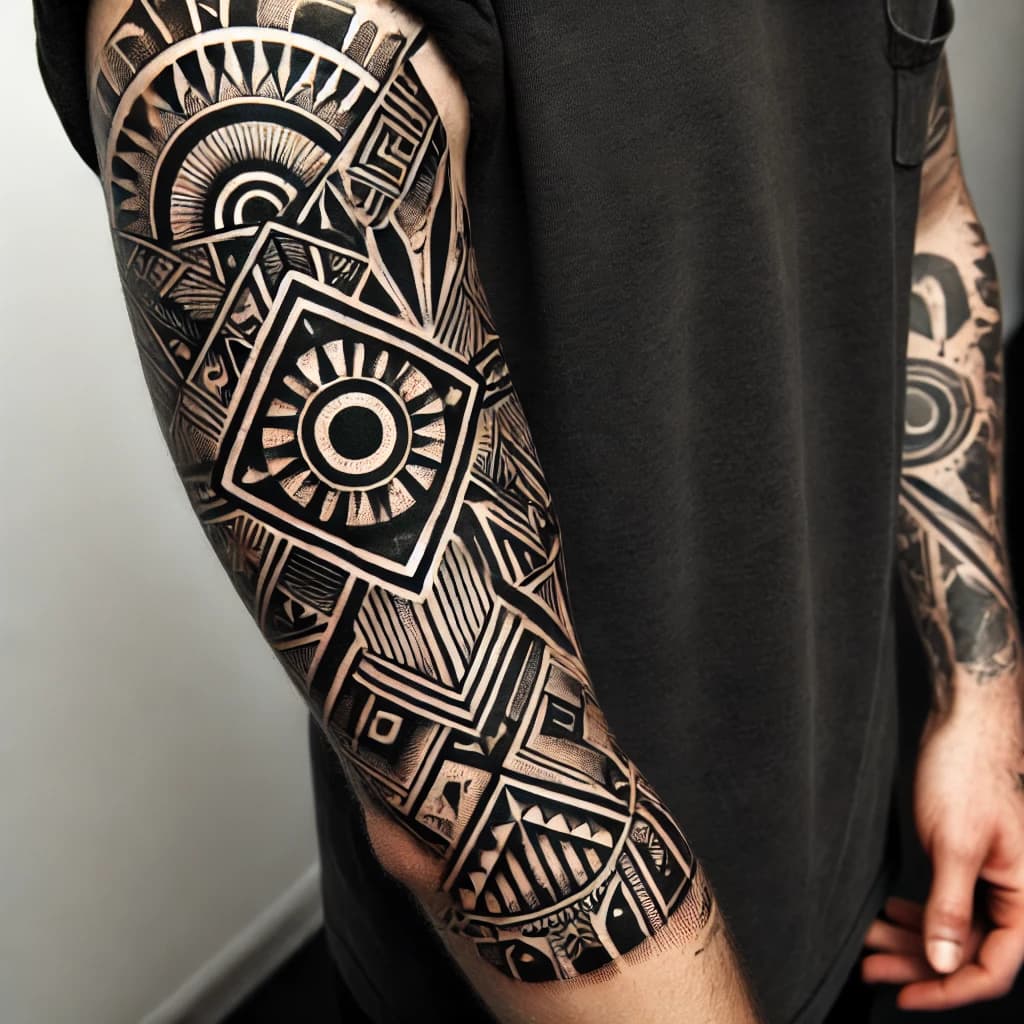
Tattoodo’s geometric coverage pushes that overlap further. Sacred geometry, dotwork patterns, mathematical shapes, symmetrical compositions, mandalas, platonic solids, and geometric animal designs all belong in the same visual family. In practice, ornamental work becomes geometric the moment the artist starts using repetition, measured spacing, and mirrored forms to create order. That is why an ornamental chest piece can sit just as comfortably beside a mandala sleeve as a fully abstract geometric panel.
Mandala structure is the bridge
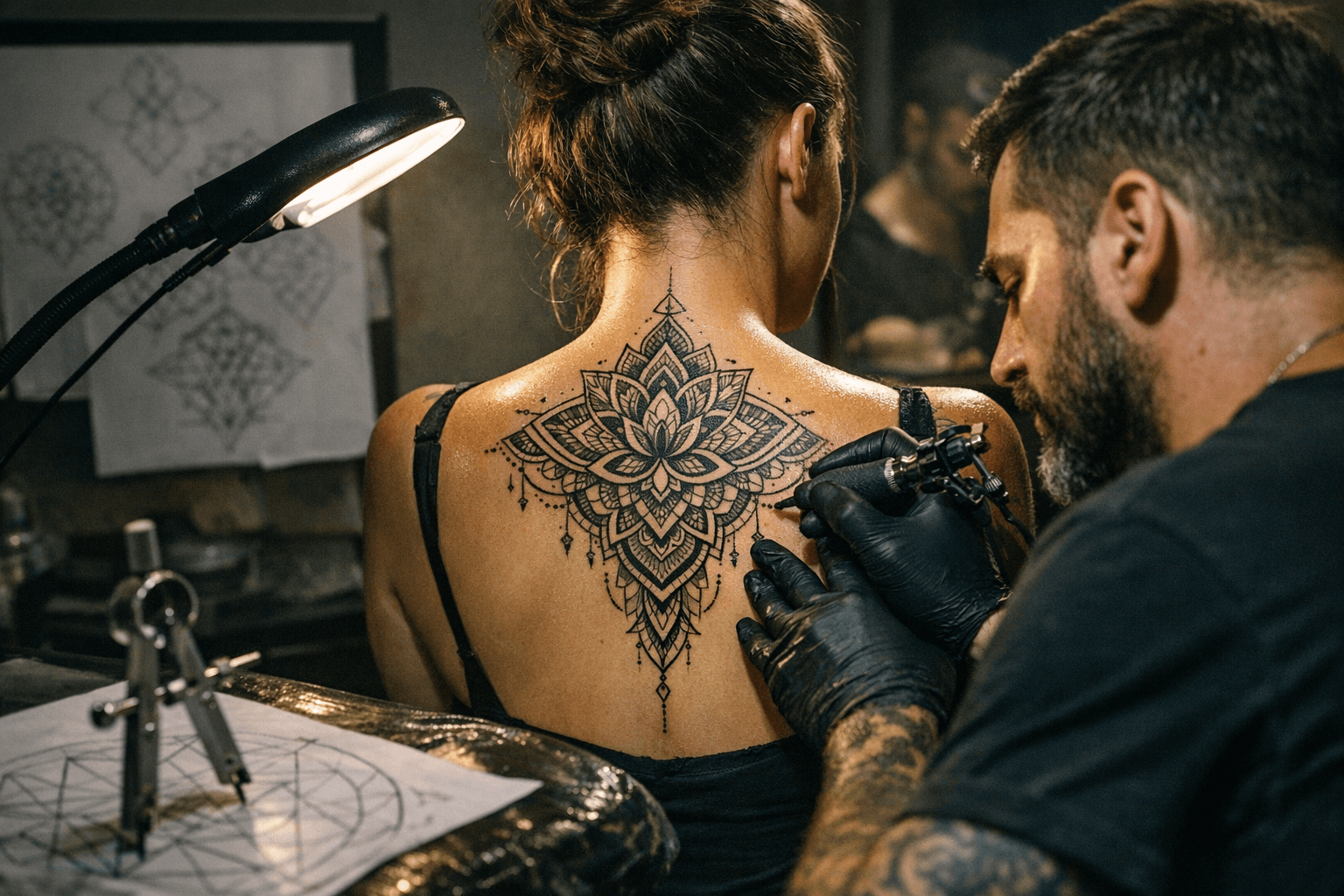
If you want the cleanest crossover point, it is the mandala. Ornamental and geometric pieces both love a centered structure with radiating balance, and both depend on consistency more than flourish. A mandala-style ornamental tattoo can feel soft and decorative, but it still lives or dies on the same technical questions as a geometric build: is the center truly centered, do the rings breathe evenly, and do the layers stack without collapsing into visual noise?
That is also why ornamental tattoos can be a smarter choice than they first appear. They let you bring in floral curves, lace-like detail, and pointillist texture without losing the discipline that geometric fans tend to value. When the design is done right, the ornament is not extra. It is the framework.
How ornamental changes the way the body reads
Flow on skin is the real test
A design that looks perfect on paper can fall apart on a rounded shoulder, a tapering sternum, or a forearm that twists constantly. Ornamental tattoos are especially sensitive to body flow because they rely on repeated shapes and symmetrical balance. If the artist does not account for the body’s curves, the pattern can start to pinwheel, skew, or bunch where it should expand.
This is where ornamental work gets practical for geometric readers. A vertical spine piece can create movement down the body without feeling rigid. A collarbone design can echo the angles of the torso. Layered flourishes can turn negative space into part of the composition, instead of leaving dead zones that look unfinished. The body is not a flat page, and ornamental work makes that obvious fast.
Placement changes both look and longevity
Placement is not a side issue, it is part of the design. Healthline notes that placement is one of the major considerations when getting a tattoo, and it specifically flags joints and flexing areas such as the wrist and ankle as slower-healing spots. That matters for ornamental and geometric pieces because both styles punish inconsistency. If the linework shifts even a little, you notice it.
Healthline also notes that the outer layer of skin usually heals in 2 to 3 weeks, while deeper healing can take up to 12 months. That is a useful reality check for anyone chasing razor-clean symmetry. The tattoo may look settled long before the skin beneath it is truly finished, which is why placement, movement, and aftercare all affect how crisp that fine ornamental lattice still looks months later.
What to ask for if you want the geometric look
Line density, symmetry, and line weight
If you are deciding between ornamental and geometric directions, start with three questions: how dense do you want the design, how exact should the symmetry be, and how much black shading do you want carrying the piece? Ornamental tattoos often use delicate pointillism and black shading to create depth without overpowering the skin. Geometric tattoos lean harder into mathematical structure, while ornamental work uses decoration to soften it.
The most successful pieces usually have a clear hierarchy. A bold central form anchors the eye, finer pattern work fills the perimeter, and spacing gives the skin room to breathe. If every corner gets packed with detail, the design stops reading as ornamental and starts reading as clutter. The smartest artists know when to stop.
Blackwork and dotwork are the common ground
Black shading, dotwork, and symmetry are the shared language between both styles. That is why ornamental tattoos often appeal to geometric clients who want something less severe than pure line geometry but still precise. The dots can shade a petal edge, reinforce a border, or fade a transition into skin without breaking the logic of the piece.
This is also why ornamental tattoos can feel both dense and elegant at the same time. The density comes from repeated motifs and layered structure. The elegance comes from control. The design only works if every repeated element has a job.
The healing and aftercare reality
Clean lines need boring habits
A tattoo’s visual finish is not decided on the day it is packed in. Medical literature describes tattooing as implanting permanent pigment granules and additives into the dermis, and that is a reminder that skin is not canvas, it is living tissue. Healing matters because the image has to settle into that tissue without triggering avoidable problems.
A medical review has linked tattoo reactions to irritation, infection, allergic reactions, granulomatous changes, and systemic inflammation. That is not a reason to avoid precision work. It is a reason to treat aftercare like part of the design process. Careful cleaning, moisturizing, and sun avoidance help protect the look as the tattoo matures, especially when the piece depends on crisp lines and exact spacing.
There is another catch that people overlook: many states do not require tattoo artists to provide aftercare instructions. That makes it worth asking for a clear plan before you leave the chair. If your tattoo depends on symmetry and fine detail, the aftercare is not an optional extra. It is the final stage of the tattoo.
The cultural layer you cannot skip
Old style, modern responsibility
Tattoodo describes ornamental tattooing as one of the oldest styles in tattooing, with roots in ancient tribal traditions. That history is part of its appeal, but it also comes with responsibility. Some ornamental references can drift into cultural appropriation if their origins are not understood, so the artist and client both need to know where a motif comes from before using it.
That does not make ornamental work off-limits. It makes it more meaningful when done carefully. The style has lasted because it carries both visual discipline and cultural depth, and that is exactly why it remains so close to the geometric world. Both styles ask for more than decoration. They ask for intention.
Ornamental tattoos reveal the symmetry behind geometric design because they expose the same craft underneath the prettier surface. The strongest pieces are not just ornamental or geometric. They are balanced, deliberate, and built to hold up on real skin, through real healing, and over real time.
This article was produced by Prism’s automated news system from verified source data, official records, and press releases, then run through automated quality and moderation checks before publishing. The system is built and supervised by the people who set the standards it runs under. Read our full AI policy.
Did this article answer your question?