Sternum Tattoos Rise in Popularity, Geometric Symmetry Takes Center Stage
Sternum pieces have gone mainstream because the chest turns symmetry into the whole story. The catch is simple: scale, anatomy, and breathing decide whether the tattoo reads clean or chaotic.
Why sternum tattoos are having a moment
Sternum tattoos have moved from niche to mainstream because the placement does something most spots cannot: it turns the body’s centerline into part of the design. BestTattoo.wiki’s sternum roundup leans into that shift, and it makes sense in the wider U.S. tattoo picture, where Pew Research Center says 32% of Americans have at least one tattoo. Women are especially driving the category, with 38% reporting at least one tattoo compared with 27% of men, and ownership is highest among women ages 18–29 at 56% and 30–49 at 53%.
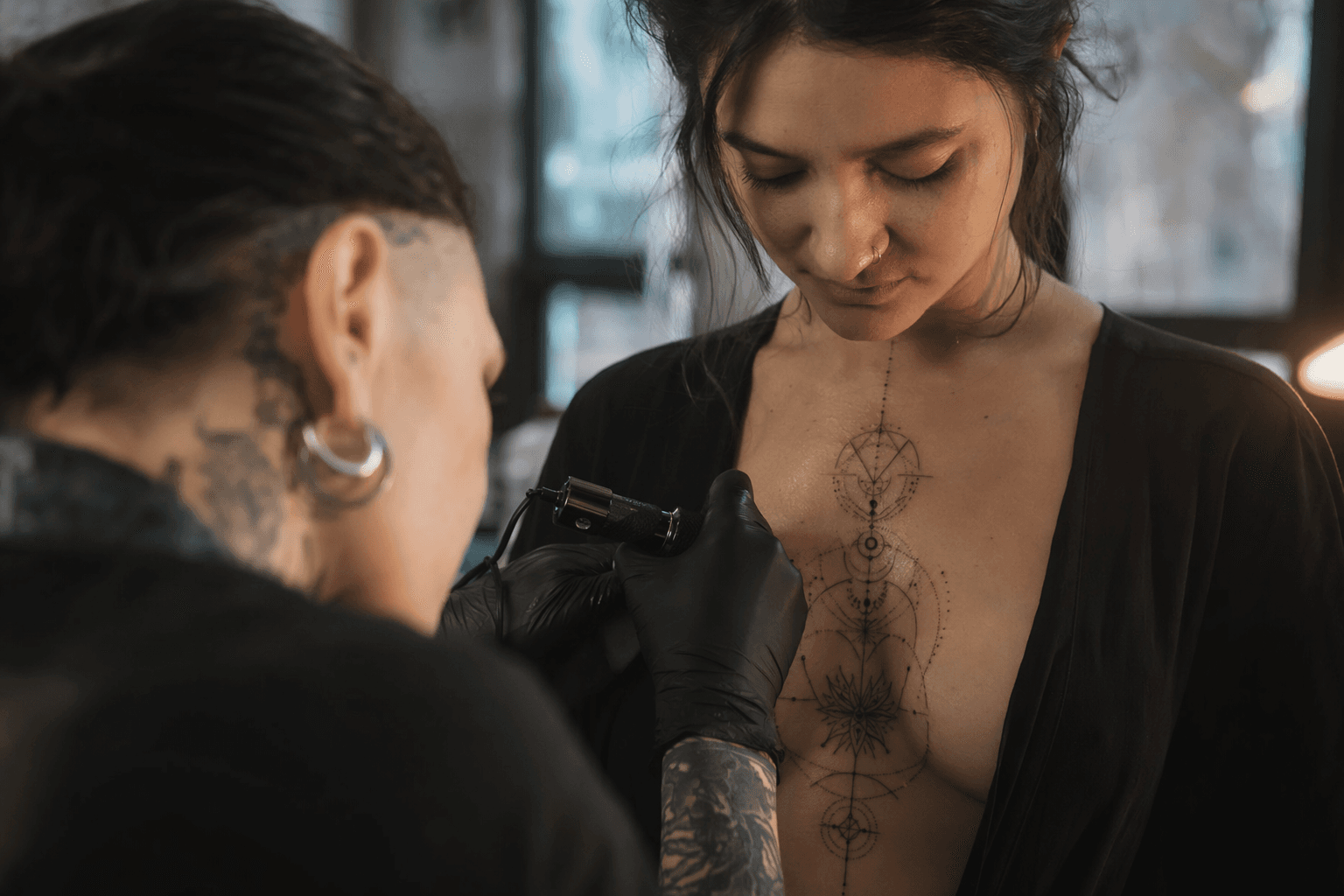
That matters for geometric tattoo readers because the sternum is brutally honest about balance. Put a centered design on the chest and any drift off-axis shows immediately. Get the symmetry right and the tattoo feels deliberate, almost architectural. That is the appeal here: the sternum gives geometric work a built-in frame, and if the composition is strong, the chest does half the visual work for you.
Geometry and the chest axis
The sternum is where geometric symmetry stops being an abstract design idea and becomes a placement problem. The body is not a flat page, and the sternum’s vertical line creates a natural spine for moons, stars, florals, mandalas, and ornamental forms. That is why this placement keeps showing up in conversations about sacred geometry and body-centered composition.
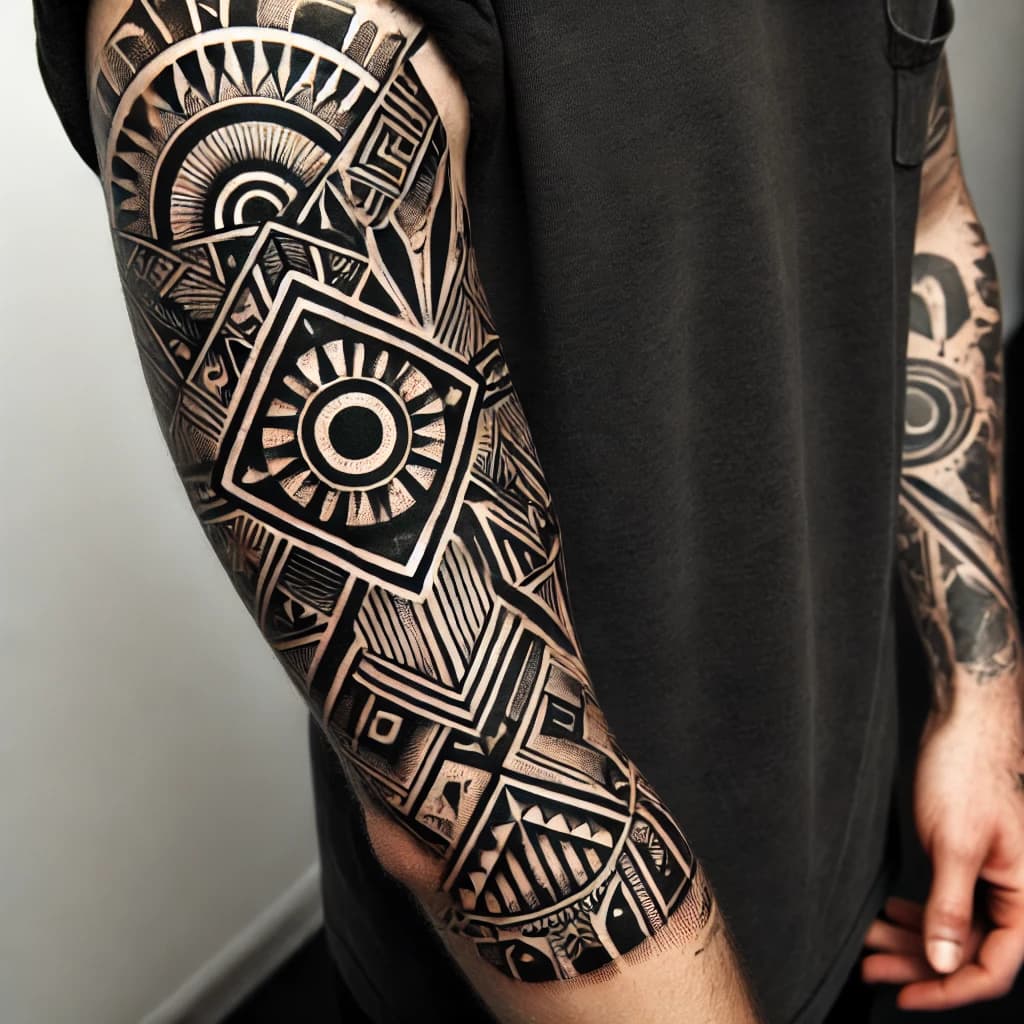
Tattoodo describes geometric tattooing as including sacred geometry, dotwork patterns, mathematical shapes, mandalas, and symmetrical compositions, which is exactly why the sternum has become such a useful canvas. The placement rewards designs that can hold their shape from the center outward. If the left and right sides do not mirror each other cleanly, the whole piece loses its tension and starts to look accidental instead of intentional.
Thomas Hooper’s work helps explain why this crossover feels so natural. His approach draws from mathematical and geometric patterns, cosmology, eastern religious images, pointillism, and detailed line-work, all of which translate well to a chest-centered composition. The sternum gives those influences a home: cosmic forms can stack vertically, mandala logic can radiate from the middle, and dotwork can soften the edges without breaking the symmetry.
What sternum placement does to the motif
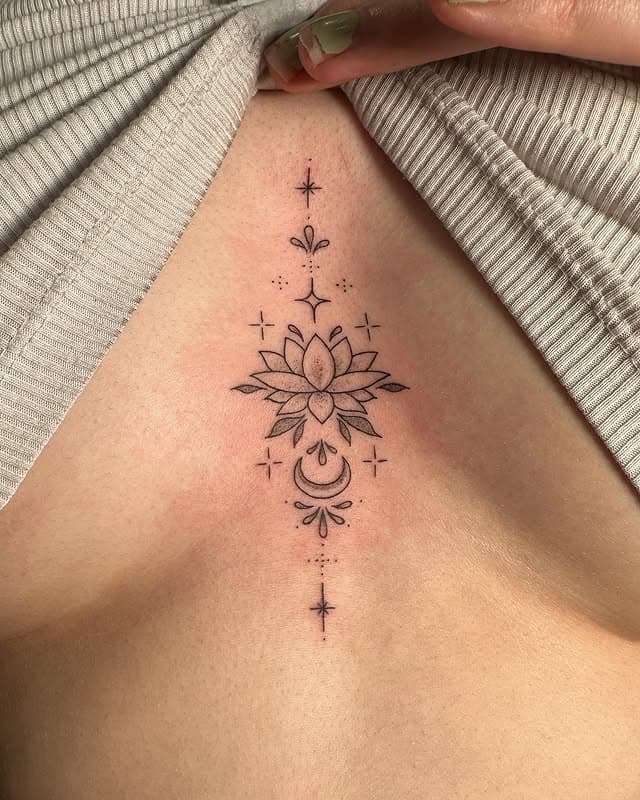
The strongest sternum pieces in the roundup are the ones that understand vertical balance. A minimalist floral flow runs straight down the chest in a symmetrical botanical rhythm, which keeps the eye moving from top to bottom instead of wandering sideways. A cosmic butterfly concept layers moon and star motifs into a vertical composition, and that works because celestial imagery naturally benefits from a centered axis.
The clearest geometric crossover is the Fine Dotwork Botanical Symmetry piece, which the roundup describes as meditative and reads like a sacred-geometry interpretation of nature. That is the key lesson for geometric tattoo readers: sternum work does not have to look hard-edged to be geometric. A design can feel soft, floral, or celestial and still be built on balanced spacing, mirrored structure, and disciplined placement.
This is also where sternum tattoos become more than decoration. Pew found that 69% of tattooed adults got a tattoo to honor or remember someone or something, and 47% got one to make a statement about what they believe. The sternum is well suited to that kind of meaning because it sits close to the center of the body and carries a sense of intention that reads immediately, even when the artwork is delicate.
Scale, readability, and what the skin will actually do
The tradeoff readers care about most is simple: scale can make or break readability. Sternum tattoos are not the place for a design that depends on tiny details surviving every movement of the chest. Breathing, posture, and the natural flex of the torso all affect how the piece reads, so a design that is too busy can collapse into visual noise fast.
Pain is the other part nobody should pretend away. Healthline notes that tattoos tend to hurt more in areas with thin skin, little fat, or many nerve endings, and the chest fits that profile for a lot of people. That does not mean sternum tattoos are impossible, but it does mean the placement asks for patience, especially when the design crosses into the center of the chest where the bone sits close to the skin.
Healing also matters more here than people think. Healthline says healing time depends partly on location, and tattoos near areas that flex take longer. The sternum moves every time you breathe, twist, or stretch, so long-term care is not just a post-appointment afterthought. If the design is too large or too dense, that movement can affect how the final tattoo settles.
How the placement behaves in real life
The sternum has another advantage that explains its rise: it is designed for selective reveal. Triangle bikini tops, deep V-necks, open-front tops, and layered festival looks all frame the tattoo differently, which means the piece can be shown deliberately instead of constantly. That visibility strategy fits 2026 tattoo culture, where the body is treated less like a flat page and more like a stage for measured reveal.
That is also why the placement feels especially modern. The sternum is intimate without being hidden, decorative without being flimsy, and symmetrical without feeling rigid. For geometric tattoos, that combination is gold. When the scale is right, the anatomy is respected, and the axis is clean, the sternum turns moons, stars, florals, dotwork, and ornamental geometry into something that reads as both personal and precise.
In the end, sternum tattoos are rising because they solve a problem geometry has always cared about: how to make balance feel alive on skin. The best pieces do not just sit on the chest. They use the chest, and that is why the placement keeps winning.
This article was produced by Prism’s automated news system from verified source data, official records, and press releases, then run through automated quality and moderation checks before publishing. The system is built and supervised by the people who set the standards it runs under. Read our full AI policy.
Did this article answer your question?