Palomar knot and strong rope tips for magnet fishing safety
The magnet usually isn’t the weak link. The rope-to-magnet knot is, and the Palomar knot is the cleanest fix before you spend money on heavier gear.
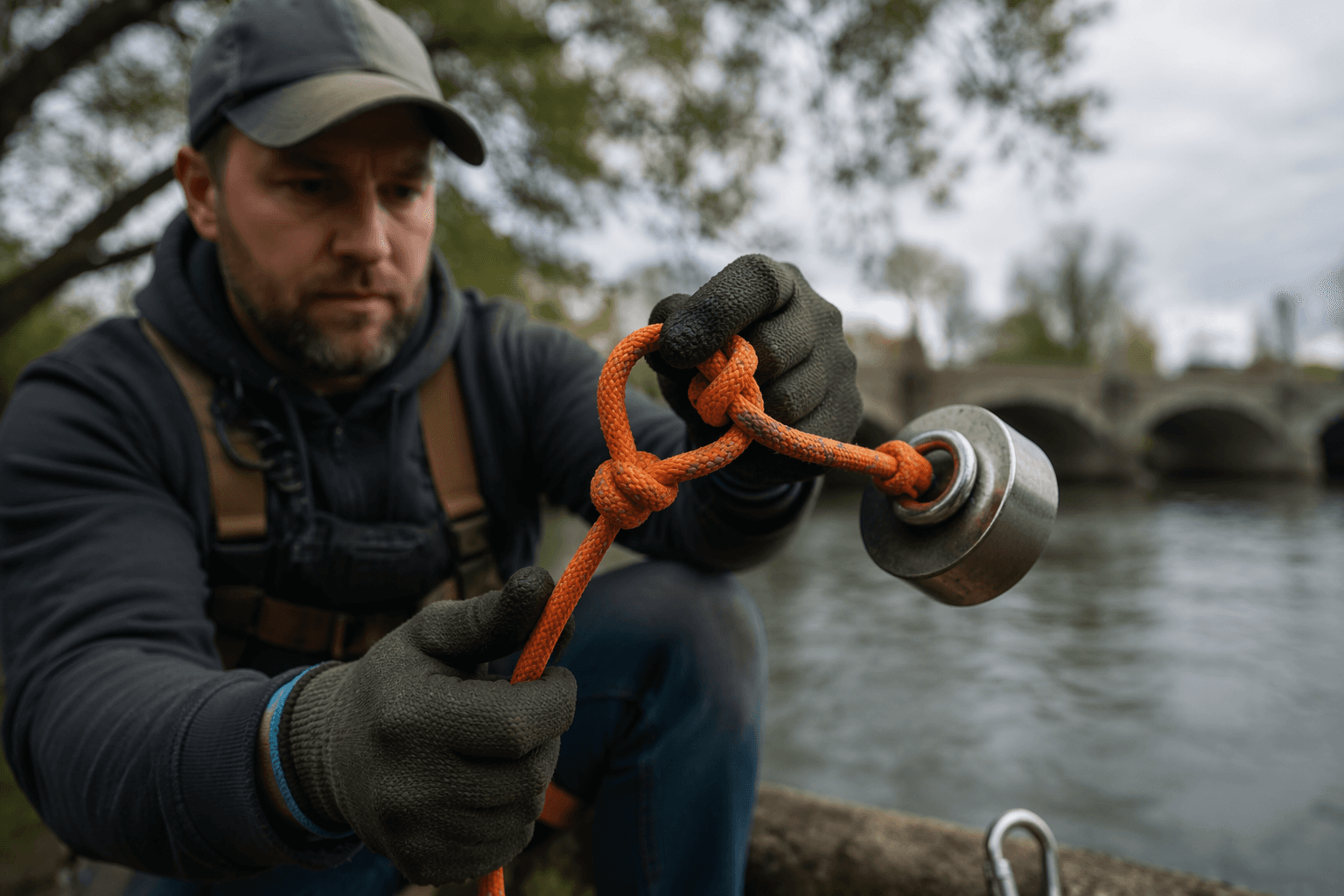
Most magnet fishing losses happen at one place: the rope-to-magnet connection. That is why the smartest upgrade is often not a bigger magnet or a pricier rope, but a knot that cinches cleanly, holds under load, and survives the kind of repeated yanks that happen when a find drags across mud, rock, and scrap.
Start with the Palomar
If you want one default knot, make it the Palomar. It is the safest bet in magnet fishing because it is simple, fast, and secure, and it can retain up to 95 percent of rope breaking strength. Magnet fishing is full of abrupt shock loads, not smooth, polite pulls.
The sequence is straightforward: form a loop, pass it through the magnet eye, tie an overhand knot, send the magnet through the second loop, then tighten carefully while making sure the rope is not crossed. That last part is the part people rush. A twisted Palomar can look fine in your hand and still bite you once the line loads up.
It is the kind of knot you can tie quickly, check by feel, and trust when the rope is wet, muddy, and stiff from cold water.
Why the connection point fails first
Magnet fishing gear lives a harder life than regular line in open water. The pull often comes over bridge edges, dock pilings, concrete, shell, and metal debris, which means the connection is exposed to abrasion as well as force. A strong rope is useful, but it cannot save a sloppy tie, and a flawless knot cannot save a rope that is being abused by a bad angle or repeated scraping.
That is why the rope-to-magnet link deserves more attention than the magnet itself. The hobby’s failure mode is usually not some dramatic mystery object pulling free at the bottom. It is a knot that slipped, a loop that crossed itself, or a connection that looked fine until the fifth cast, when the load finally found the weak spot.
The Palomar works so well because it is compact and consistent. Fewer moving parts means fewer opportunities for the knot to dress badly, and that matters when your hands are wet and the rope wants to spring back into a mess.
The alternates that still have a place
The double figure 8 loop is a useful option when you want a knot that tightens as tension rises. It is easy to tie, which is part of its appeal on the bank, but it is harder to untie after it has been loaded, so it is not the most convenient choice if you swap gear often or reset your rig several times in a session.
The uni knot has its own niche. It is especially handy on larger-diameter line and tolerates sudden jerks well, which makes it a solid option when your setup is a little heavier or you expect shock loading. It is a legitimate backup when the line and the pull pattern suit it better.
Rope choice should match the knot
The rope is not an accessory, it is part of the safety system. Purpose-built magnet fishing ropes are commonly sold in 65-foot or 20-meter lengths, which is enough reach for bridges, canals, docks, and shorelines without becoming a sloppy tangle on the ground.
FIRST4MAGNETS lists a 10mm rope with a 2,200kg, or 4,850lb, breaking strength, and it also sells a 5/16 in. rope rated at 1,800kg, or 3,968lb. Magnetar offers 6mm, 8mm, and 10mm options rated at 720kg, 1300kg, and 2000kg, with double-braided, non-elastic rope resistant to water, UV, mildew, and wear.
Magnetar also bundles a pre-made loop and stainless steel carabiner, which makes setup faster and reduces the temptation to improvise with random hardware. That can be handy if you want quick swaps between magnets or hooks. A tied knot lets you change rigs, change spots, and keep the attachment point simple and inspectable.
Magnet fishing is a safety hobby as much as a treasure hunt
The hobby took off in Europe in the early 2000s and traces back even further to boaters using magnets to recover fallen keys from water. It has grown into something broader than a novelty throw-in-the-river pastime. People pull up trash, bicycles, guns, safes, and all kinds of metal debris.
The risky part is obvious when the find is not a bike frame or a toolbox. Magnet fishers have brought up WWII-era grenades and artillery shells, triggering bomb-squad responses.
Know the rules before you cast
In the United States, magnet fishing is governed by local, state, and federal rules rather than one single statute. The legal landscape includes the Archaeological Resources Protection Act, the National Historic Preservation Act, the Clean Water Act, and the Rivers and Harbors Act.
National Park Service lands prohibit magnet fishing, and South Carolina bans it statewide. The Canal & River Trust is another common restriction point because it does not issue magnet-fishing permits.
This article was produced by Prism’s automated news system from verified source data, official records, and press releases, then run through automated quality and moderation checks before publishing. The system is built and supervised by the people who set the standards it runs under. Read our full AI policy.
Did this article answer your question?