Open-source firmware turns LILYGO T-Display-P4 into portable ADS-B receiver
John Stockdale’s firmware lets a LILYGO T-Display-P4 talk straight to an RTL-SDR dongle, turning a handheld into a battery-sized ADS-B scope.
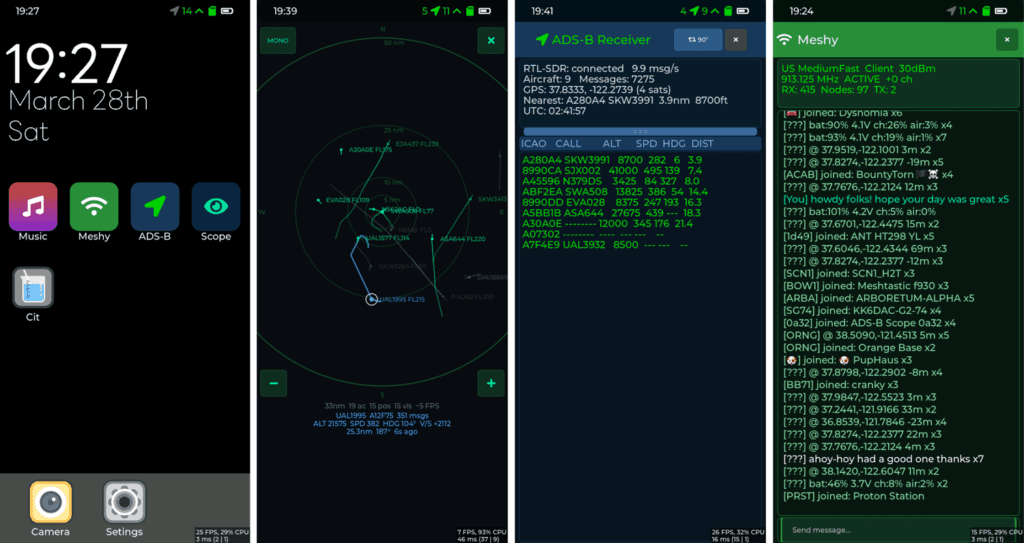
John Stockdale has pushed the LILYGO T-Display-P4 far beyond the usual “nice screen on an ESP32” demo. His ADS-B Scope firmware turns the handheld into a portable aircraft tracker that plugs an RTL-SDR dongle directly into the board, with no Raspberry Pi or laptop in the middle. For the Meshtastic crowd, that matters because it fits the same off-grid habit: carry one device for comms, another for situational awareness, and keep the whole stack small enough to run on battery power.
The T-Display-P4 is a strong fit for that kind of experiment. LILYGO bases it on the ESP32-P4 RISC-V dual-core 360 MHz platform and pairs it with 32 MB PSRAM and 16 MB flash. The company positions the board as a multi-functional development platform for graphics, multimedia, and IoT work, which is exactly the sort of hardware that invites mashups. Espressif’s USB Host documentation says the ESP32-P4 has native USB host support and can run custom host class drivers, and that is the technical trick that makes direct dongle integration plausible.
Stockdale’s firmware supports RTL-SDR Blog V4 and V3 sticks, adds software bias-tee control, and runs Mode-S demodulation in real time. On the handheld itself, ADS-B Scope shows an aircraft table and a radar-style display, while the software stack layers in adaptive gain control, OpenSky aircraft database caching, SD card logging, USB hot-plug support, OTA updates, MQTT telemetry, and a WebSerial companion app for live maps, 3D views, CSV replay, and flashing tools.
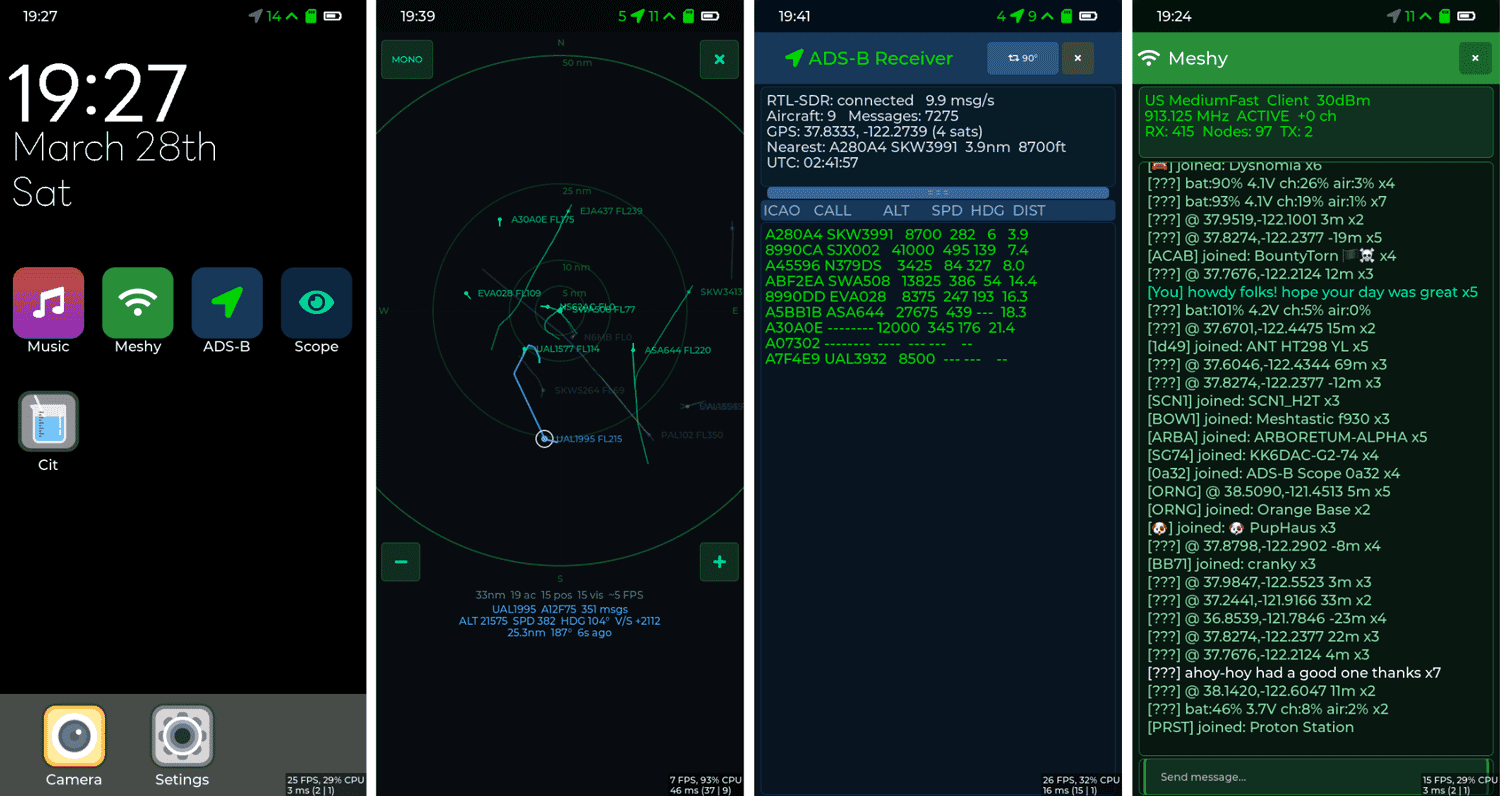
The numbers are the fun part. Stockdale reported about 30 nautical miles of range from Oakland, California using a 7 inch telescopic antenna. He also said the system could decode roughly 15 to 30 ADS-B messages per second while tracking a dozen or more aircraft. That is enough to make the board feel less like a novelty and more like a field tool.
The Meshtastic connection is real, but it is specific. ADS-B Scope is not a mesh product, and aircraft tracking has nothing to do with packet relays or direct messages. What it does share with Meshtastic is the off-grid mindset, and the T-Display-P4’s SX1262 LoRa radio can serve as a Meshtastic-compatible mesh interface. Meshtastic itself is built as an open-source off-grid decentralized mesh network on low-power devices, and its direct messages now use public-key cryptography, with MQTT bridging available for gateways. Put together, the T-Display-P4 starts to look like the kind of handheld radio lab people keep asking for: one screen for the sky, one radio for the mesh, and no desktop tower required.
Know something we missed? Have a correction or additional information?
Submit a Tip