EEG Study Links Mindfulness Meditation to Brain Changes in Emotional Eaters
Frontal theta rose and alpha fell in emotional eaters after 14 minutes of guided mindfulness in a new EEG study, brain signals that may explain why brief meditation blunts cravings.
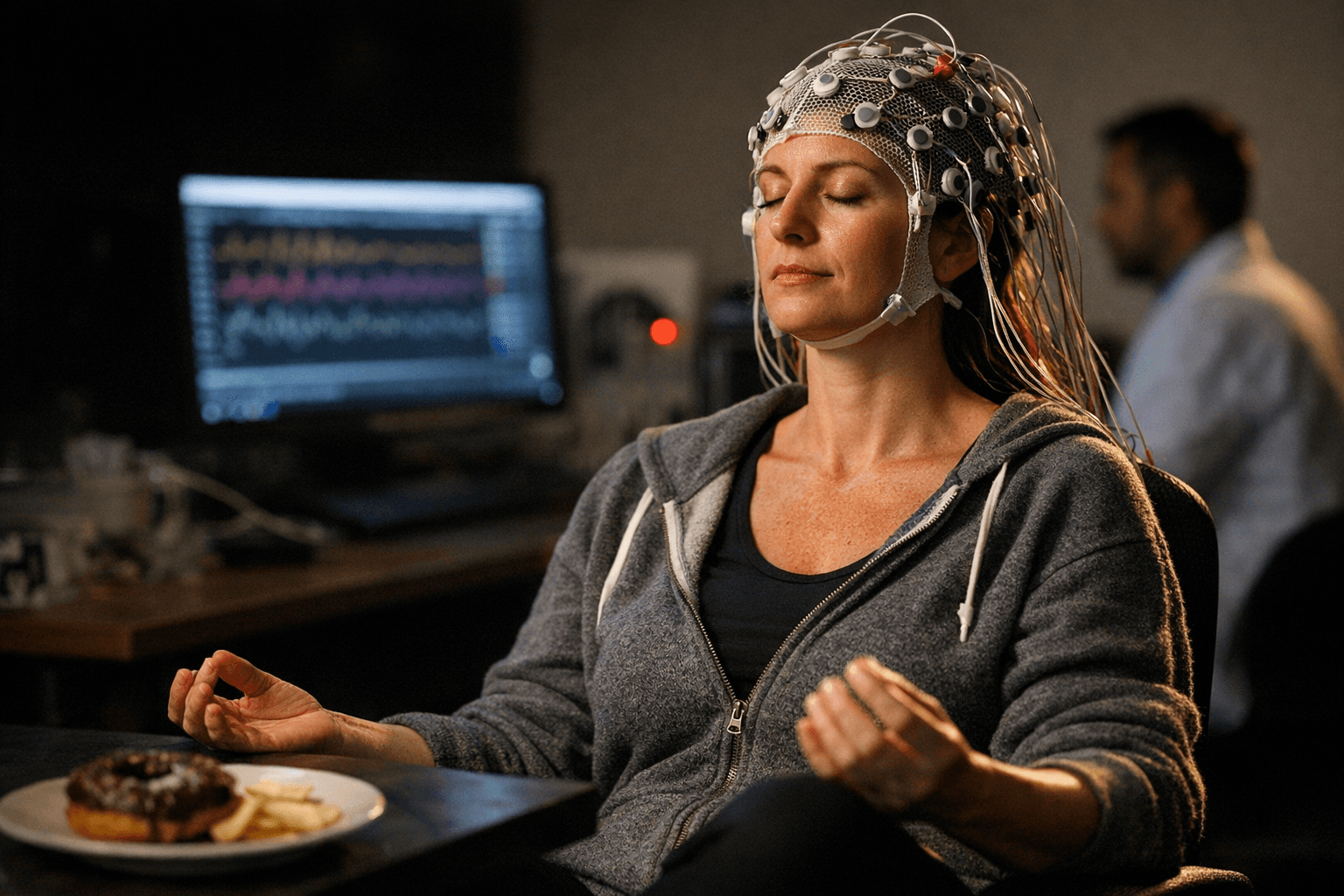
The next time a stressful afternoon sends you reaching for the snack drawer, your frontal cortex may be the key battleground. A paper published March 31 in the Journal of Eating Disorders, led by Roy Rongyue Zeng, Rangchun Hou, Hiu Yin Lai, and colleagues, used EEG to capture what happens inside the brain of an emotional eater during and immediately after a guided mindfulness session. The brain signals of emotional eaters shifted in measurable, distinct ways, and the findings point toward a practical protocol practitioners can deploy right now.
The team enrolled 49 adults, sorted into an emotional-eating group and a comparison group using the emotional-eating subscale of the Dutch Eating Behaviour Questionnaire. Each participant completed three 14-minute audio-guided sessions, each built around three consecutive phases: mindful breathing, an emotion-evocation segment designed to surface difficult feelings, and a focused meditation phase. EEG electrodes tracked brain activity throughout, with resting measurements captured before and after each session.
Compared to the non-emotional-eating group, those who scored high on emotional eating showed two clear post-practice signatures: elevated frontal midline theta power and reduced frontal midline alpha power. In plain terms, theta in this region reflects the brain actively working to regulate attention and emotional content; its rise signals that emotional eaters were doing more effortful cognitive work during practice. Alpha, often a marker of diffuse, disengaged processing, dropping simultaneously suggests a shift away from the reactive mental drift that tends to precede stress-driven eating. Critically, both effects were driven primarily by the meditation phase, not the breathing or emotion-evocation segments. The team also found that changes in frontal midline delta power tracked with each participant's emotional eating severity, while shifts in beta-1 power correlated with cognitive reappraisal, the mental skill of recasting a stressful moment rather than reacting to it.
For practitioners working with eating behavior, these findings sketch a usable pre-craving protocol modeled on the trial's own structure. When a food urge surfaces alongside an identifiable emotion, set 14 minutes aside. Open with mindful breathing to anchor attention, move through a brief period of naming and sitting with the emotion underneath the craving, then settle into quiet meditation. The meditation segment appears to be the active ingredient for producing the theta-alpha shift; if time is short, lean into that final phase and notice whether emotional urgency softens before the session ends.
Worth keeping in proportion: the study measured only acute, immediate neurophysiological responses. Whether these EEG signatures predict fewer emotional eating episodes over days or weeks remains untested. The sample of 49 participants is modest, the experiment was conducted in a controlled lab setting, and the manuscript was an early, unedited version at the time of publication, pending final editorial review. The authors themselves call explicitly for further research to establish clinical significance.
What the paper does establish is a testable mechanistic bridge between a brief, structured mindfulness practice and specific brain-activity patterns in people who eat in response to emotions. Zeng, Hou, Lai, and their co-authors have given researchers and clinicians a sharper biological target to aim at, and that precision is what separates this work from the broader, harder-to-act-on literature that mindfulness quiets the mind generally.
This article was produced by Prism’s automated news system from verified source data, official records, and press releases, then run through automated quality and moderation checks before publishing. The system is built and supervised by the people who set the standards it runs under. Read our full AI policy.
Did this article answer your question?