Mindfulness training sharpens attention and scores in elite rifle shooters
A seven-week mindfulness program helped elite rifle shooters lift post-test scores and showed a notable alpha-band EEG shift under pressure.
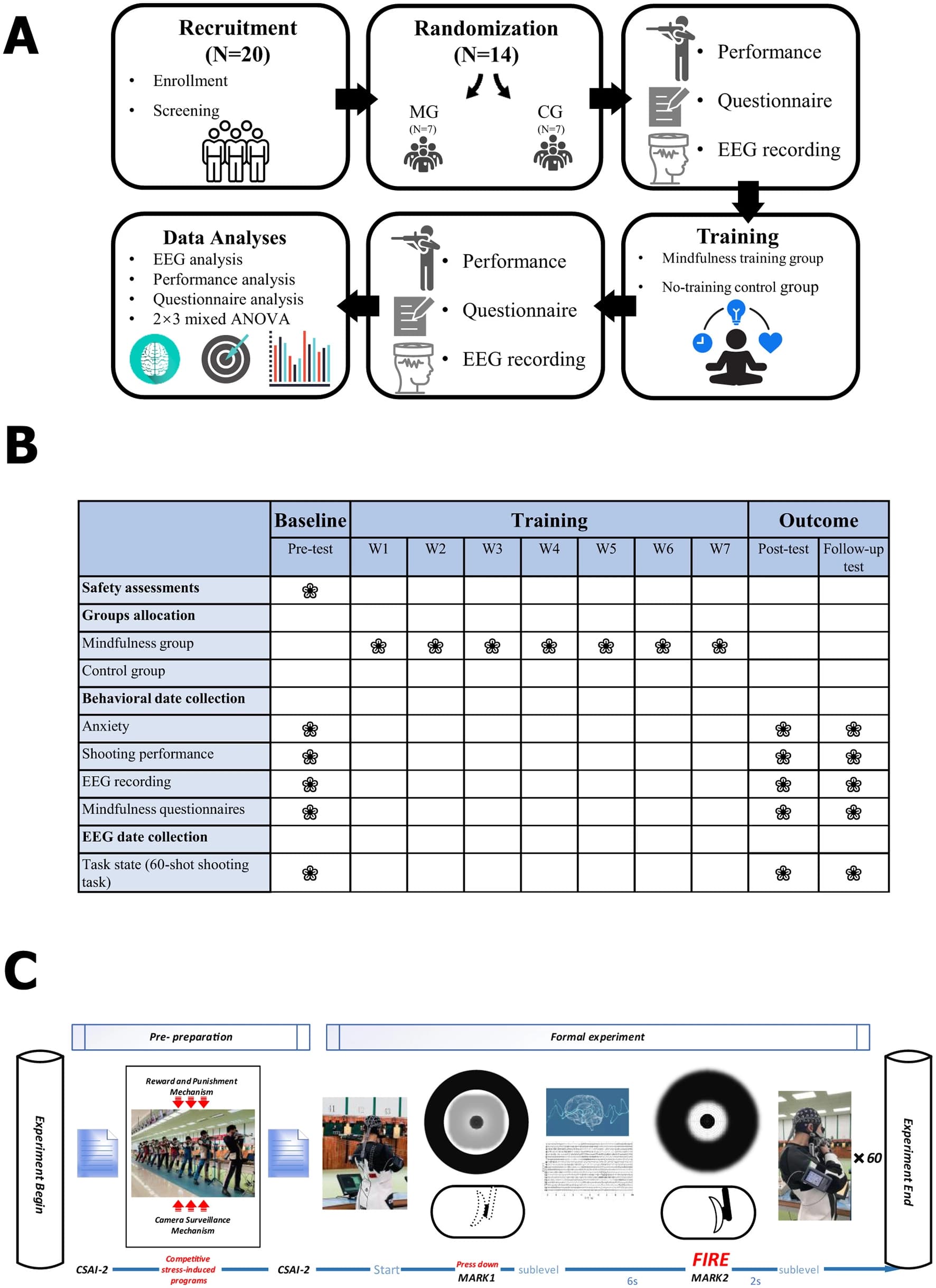
Elite rifle shooting leaves no room for a wandering mind, and this new Frontiers study puts a hard, measurable number behind that reality. In 14 elite 10-meter air rifle shooters, a seven-week Mindfulness-Acceptance-Insight-Commitment program was tied to better post-test scores, a bigger jump in mindfulness, and a distinct alpha-band EEG shift when the athletes were pushed through competitive stress.
What the study tested under pressure
The paper, titled *Mindfulness Training Modulates EEG Oscillations and Improves Shooting Accuracy in Competitive Stress*, asked a practical question that matters far beyond the firing line: can mindfulness help elite performers stay precise when the stakes rise? The answer came from a tightly controlled setup in an ISSF-compliant range, where the shooters were tested at baseline, after the intervention, and again at a two-week follow-up under a validated stress-induction protocol.
The sample was small but highly specific, with 14 elite shooters split evenly into a mindfulness group and a control group. That matters, because this was not a general wellness trial. It was a pressure test for performance, built around SIUS LS10 shooting scores, state anxiety from the CSAI-2, dispositional mindfulness from the FFMQ, and 64-channel EEG power across delta, theta, alpha, beta, and gamma bands.
How the seven-week MAIC program was delivered
The intervention ran for seven weeks and included two MAIC sessions per week alongside routine training. That detail is important for anyone trying to translate the study into real practice: this was not a retreat model or a meditation challenge detached from sport. It was layered onto the athletes’ normal preparation, which makes the results more relevant to competitors who have to train in the middle of real schedules, not ideal ones.
The authors were not trying to sell mindfulness as a vague relaxation tool. They framed it as a performance method, one that could improve attentional neural efficiency when a shot has to be made cleanly, quickly, and under stress. For athletes, performers, and hobbyists who need steady attention in high-pressure moments, that is the central question: not whether mindfulness feels calm, but whether it helps you act with more control when calm is not guaranteed.
What changed in the brain and on the scorecard
The abstract’s findings are cautious, but they point in the same direction. Stress induction increased anxiety in both groups, which is exactly what you would expect from a genuine pressure protocol. The mindfulness group, however, showed a greater increase in mindfulness scores, suggesting the training did what it was meant to do psychologically.
The EEG result is the sharpest piece of the story. The authors reported a significant group-by-time interaction for alpha-band power, with F(2,24)=5.62 and p=.028, and a main effect of time for delta-band power, with F(2,24)=5.35 and p=.012. Their interpretation is that the alpha change reflects enhanced top-down attentional control, a useful sign when the task demands precision rather than brute effort.
On the performance side, the mindfulness group scored significantly higher than the control group at post-test. The within-group improvement in shooting accuracy was described as more of a trend than a definitive interaction effect, so this is not a sweeping victory lap. It is a measured result that says mindfulness may sharpen shot execution under pressure, while also showing the limits of a small trial.
Why this matters for readers outside elite shooting
This study lands because it connects mindfulness to a concrete outcome that readers recognize immediately: performance under stress. The broader takeaway is not that meditation magically improves every skill, but that it may be especially useful where attention has to stay narrow, stable, and responsive in a split second.
That makes the findings relevant to more than shooters. Athletes facing penalty kicks, archers waiting through a long hold, musicians entering a difficult passage, and hobbyists who compete in timed or precision-based settings all face the same basic problem: stress can pull attention away from the task. This paper suggests mindfulness may help by changing the neural conditions behind that focus, not just the feeling around it.
Still, the limits matter. These were elite 10-meter air rifle shooters working in a controlled range with a validated stress protocol. Their results do not automatically transfer to everyday meditation practice or to all sports, and the sample was only 14 athletes. The study strengthens the case for mindfulness as a performance tool, but it does not turn a short training block into a guarantee of better results in every setting.
The research sits inside a small but growing shooting-sport pattern
The 2026 Frontiers paper does not arrive in a vacuum. A 2021 Frontiers study on elite national shooting and archery athletes found they were faster on the Attention Network Test than provincial athletes by 28.84 ms, and that mindfulness training improved orienting by 10.02 ms and conflict control by 12.01 ms after roughly five to eight weeks. That earlier work already hinted that elite shooting and archery depend on more efficient attention networks, and that mindfulness can train those networks further.
A separate 2021 study in *Cuadernos de Psicología del Deporte* added another layer by following 24 young male professional shooters. In that trial, mindfulness and cognitive-behavioral interventions reduced pre-competitive stress as measured by salivary cortisol, and the mindfulness effects persisted at a two-month follow-up. Together, these studies give the new EEG findings a credible backdrop: mindfulness in shooting has already shown effects on attention, stress biology, and now brain oscillations plus score outcomes.
The sport context is changing too
The International Shooting Sport Federation has made clear that the sport itself is evolving. Its 2026 Rulebook changes were announced on December 10, 2025, and took effect on January 1, 2026 after review of the Paris 2024 Olympic Games and consultation with the IOC, athletes, coaches, officials, the Olympic Broadcast Services, and Omega. That matters because performance under pressure is not a side issue in this sport, it is part of the structure.
The calendar reinforces that point. The 2026 ISSF schedule lists the World Cup Rifle/Pistol in Munich, Germany, from May 24 to May 31, 2026, one of the major international stops where athletes will have to manage nerves, timing, and scoring in a highly regulated environment. In that kind of circuit, attention control is not abstract psychology. It is competitive currency.
Who carried out the work
The article was authored by Weitao Li, Jiawen Guo, Meiting Wei, and Guangheng Dong, with affiliations at Yunnan University, Huaqiao University, Central China Normal University, and Yunnan Normal University. That network matters because it shows the study sits inside an active research line, not a one-off experiment. The names and institutions help map where this work is coming from as the conversation around mindfulness moves deeper into sport science.
The clearest lesson from this study is also the most practical one: mindfulness looks most persuasive when it is tested where pressure is real. In elite rifle shooting, that meant seven weeks of training, measurable anxiety, EEG data, and score changes under stress. For anyone training for precision, the next useful step is the same as the athletes’ setup here: practice mindfulness inside the conditions where focus has to hold, not only when the room is quiet.
Know something we missed? Have a correction or additional information?
Submit a Tip