Home-based neuromodulation plus mindfulness rapidly reduces knee osteoarthritis pain in older adults, randomized trial finds
Ten 20-minute home sessions cut knee OA pain rapidly in older adults, but adding mindfulness to brain stimulation produced no extra benefit, a 208-person RCT finds.
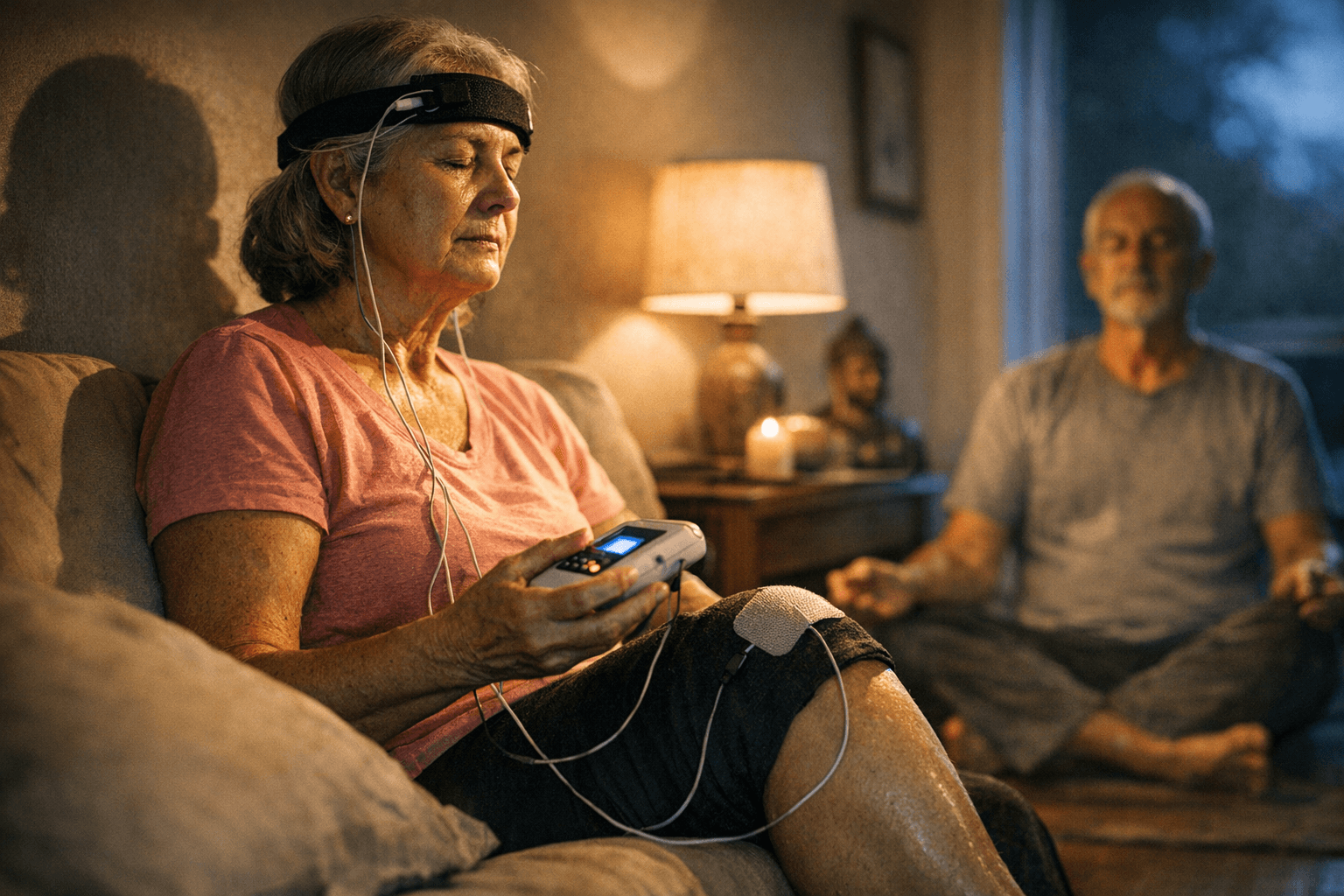
Ten 20-minute sessions. Two weeks. A portable brain stimulator worn at home. Juyoung Park and colleagues at the University of Arizona published results showing that protocol produced rapid, measurable reductions in knee osteoarthritis pain in 208 older adults — though what the trial did NOT find may reshape how the mindfulness community thinks about combining these therapies.
The study, registered under NCT04375072 and published open-access in npj Digital Medicine, randomized participants into four arms: active transcranial direct current stimulation (tDCS) paired with active mindfulness-based meditation (MBM), active tDCS with sham MBM, sham tDCS with active MBM, and a fully sham double-control arm. That four-arm factorial design is methodologically unusual. Most studies test one treatment against a placebo; this one systematically dissected whether pairing brain stimulation and mindfulness produced effects greater than either approach delivered alone.
The double-blind, sham-controlled structure is what gives the findings their credibility. Participants in the sham tDCS arms received a device that replicated the mild tingling sensation of real stimulation but delivered no therapeutic current, making it nearly impossible to detect assignment. That blinding removes the most persistent criticism of neuromodulation research: that participants who know they are receiving real treatment simply report feeling better.
Both arms receiving active tDCS improved in pain outcomes during and immediately after the two-week program. The counterintuitive catch is that adding mindfulness-based meditation on top of the stimulation produced no statistically significant additional benefit over tDCS alone. And by the three-month follow-up, improvements across groups had largely attenuated. Park's team describes these as "first evidence" results, establishing that a fully remote, digitally supervised combined protocol is both feasible and capable of producing short-term relief, while leaving durability questions open for future trials.
What home-based means in practice here is noteworthy. Participants never visited a clinic. They used a supervised digital platform, received remote oversight, and self-administered the tDCS device at home across two weeks. That model directly addresses one of the most persistent barriers in chronic pain care for older adults: access. Clinic-based neuromodulation requires transport, repeated scheduling, and physical mobility that many older adults with advanced knee OA simply cannot sustain.
The null result for the combination arm raises legitimate mechanistic questions about dose and timing. Ten sessions across two weeks may be insufficient for mindfulness practice to build the attentional and regulatory mechanisms that might augment neural plasticity from tDCS. Park's team points toward personalized, extended, or booster-session designs as the logical next step, alongside efforts to identify which subgroups respond most robustly.
Before pursuing any home tDCS protocol, a conversation with a physician or neurologist should cover several areas: whether implanted electrical devices or metal are present in the skull, any history of seizures, scalp conditions that could interfere with electrode placement, and whether the specific device being considered operates under a supervised clinical protocol or as an unregulated consumer product. Asking who monitors session quality remotely, what adverse-event procedures exist, and what evidence base supports the specific device and parameters in question are all essential before starting.
Knee osteoarthritis ranks among the most prevalent drivers of chronic pain and functional loss in aging populations worldwide. A brief, scalable, nonpharmacological protocol that operates outside a clinic and generates rapid symptom relief, even one whose benefits currently fade within three months, represents a meaningful proof of concept for care models increasingly built around digital delivery and patient-administered devices.
Know something we missed? Have a correction or additional information?
Submit a Tip