Meditation Research Shifts Toward Brain-Tailored Practice and Deep States
The new question is not whether meditation works, but which practice fits which brain, and how far advanced states can take the field.
From stress relief to brain-tailored practice
Meditation research is moving past the old one-size-fits-all question. The new focus is sharper: how does meditation work in different brains, and which practice best matches a person’s goals, tendencies, and stage of training?
That shift matters because it treats meditation less like a generic wellness habit and more like a developmental path. For a beginner trying to choose between breath work, visualization, or a deeper concentration practice, the practical question is no longer just, “Will this calm me down?” It is, “What kind of training is this building toward?”
What the new research is really studying
The center of this shift is the Meditation Research Program at Harvard Medical School and Massachusetts General Hospital, founded in 2022. Matthew D. Sacchet directs the program at Massachusetts General Hospital and is an associate professor of psychiatry at Harvard Medical School, with the work tied to the Athinoula A. Martinos Center for Biomedical Imaging and the Department of Psychiatry.
In the newer framing, researchers are not only measuring short-term outcomes like relaxation or reduced stress. They are looking at what the field now calls meditative endpoints, meaning advanced states and stages that emerge with mastery. That includes experiences described in contemplative traditions as enlightenment, peace, and cessations of consciousness. It also includes the question of whether different people may be better suited to different techniques, instead of forcing everyone through the same template.
That is a meaningful change in emphasis. It suggests that the next generation of meditation guidance may be built around fit, not folklore.
Why “third wave” meditation research matters
A recent article in Neuron described this direction as third wave meditation research, the study of advanced meditation. In that frame, the science is not only asking whether meditation reduces anxiety or improves attention. It is asking how states, stages, and endpoints of practice unfold as mastery deepens.
Mass General has described this broader field as focused on the “deep” end of practice, including ecstatic bliss, insight, compassion, and empathy. That language matters because it widens the lens beyond symptom management. It places meditation inside a larger map of human development, one that includes long training arcs and altered states rather than quick self-soothing alone.
For readers, the implication is simple: if your goal is better sleep, a short daily practice may be enough. If your goal is long-term contemplative development, the research is increasingly asking what the path looks like after the basics.
What brain imaging is beginning to show
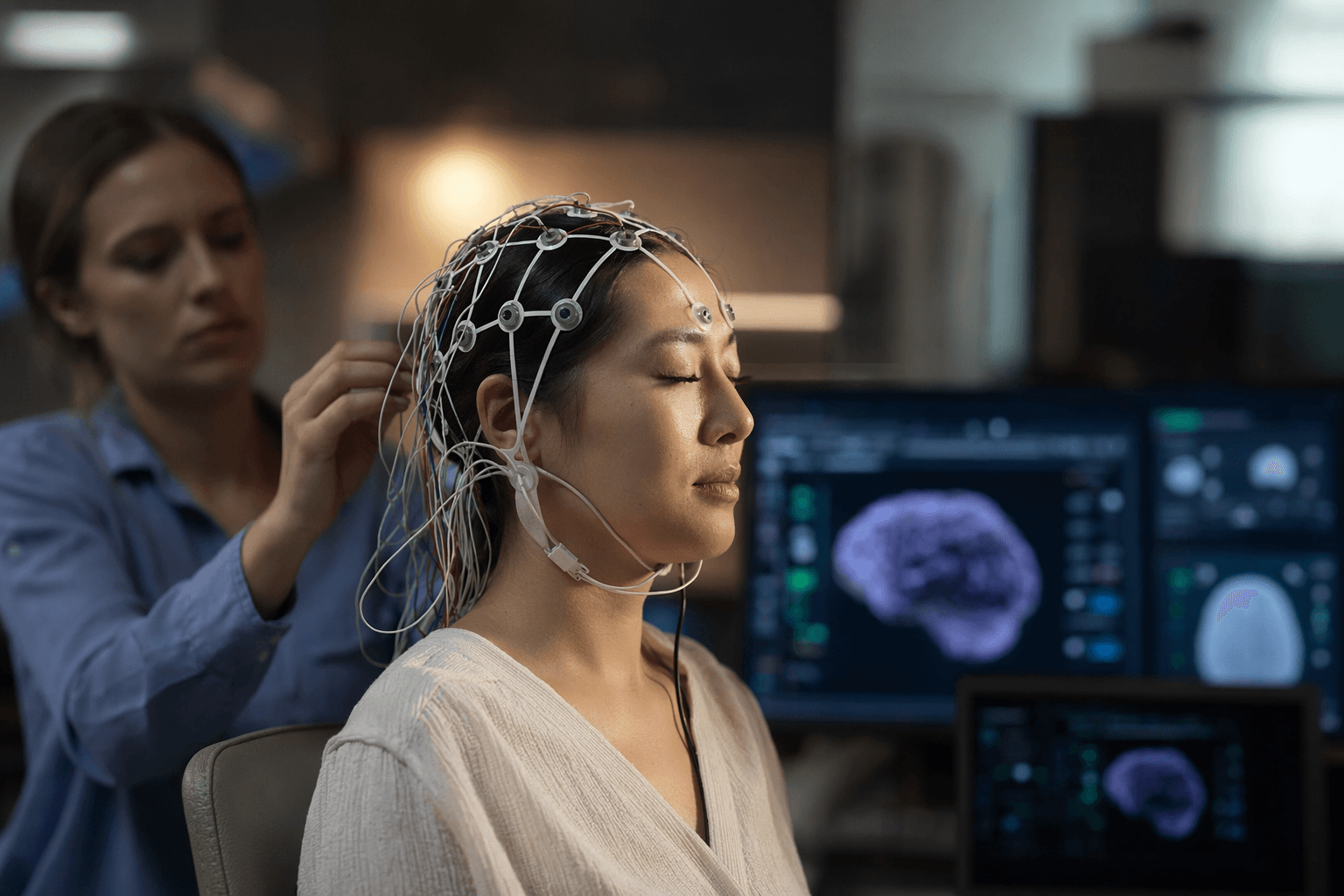
The most interesting part of this shift is not just the vocabulary. It is the machinery. In 2024, Mass General reported an ultra-high-field 7T MRI study of an advanced concentration meditation known as jhana, saying the technology had never before been used in any meditation study. The point was not novelty for its own sake. The imaging allowed researchers to evaluate activity with high precision across the cortex, subcortex, brainstem, and cerebellum.
That is a big deal for anyone who has ever heard meditation described only in vague terms. The field is starting to connect specific practices with specific brain activity, which is exactly what you would need if you wanted to move toward personalized recommendations.
If the brain patterns associated with one style of practice differ from another, then a breath-based method, a visualization practice, or a concentration-heavy protocol may not be interchangeable after all. The new research suggests future guidance could be more like matching a training block to a runner’s goal than handing everyone the same routine.
Why this could change what practitioners choose
This is where the science becomes useful in daily life. A lot of people quit meditation because they assume they are doing it wrong. The newer research makes a different point: there may be more than one right way, depending on what you want and how your mind responds.
- If you want a low-friction entry point, a simpler breath-based practice may still be the most practical starting place.
- If your mind is vivid and image-driven, a visualization practice may be a better fit than fighting to stay with the breath.
- If your aim is advanced concentration, the research on jhana suggests that deep absorptive states are not just philosophical ideas but measurable training targets.
- If you care about mental health, the emerging question is not only whether meditation helps, but which practice supports which outcome best.
That personalized framing could matter for beginners, health seekers, and experienced meditators alike. It also challenges the habit of treating all mindfulness as the same, when the field is increasingly showing that the method matters.
The altered-state question is not fringe anymore
Another reason this research has momentum is that altered states may be more common than many people assume. Harvard reported in 2024 that 45% of 3,135 adults surveyed in the United States and the United Kingdom said they had experienced a non-pharmacologically induced altered state of consciousness at least once. That is not a tiny fringe of mystics. It is a substantial slice of ordinary adults.
That finding helps explain why the science is broadening. Researchers are now studying experiences that many people report but have not had a clean scientific vocabulary for. The point is not to sensationalize altered states. It is to take them seriously enough to study how they happen, what they feel like, and how they might relate to well-being, cognition, and training.
How the field got here
This new work did not appear out of nowhere. Long before the current focus on endpoints and deep states, Harvard-linked researchers were using brain imaging to examine the effects of meditation and yoga on cognition and behavior. Sara Lazar’s lab at Mass General has studied the impact of yoga and meditation on cognitive and behavioral functions using scientifically validated brain imaging technologies.
The earlier clinical foundation matters too. Harvard coverage has long described mindfulness-based stress reduction, or MBSR, as the eight-week intervention developed by Jon Kabat-Zinn at UMass. That model helped make meditation legible to mainstream medicine by emphasizing stress reduction, attention, and repeatable practice.
The new research does not replace that foundation. It builds on it. MBSR showed that meditation could be studied in a structured, evidence-based way. The newer work asks what happens after that first layer, when the goal becomes not just relief, but insight, altered states, and practice pathways tailored to the brain itself.
What to take from the shift
The practical message is not that everyone needs to chase advanced states. It is that meditation science is finally getting more precise about what different practices do, who they may suit, and where they lead. That is likely to matter for future mental-health interventions, training recommendations, and the scientific study of consciousness itself.
For anyone choosing a practice today, the useful takeaway is straightforward: stop assuming meditation is a single product. It is increasingly being studied as a family of methods with different effects, different depths, and possibly different fits. That is the kind of research that could make the next round of meditation guidance much more honest, and much more useful.
This article was produced by Prism’s automated news system from verified source data, official records, and press releases, then run through automated quality and moderation checks before publishing. The system is built and supervised by the people who set the standards it runs under. Read our full AI policy.
Did this article answer your question?