Mindful breathing and eating curb emotional eating after bad moods
A short breathing-and-snack routine cut calories after bad moods, showing mindfulness can interrupt emotional eating before impulse takes over.
A brief pause changed what happened next
If your bad mood sends you straight toward the snack drawer, this study hits a very specific nerve: a short mindfulness sequence, built around mindful breathing and then mindful eating, reduced how much people ate after negative emotion was stirred up. The point is not vague “wellness.” It is interruption, and the interruption was measurable.
What the study actually tested
Researchers worked with 121 female undergraduate students and randomly assigned them to one of three conditions after a negative-emotion induction. One group did the mindfulness sequence, one group watched a video while eating a small snack, and one group simply ate the snack without the mindfulness steps. That setup matters because it isolates the question most people actually care about in real life: when a mood drops, does a brief practice change the eating that follows?
The mindfulness condition was not a generic “eat more mindfully” prompt. It used two parts in order: mindful breathing first, then mindful eating of a small snack. That is a practical detail, because it turns the practice into a timed reset between feeling bad and reaching for food. The comparison groups show the difference clearly. One had distraction while eating, and one had plain eating. The mindful group did better than both.
Why that matters for emotional eating
The target here was emotional eating, which the paper treats as a maladaptive coping strategy that can raise the risk of clinical eating disorders. Prior work has also described it as an impulsive mood-regulation strategy that tends to show up after psychological distress. That framing is important: emotional eating is not just about appetite. It is about using food to manage a state.
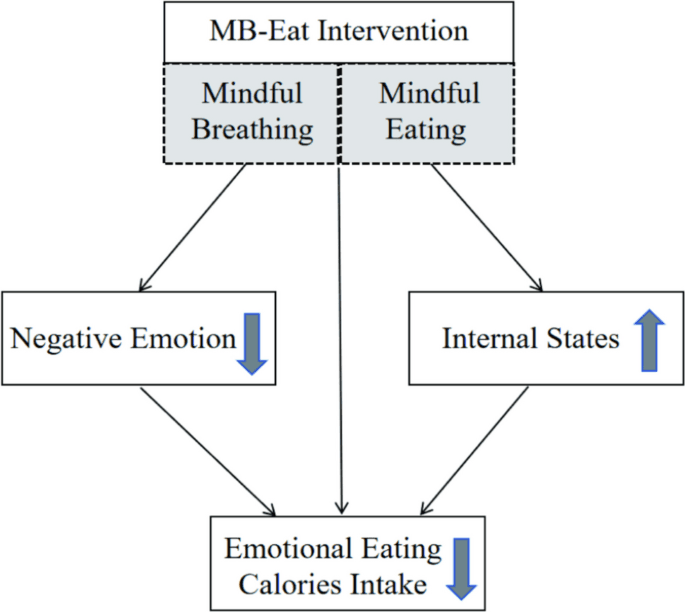
That is also why the mechanism in this study matters. The intervention appears to work by reducing negative emotion first, which then lowers the pull to eat emotionally. In other words, it is not only teaching attention to food. It is trying to soften the mood spike that usually kicks off the snacking spiral. For anyone who has watched a rough afternoon turn into a bag of chips, that is the part worth noticing.

The result was blunt and readable
The mindfulness group consumed significantly fewer calories than both the distraction group and the control group. The reported statistic was F(2, 118)=21.35, p<0.001, which is a strong signal that the difference was not random noise. In plain English, the brief breathing-plus-eating sequence changed behavior in a way the other two conditions did not.
That makes the study unusually easy to translate into everyday terms. It does not ask for a retreat, a long course, or a lifestyle overhaul. It asks for a short, structured pause before eating when mood is already a factor. For subclinical emotional eating, that is a meaningful practical fit. It may not be a cure-all, but it is the kind of low-burden tool people can actually picture using.
Why this is different from generic mindful eating advice
A lot of “mindful eating” advice stays broad and fuzzy: slow down, taste your food, notice your hunger. Useful in theory, but it can drift into something people only do when everything is already calm. This study is narrower and more useful than that. It tests a dual-component intervention at the exact moment a bad mood is most likely to distort eating.
The breathing step is doing real work here. It gives you a reset before food enters the picture, which is different from simply being mindful while you eat. That difference matters because emotional eating is often impulsive. If you only notice the behavior after the first handful, you are already late. The study suggests that a short breathing practice followed by a mindful snack may interrupt the emotion-to-impulse chain earlier.
How it fits the larger research picture
This is not a one-off result floating in isolation. A 2025 systematic review and meta-analysis of mindfulness-based interventions for binge eating found 54 studies in the past decade, up from 19 in the earlier 2015 review. It also reported medium-large effects versus non-psychological controls at post-treatment and follow-up, which tells you the field has moved well beyond speculation.

Other recent work points the same way. A 2024 study in Scientific Reports found mindfulness meditation training reduced stress- and emotional-eating tendencies and food cravings compared with health training. A 2026 Springer review on mindful eating interventions in youth reported reductions in caloric consumption, overall food intake, and emotional eating. And a 2019 paper argued that emotional eating matters because it predicts poor outcomes in weight-loss interventions. Taken together, these studies make a strong case that emotional eating is not just a side issue. It is a central target.
Why the sample matters
The sample was young women in college, and that is not an accident. Emotional eating and related disordered eating behaviors are frequently studied in non-clinical female college-student samples, and there is a reason for that. College life brings academic stress, social pressure, and plenty of chances for mood-driven eating to show up in ordinary form. The paper fits that broader pattern while staying focused on a non-clinical group.
That also sets the boundary for how far you should push the result. This is a proof-of-concept in a specific population, not a universal claim about every eater in every setting. But as a practical test of whether a short mindfulness practice can blunt a bad-mood-to-snacking spiral, it is clean and convincing.
The bigger takeaway for practice
The best lesson here is not “be more mindful” in some vague, lifestyle-magazine sense. It is this: when the mood hits and you want to eat for comfort, insert a short breathing practice before the food. Then eat the snack with attention, not autopilot. The study suggests that this kind of brief, dual-step intervention can lower calorie intake by easing the emotional push behind it.
If you want to try the logic of the experiment in real life this week, keep it simple: take a few minutes for mindful breathing, then eat one small snack without multitasking. That small sequence is the whole point. It gives the bad mood a chance to cool before it turns into an eating decision, and that is exactly where mindfulness earns its keep.
This article was produced by Prism’s automated news system from verified source data, official records, and press releases, then run through automated quality and moderation checks before publishing. The system is built and supervised by the people who set the standards it runs under. Read our full AI policy.
Did this article answer your question?